

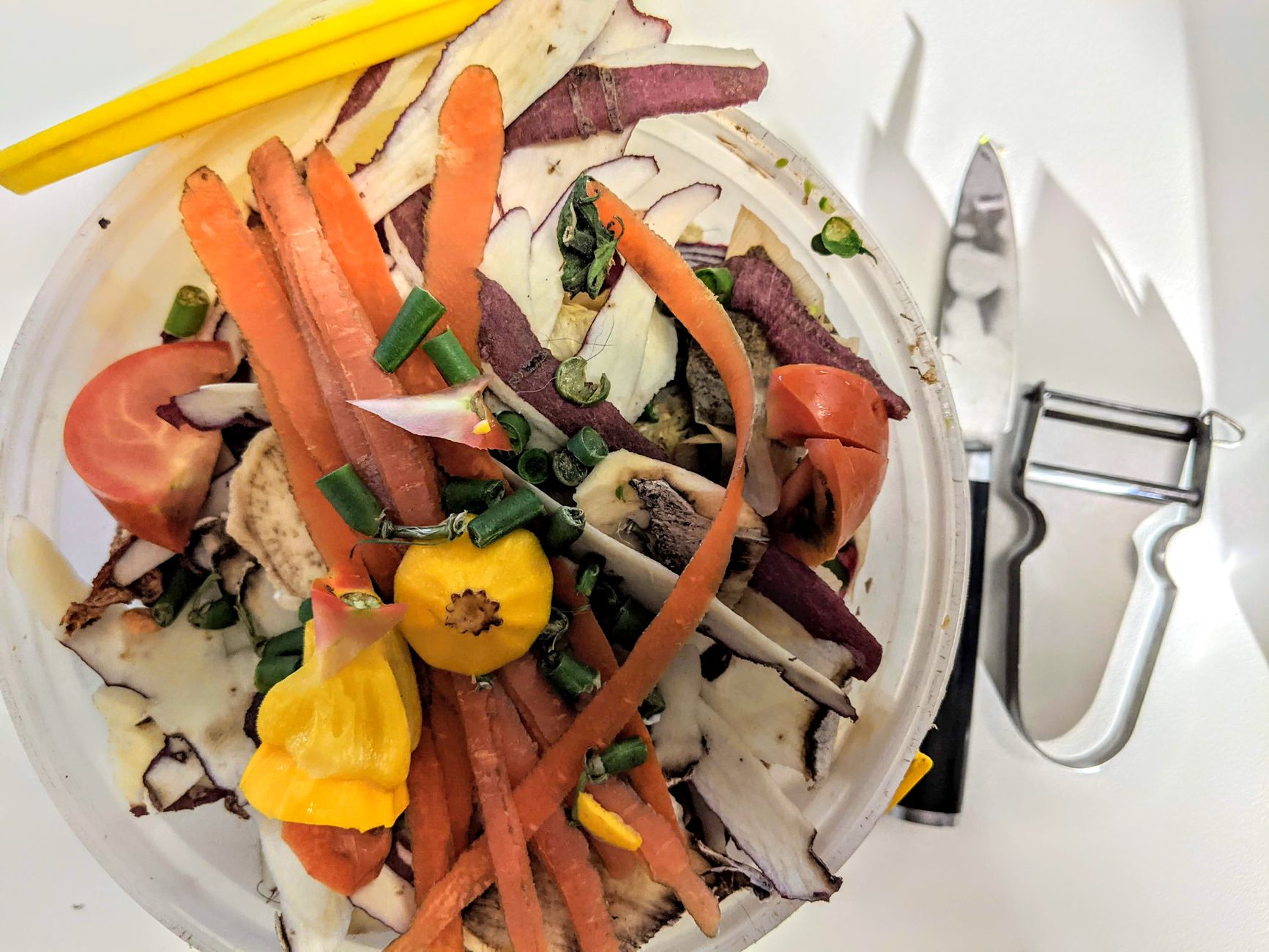
A discarded cabbage leaf does not look like the beginning of a wall panel. It is wet, soft and quick to decay. Yet once University of Tokyo researchers removed the water, ground the leaf into powder and pressed it under heat, the same plant matter became a rigid material that resisted bending better than their benchmark for ordinary concrete.
The most successful specimen, made from Chinese cabbage, reached about 18 megapascals in flexural strength. The project also produced materials from banana and orange peels, onion skin, pumpkin peel, ordinary cabbage and seaweed. No petroleum resin was needed to hold the particles together.
That is an intriguing result, but its limits matter as much as its headline number. These were small laboratory specimens, the original report was a conference paper and preprint rather than a peer-reviewed structural study, and the strength comparison concerned bending rather than the way concrete usually carries a building’s weight.
From peel to pressed panel
Kota Machida and materials engineer Yuya Sakai began with scraps that are often removed before food reaches a plate. Their original list included orange, onion, pumpkin and banana peels; the outer leaves of Chinese and ordinary cabbage; and seaweed.
The process had four basic stages. The researchers cut and dried the scraps, pulverised them into a powder, mixed the powder with water or edible seasonings, and compressed it inside a heated mould. They tested temperatures from 60 to 180 degrees Celsius and pressures from 6 to 50 megapascals. A common baseline was 100 degrees, 50 MPa and 10 minutes, although the best conditions varied by ingredient.
A later University of Tokyo account says the researchers have made useful materials from about 30 types of food waste. The point is not simply that plant fibre becomes denser under pressure. Heat also changes how the carbohydrates behave.
Why cabbage became so strong
Sakai’s explanation centres on the interaction between sugars and dietary fibre. As the powder is heated, glucose and other sugar-rich components soften and move into spaces between plant particles. Cooling then leaves a hardened matrix around the fibres, allowing the original food to supply both reinforcement and binder.
More sugar did not automatically produce a stronger sample. Particle size, drying method, moisture, temperature and the balance between fibre and carbohydrate all changed the result. Chinese cabbage appears to have offered an especially useful combination.
In three-point bending tests, the Chinese cabbage specimen reached 17.7 MPa. The researchers compared that with 5 MPa for ordinary concrete. Numerically, the result is about 3.5 times the benchmark. The 2021 paper described it as more than three times stronger, while the university’s later feature rounded the comparison to four times.
Most of the other food-derived specimens also met or exceeded the 5 MPa target. Pumpkin was the exception, but a blend containing 25 percent Chinese cabbage raised its flexural strength to roughly 10 MPa. That mixing result suggests weak waste streams might be reinforced with stronger ones rather than rejected.
Four times concrete does not mean a concrete replacement
Flexural strength measures how well a specimen resists bending. Concrete is ordinarily valued for compressive strength, its ability to carry loads that squeeze it. A vegetable-based sheet outperforming a 5 MPa flexural benchmark does not establish that it can substitute for a column, foundation or reinforced slab.
A construction material must also survive impact, fire, repeated loading, seasonal humidity, ultraviolet light, pests and years of dimensional change. Engineers would need data on creep, fracture behaviour, connections, manufacturing consistency and emissions. Full-size components would have to be produced and tested under relevant standards.
That distinction is familiar across experimental bio-based materials. ScienceBlog has covered mycelium tiles designed to cool buildings and 3D-printed yeast structures. In each case, an inventive ingredient or strong laboratory result begins the engineering process rather than finishing it.
What “remained edible” actually means
The researchers made the untreated specimens entirely from food-derived ingredients. They tasted samples themselves and experimented with salt, sugar and a natural edible clay. Salt improved the flavour and, in some tests, increased strength. Vacuum-dried material retained more of its original colour, smell and taste, while oven-dried samples were more likely to darken and taste bitter.
That is the basis for calling the prototypes edible. It does not amount to independent food-safety certification. The paper did not report a formal sensory panel, toxicology study, shelf-life programme or regulatory assessment. A system using mixed scraps from factories, supermarkets or homes would also need controls for microbes, cleaning chemicals, allergens and foreign material.
The claim is therefore best read literally and narrowly: the small, untreated experimental pieces were made from food ingredients and were tasted by the authors. It should not be read as evidence that a future commercial panel could be safely eaten after years in service.
Moisture is the hardest practical problem
Plant-based materials readily absorb water, and these prototypes were no exception. The uncoated specimens lost strength when wet. In a four-month room-temperature observation, the researchers reported no visible mould, rot, insects or worms, although most of the original smell faded. Four months indoors is encouraging for an early experiment, but it says little about years of humidity, leaks or outdoor exposure.
The startup fabula, founded by Machida and colleagues, has used urethane coatings to improve water resistance in commercial objects. That creates a clear trade-off. A coating may make the material more practical, but the finished object is no longer edible, no longer consists entirely of food waste and may be harder to compost or recycle.
Dry interior uses are consequently easier to imagine than structural ones. Decorative tiles, furniture surfaces, tableware, toys or temporary displays could take advantage of the colour and texture of the original plants while keeping loads and weather exposure modest. Those are possibilities, not uses validated by the 2021 tests.
Waste is only useful if the whole process works
Turning discarded food into a durable object could reduce demand for virgin material and give unavoidable scraps a second use. But the environmental case cannot be inferred from the ingredient alone. Drying at 105 degrees, pulverising and high-pressure moulding all consume energy. Collection and sanitisation add further costs, and coatings can dominate the end-of-life outcome.
A proper comparison would count those inputs and measure the service life of the resulting product. It would also compare the process with composting, anaerobic digestion, animal feed and simply preventing the waste. The same discipline applies to more conventional circular construction, where demolition waste is being turned into new concrete but still has to satisfy standards and lifecycle accounting.
A material hidden inside dinner scraps
The University of Tokyo work is most persuasive when treated as a materials-science demonstration. It shows that food scraps are not chemically empty. Their fibres can reinforce a solid, their sugars can help bind it, and the recipe can be tuned by drying, grinding, blending and heat.
Chinese cabbage delivered the standout result: nearly 18 MPa in bending against a 5 MPa ordinary-concrete benchmark, or roughly 3.5 to four times as much. That does not make it a structural concrete substitute, and “edible” does not make it certified food. It does reveal a surprisingly capable material inside something normally headed for a bin.