

A glance can direct another person towards a doorway, a tool or a danger without moving the head or saying a word. Human eyes make that signal unusually visible because a dark iris moves across a broadly exposed, pale background.
The sclera is the tough outer coat of the eyeball. In humans, the exposed part is normally depigmented and appears white beneath the transparent conjunctiva. Other great apes can have pale or even white scleral patches, but humans appear unusual in combining a horizontally elongated eye opening with sclera that is uniformly pale from the iris to the corners across almost all individuals.
The cooperative eye hypothesis proposes that this conspicuous design was favoured because humans rely heavily on shared attention and coordination. It is an influential evolutionary explanation, not a demonstrated sequence preserved in fossils. Later work supports a perceptual benefit from white sclera while challenging the older claim that white sclera itself belongs to humans alone.
What makes a human gaze so easy to read
Gaze direction depends on more than one colour. An observer needs to locate the outline of the eye and the position of the iris within it. Human eyelids expose a relatively wide horizontal region, while the dark iris and pupil usually contrast against pale sclera. When the iris shifts left or right, the two visible wedges of sclera change immediately.
A 2001 comparison of external eye morphology across nearly half of living primate species reported three exceptional human features: unpigmented exposed sclera, a high ratio of exposed sclera and an unusually elongated eye outline. The authors proposed that conspicuous eyes could help other people detect gaze, while darker eyes might conceal attention in more competitive settings.
That work is foundational, but its species photographs were not a census of every individual. Later, larger samples found much more variation within nonhuman apes. The most defensible human distinction is therefore not that no other ape ever shows white sclera. It is that exposed human sclera is consistently and uniformly pale across individuals, rather than white only in patches, at the edge of an averted eye or during one life stage.
The 2007 cooperative eye experiment
Michael Tomasello, Brian Hare, Hagen Lehmann and Josep Call gave the hypothesis its familiar name in a 2007 Journal of Human Evolution paper. They tested 19 great apes housed at the Leipzig Zoo research centre: 11 chimpanzees, four gorillas and four bonobos. The human comparison involved 20 infants aged 12 months and 20 aged 18 months.
A human experimenter directed attention towards the ceiling under four conditions: eyes only while the head remained level, head only while the eyes were closed, both head and eyes, or neither. Both apes and infants followed when head and eyes pointed together. When those cues conflicted, the groups differed.
The great apes followed mainly the experimenter’s head direction, although eye direction played some role. Human infants relied almost exclusively on the eyes. The authors interpreted that contrast as evidence that eyes had acquired a specialised social function in human evolution, supporting close-range joint attention and communication.
The study tested one human experimenter, captive apes with particular rearing histories and infants from one German city. It did not manipulate scleral colour, identify genes under selection or observe ancestral humans. Its behavioural result was clear within the task; its evolutionary interpretation was necessarily an inference.
From gaze following to joint attention
Following gaze means turning towards the place another individual is looking. Joint attention adds a shared understanding: two people attend to the same object or event and recognise their common focus. A child checks an adult’s face, follows the adult’s eyes towards a toy, then looks back. The exchange can establish what a word refers to, what action is being demonstrated or what problem partners are solving.
ScienceBlog has previously described how infant and adult brains track joint attention during play. In everyday development, gaze combines with pointing, facial expression, speech and prior knowledge. Eyes rarely carry the entire message alone.
Teaching, cultural learning and coordination all make use of shared attention. The stronger claim in the headline, that readable gaze helped large-scale cooperation, links these repeated small interactions to a broader human social system. That is reasonable as a hypothesis. The 2007 ceiling experiment did not directly test teaching, collective action or cooperation among strangers.
White sclera has a measurable perceptual advantage
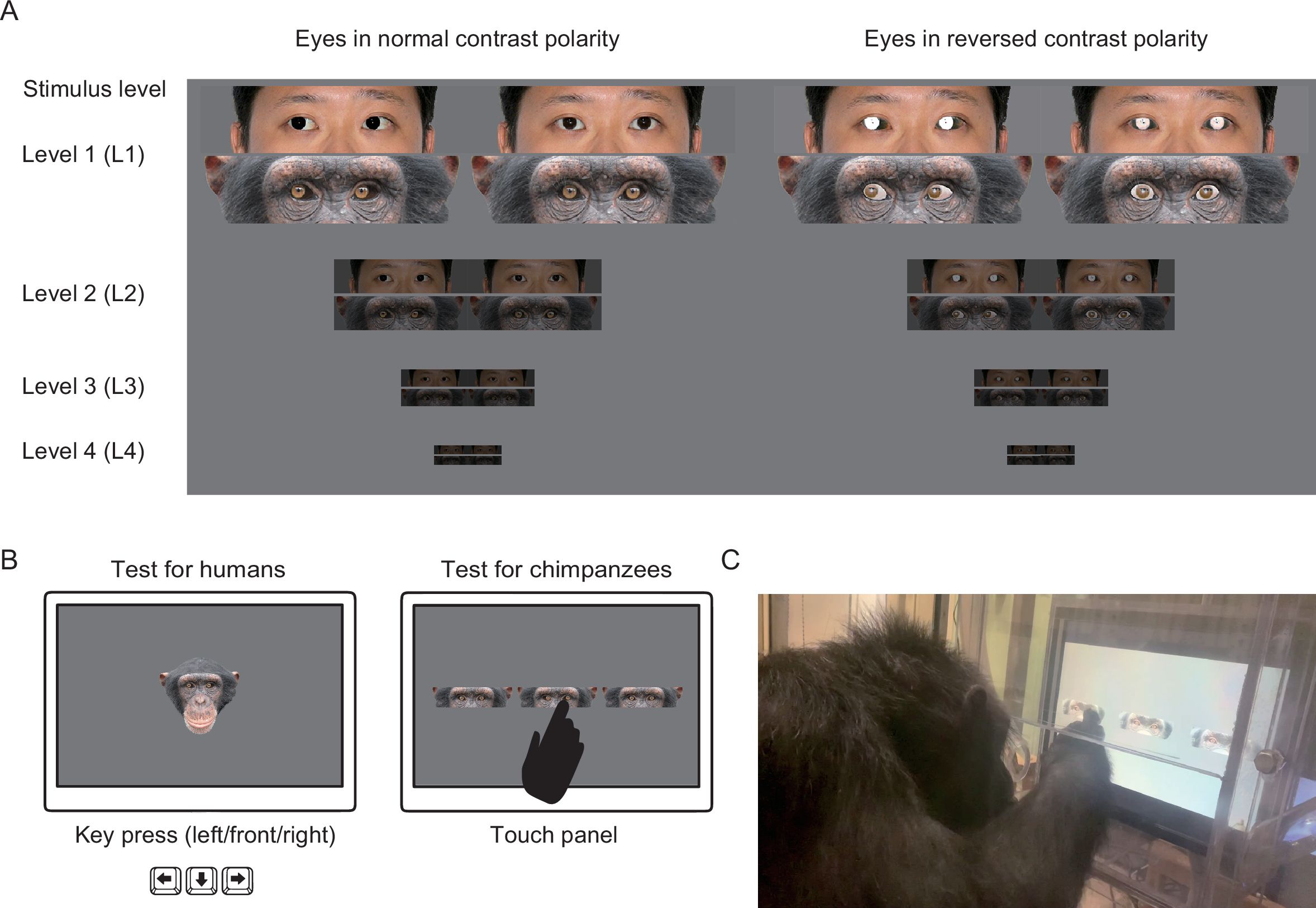
A 2022 eLife experiment addressed a missing step: whether uniform white sclera actually improves gaze discrimination. Human and chimpanzee participants viewed cropped human and chimpanzee faces and indicated where the eyes were directed. The researchers made images progressively smaller and darker to simulate distance and shade.
They also reversed the light-dark relationship within the eyes. Normal human images had pale sclera around darker irises. Reversed human eyes became dark around light irises. Normal chimpanzee eyes had darker sclera and lighter irises; the reversed version gave the chimpanzees a more human-like pale background.
Both participant species discriminated human gaze more accurately than chimpanzee gaze, particularly as visibility deteriorated. Giving chimpanzee faces pale sclera and darker irises improved performance for humans and chimpanzees. Uniform whiteness therefore offered a perceptual advantage independently of which species was viewing it.
This experiment supplies evidence for the signal, not its prehistoric cause. A feature can improve communication today without having evolved solely for that purpose. It also does not show that eye colour alone generates cooperative motivation.
Other apes complicate the uniqueness claim
Recent surveys show that nonhuman ape eyes are more variable than older comparisons suggested. A 2021 analysis of humans, great apes and gibbons found a graded pattern rather than a simple human-versus-ape split. Some gorillas have white sclera, while bonobos and orangutans can have light brown sclera. Dark sclera can also contrast strongly with a lighter iris, leaving gaze conspicuous through the opposite colour arrangement.
A 2023 study of 230 wild chimpanzees at Ngogo in Uganda found white sclera in 15% of individuals. Five displayed it while looking forward; in the others, it became visible when gaze turned and exposed the eye’s periphery. Another 95 chimpanzees had tan, brown or patchily depigmented sclera.
White or light sclera was especially common among young chimpanzees and often darkened with age. The same paper surveyed photographs from 70 zoo mammal species and found at least one white-sclera individual in 19. Sampling a few adults from each species can therefore miss real variation.
These findings undermine the statement that white sclera occurs only in humans. They do not erase the pattern named in the headline. Researchers still regard humans as distinctive for uniformly white exposed sclera and relatively little variation between individuals and populations.
An eye cannot reveal its own evolutionary date
Scleral pigmentation, eyelids and other exposed soft tissues do not fossilise in a form that shows their colour. Reconstructions of extinct hominins with white sclera are informed artistic choices, not observations from bone. The trait could predate Homo sapiens, but current fossils cannot establish when it became common or uniform.
That gap matters because several evolutionary routes could produce the same present anatomy. Conspicuous eyes might aid intentional gaze signalling. Pale, even sclera might also signal youth, health or developmental stability and become subject to mate choice. Reduced pigmentation could arise alongside broader changes associated with social tolerance, or become fixed partly through genetic drift.
These possibilities are not mutually exclusive. A trait that initially spread for one reason can acquire another function. Once readable gaze became embedded in development, teaching and language, cultural practices could increase its value without explaining the trait’s first appearance.
A hypothesis under active revision
A 2025 review of the cooperative eye hypothesis argued that the classic account assigns too much explanatory weight to scleral colour and to one comparison between infants and captive apes. Great apes follow gaze, use social information and possess eye contrasts that can be conspicuous without matching the human pattern.
The review also emphasised that communication is not the only possible source of selection on eye appearance. Light exposure, mate choice, age signalling, species recognition and correlated changes in pigmentation deserve testing. A neat contrast between cooperative humans with white eyes and competitive apes with hidden gaze is no longer supported by the comparative evidence.
That critique does not make the white background of a human eye irrelevant. It separates a demonstrated perceptual effect from a larger evolutionary narrative. Uniform white sclera can improve gaze visibility even if cooperation was only one of several pressures, or even if the morphology arose before its present communicative role.
The strongest conclusion is narrower
Human eyes are unusually effective public signals. Infants attend strongly to eye direction, and controlled experiments show that uniformly pale sclera makes gaze easier for both humans and chimpanzees to discriminate when images are small or shaded.
The further claim that readable eyes helped turn gaze into a foundation for teaching and large-scale cooperation remains plausible but is harder to isolate. Cooperation depends on motivation, trust, memory, language, social learning and institutions as well as anatomy. No eye-colour experiment can reconstruct that entire causal chain.
The cooperative eye hypothesis captures an elegant possibility: an anatomical change made attention easier to share, and shared attention rewarded the anatomy. The evidence supports the signal. The full evolutionary feedback loop remains a hypothesis.