
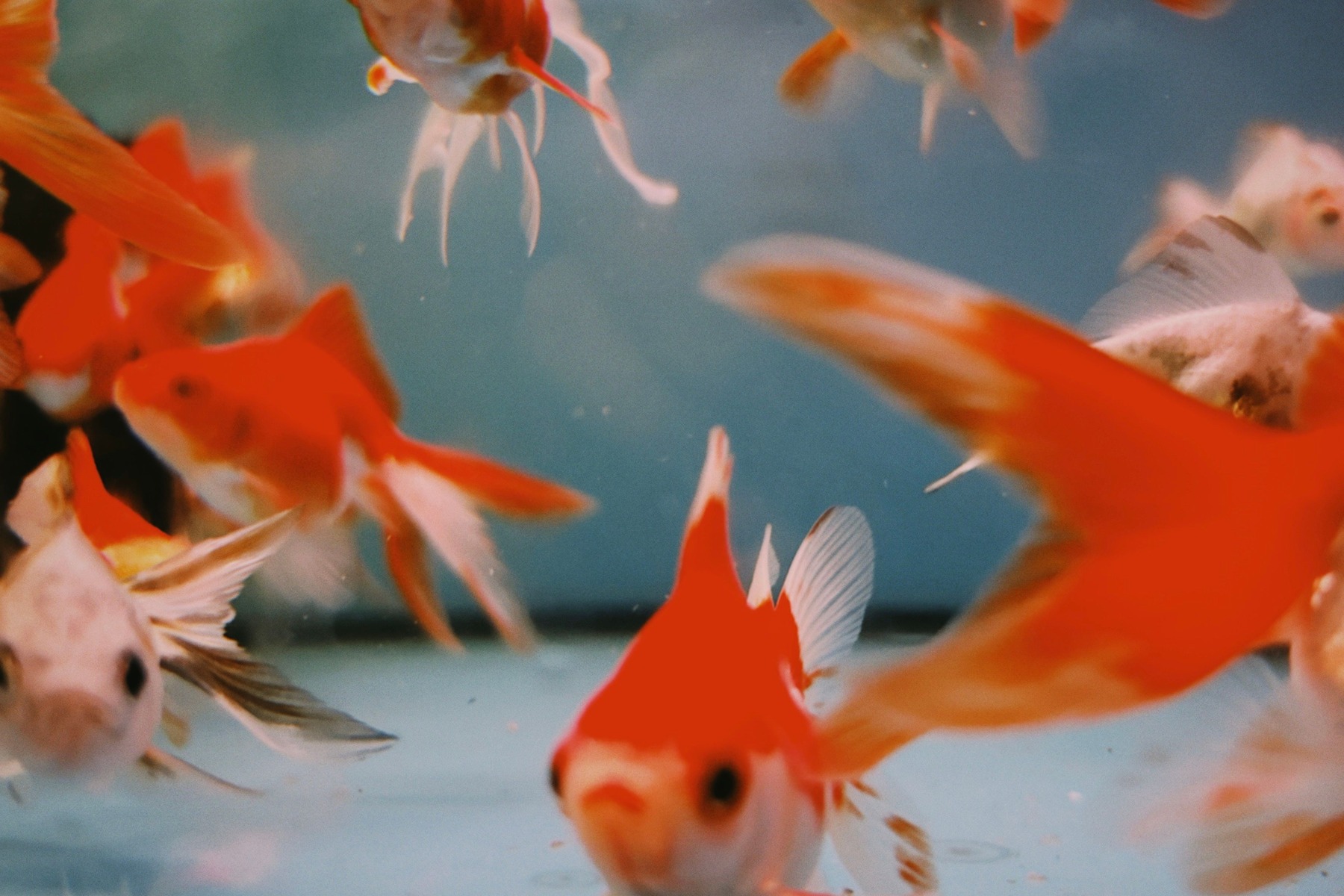
It may be the internet’s neatest warning about the digital age: the average person can now concentrate for only eight seconds, while a goldfish manages nine. The comparison supplies a villain, a victim and two numbers small enough to remember. It has appeared in news stories, presentations and advice about designing everything from advertisements to classrooms.
It is also unsupported. There is no scientifically established universal eight-second human attention span, and no traceable experiment has established a nine-second span for goldfish. The famous figures became attached to a real 2015 Microsoft report, but they were not results of Microsoft’s research.
The three numbers in one graphic
The pivotal document was Microsoft Canada’s 2015 Attention Spans report, prepared for marketers. Page six displayed a simple graphic: 12 seconds for the average human in 2000, eight seconds in 2013 and nine seconds for a goldfish. Beneath the graphic were two words, “Source: Statistic brain.”
That attribution matters. Microsoft did conduct research for the report, but its research did not generate those three figures. The report described an online survey with game-like attention tasks involving 2,000 Canadians, followed by EEG work with 112 participants. The team examined media habits, distraction, bursts of attention and memory encoding across different activities. Goldfish were not part of either sample.
Nor did Microsoft present a procedure in which its Canadian participants averaged exactly eight seconds before attention failed. The figure appeared as background material borrowed from a commercial statistics website.
When the source was asked for its source
BBC reporter Simon Maybin followed the citation trail in 2017 for the radio program More or Less. Statistic Brain had named the National Center for Biotechnology Information at the United States National Library of Medicine and the Associated Press in connection with the figures. According to the investigation, neither organization could find a record of research that supported them, and attempts to obtain substantiation from Statistic Brain produced nothing.
A BBC summary of that investigation put the result plainly: the program could not find scientific evidence that human attention spans were shrinking in the way claimed. The goldfish figure had no demonstrated research foundation either.
This does not prove that nobody, anywhere, has ever looked away after eight seconds. It means something more specific: the widely repeated population average has no identifiable primary study, sample, operational definition or reproducible method behind it. A statistic without those things cannot support what it claims to measure.
The report contradicted its own viral simplification
The irony is that Microsoft’s report offered a more sophisticated account only a few pages later. It said attention could not be characterized simply by how long people concentrate and separated it into sustained, selective and alternating forms.
Sustained attention means maintaining readiness or focus during an activity over time. Selective attention means prioritizing relevant information while resisting distraction. Alternating attention describes switching efficiently between tasks that require different mental operations. Microsoft’s participants completed different exercises for those different abilities.
The report’s opening message was also more complicated than the headline it inspired. It argued that heavy digital-media use was associated with difficulty maintaining prolonged focus in some settings, but with stronger short bursts and more efficient processing in others. Those findings can be debated on their methods and limitations. They still do not add up to a universal eight-second biological timer.
There is no single attention stopwatch
Attention is an umbrella term for several related processes, not a fuel gauge that reaches empty at the same moment for every person and activity. A major review of the human attention system describes distinguishable networks involved in alerting, orienting and executive control. Other frameworks divide attention differently, but the central point is the same: researchers have to specify which function they are testing.
Even “sustained attention” needs an operational definition. Does attention end when someone’s eyes move, when the mind wanders, when a target is missed, when response time slows, when another browser window comes forward or when the person later fails a memory test? Those are different events. They will not produce the same number.
The task changes the answer too. Interest, difficulty, fatigue, sleep, motivation, practice, age, surrounding noise and the cost of an error can all alter performance. A person may abandon an irrelevant advertisement in less than a second, read a novel for an hour, monitor a road for much longer and still miss an unexpected hazard. Fast disengagement can be a judgment that something is not worth further processing, not evidence that the brain has exhausted its capacity.
This task dependence is visible in ScienceBlog’s report on an inattentional-blindness experiment. Radiologists carefully searched lung scans for nodules, yet 20 of 24 missed a gorilla inserted into one image. Eye tracking showed that half of those who missed it had looked directly at it. Their attention had not simply switched off. It was tightly organized around the wrong category of target.
Goldfish are not a control group
The nine-second goldfish claim has an additional problem: it is rarely clear what “attention” would mean for a fish. Orienting toward food, learning a route, responding to a cue and retaining a memory are related but distinct behaviors. Turning them into one species-wide stopwatch value would require a validated task and agreed endpoint, neither of which accompanies the viral number.
Actual goldfish research is much narrower. In a 2019 exploratory study, fish lived for 183 days in enriched or relatively sparse aquariums, then completed spatial-learning and object-recognition tests over repeated sessions. The study reported differences in learning and brain-cell measures associated with the environments. It did not attempt to define a universal goldfish attention span.
Earlier laboratory work has also trained goldfish on discrimination and avoidance tasks with later tests of retention. Such studies do not prove that goldfish focus continuously for a particular heroic length of time. They do show why the folk image of a mind resetting every few seconds is a poor description of an animal capable of learning across trials and recalling task information later.
Memory is not attention in any case. A person or fish may stop orienting toward a stimulus but retain what was learned. Conversely, sustained looking does not guarantee durable memory. The goldfish comparison gains rhetorical power by sliding between those concepts without defining either one.
Bad statistic, real questions
Discarding the eight-second figure does not require pretending that modern environments never fragment attention. Notifications can interrupt work. Switching between media can impose costs. Phone use during a lesson can compete with learning. Long monitoring tasks can produce vigilance declines, and habits built around rapidly changing content may affect what people choose to engage with.
Those claims need their own measures: error rates, response times, recall, task completion, stress, mind-wandering reports or the frequency of switching between windows. A fall in average screen dwell time, for example, would describe behavior within a particular technological setting. It would not by itself demonstrate that the human brain’s general capacity for attention had fallen to that duration.
The difference between capacity and choice is especially important online. People encounter far more material than they can process. Rapidly rejecting a page can reflect efficient filtering, a poor match to the user’s goal or deliberate selection among alternatives. Calling every departure an attention failure assumes the conclusion before the behavior has been explained.
Why the myth proved so durable
The claim spread through a familiar process of citation compression. A website supplied numbers without a recoverable study. A corporate report reproduced them in a polished graphic. News coverage then described the figures as though Microsoft’s sample had produced them. Each retelling shortened the trail while making the authority sound stronger.
The comparison was also unusually memorable. “Attention depends on task demands and measurement” is accurate but difficult to put on a slide. “You are worse than a goldfish” is vivid, alarming and flattering to anyone selling a cure. The statistic’s success is therefore evidence of good packaging, not good measurement.
By 2021, the idea had become public common sense. A King’s College London survey of 2,093 UK adults found that people were twice as likely to call the eight-second adult claim true as false, by 50 percent to 25 percent. The researchers labeled it a widespread myth and emphasized that the time someone can sustain attention depends on the task.
A better way to read an attention claim
Before accepting any new number for “the attention span,” ask four questions. What kind of attention was tested? What task and endpoint defined failure? Who was measured, and under what conditions? Does the citation lead to the experiment that produced the number rather than to another summary repeating it?
Those questions do not make attention research less urgent. They make it testable. Researchers can measure vigilance during a monotonous signal-detection task, distraction while driving, recall after a lecture or switching during computer work. What they cannot responsibly do is collapse all those performances into one species-wide countdown without evidence.
The defensible conclusion is less catchy and more useful. Human attention changes with the person, purpose, task and environment. Goldfish learning and attention must also be defined by specific behavior. Eight seconds versus nine is not a discovery about two species. It is a lesson in how an unsourced number can command attention for far longer than the span it claims to measure.