

Humans look, at first glance, like a poor design for saving water. We have unusually dense eccrine sweat glands, we can sweat heavily for long periods, and our cooling system depends on losing water through the skin.
But a Duke-led study reached a less obvious conclusion: compared with other great apes, humans appear to process substantially less water each day. The body that became unusually good at sweating also seems to have become unusually good at conserving water.
This is not hydration advice. It is a report on comparative physiology and evolution, not a recommendation to drink less water.
The central study, led by Herman Pontzer and published in Current Biology, compared water turnover in 309 humans and 72 non-human apes. The human participants included people with different lifestyles, from office workers to farmers and hunter-gatherers. The non-human apes included chimpanzees, bonobos, gorillas, and orangutans living in zoos and sanctuaries.
Water turnover is not the same as how much water someone drinks from a glass. It is the total daily movement of water through the body: water coming in through food and drink, and water going out through sweat, urine, breathing, and the digestive tract. In the Duke summary of the work, the researchers reported that humans used 30% to 50% less water per day than our closest living animal relatives after accounting for body size, climate, activity, and energy expenditure.
The oddness of being a sweaty ape
The result is counterintuitive because sweating is one of the things humans do especially well. Many mammals cool themselves by panting, using fur, changing posture, seeking shade, or relying on other routes of heat loss. Humans, by contrast, cool the body largely by evaporating watery sweat from relatively bare skin.
That system is powerful. It helps explain how people can walk, run, hunt, gather, and work in hot conditions without overheating as quickly as many other animals of similar size. But it is also expensive in water. Evaporation cools because liquid water leaves the body and carries heat away.
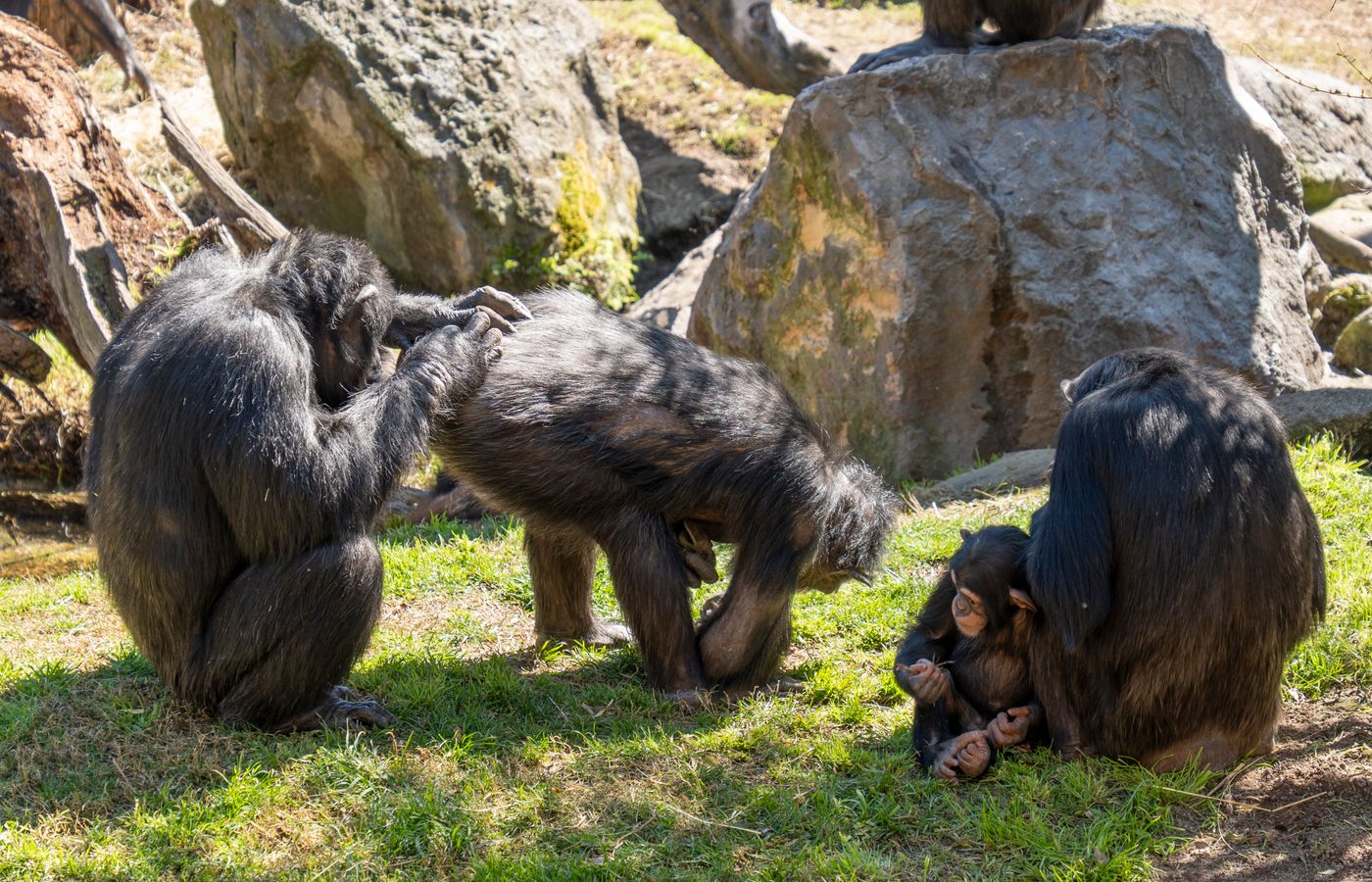
This is why the comparison with chimpanzees is so striking. Duke quoted Pontzer as saying that, per square inch of skin, humans have about 10 times as many sweat glands as chimpanzees. A 2018 paper in the Journal of Human Evolution by Yana Kamberov and colleagues also treated sweat-gland density and hair traits as distinct evolutionary features, arguing from comparative primate evidence that hair and sweat gland traits evolved partly independently in primates.
Put simply, humans did not merely become less hairy versions of other apes. Our skin, cooling system, locomotion, and water economy appear to have changed together, but not as one neat package.
What the Duke study actually measured
The study did not rely on a simple observation that humans drink less often than zoo apes. It used measured water turnover, including isotope-based methods for estimating how much water moved through the body. That matters because apes get much of their water from food, especially water-rich plant foods, while humans often separate eating and drinking more clearly.
According to Duke’s account, the average person in the study processed about three litres of water a day. A chimpanzee or gorilla in a zoo processed roughly twice that amount. The researchers were surprised because non-human great apes are generally less active than people in physically demanding environments, and because humans are so capable of sweating.
The comparison was not left at that crude level. Pontzer and colleagues adjusted for climate, body size, activity, and calories burned per day. Their conclusion was that the human water savings remained even after those differences were taken into account.
That does not mean every individual human uses less water than every individual chimpanzee, gorilla, bonobo, or orangutan. It means the pattern in this dataset pointed toward a species-level shift in water economy.
Why water efficiency would matter
The evolutionary argument is straightforward. Early humans and their relatives increasingly lived, moved, and foraged in environments where water sources were not always close by. If a body can go slightly longer between water stops, it can range farther from rivers, lakes, and springs without taking the same risk.
That advantage does not have to be dramatic to matter. Pontzer put it plainly in the Duke release: a little more time away from water could have helped early humans make a living in dry savannah landscapes. A longer ecological leash is still a leash, but it changes the area available for daily life.
The finding also complicates a popular story about human evolution. We often describe humans as endurance walkers and runners, heat-dumping specialists, and unusually sweaty primates. All of that points toward high water demand. The water-turnover result suggests another part of the story: the same lineage may also have evolved ways to reduce losses or regulate water needs more tightly.
Possible mechanisms
The study did not identify a single mechanism. It raised hypotheses.
One possibility is that human thirst and water regulation were retuned. Duke noted that even human breast milk has a lower water-to-calorie ratio than the milk of other great apes. If humans require less water per calorie from infancy onward, that would point to a broad physiological difference rather than a behaviour limited to adults.
Another possibility involves the nose. Human nasal passages help recover water from exhaled air by cooling and condensing moisture before it is breathed out. Fossil evidence suggests that a more projecting external nose was present by the time of Homo erectus, and Pontzer’s team raised the possibility that this anatomy helped conserve water during breathing.
Neither explanation is settled. The nose hypothesis is plausible but not proved by the water-turnover data alone. The thirst-response idea is also a research question, not a finished answer.
The limits of the comparison
The non-human apes in the study lived in zoos and sanctuaries, not across the full range of wild conditions. That is a limitation, although the researchers could still measure water movement carefully and compare it with human data from different lifestyles.
There is also a difference between conserving water and being resistant to dehydration. Humans still need water frequently. Heavy exercise, heat, illness, pregnancy, altitude, and many other conditions can change water needs sharply. The study is about evolutionary physiology, not a universal daily target.
The better reading is not that humans somehow escaped dependence on water. We did not. The better reading is that evolution may have made our dependence slightly less demanding than expected for a sweaty, active ape.
That is the interesting tension. Humans became exceptional sweaters, yet the daily accounting of water suggests a quieter adaptation in the opposite direction. Our bodies learned to spend water for cooling, but also to make each litre go further.