

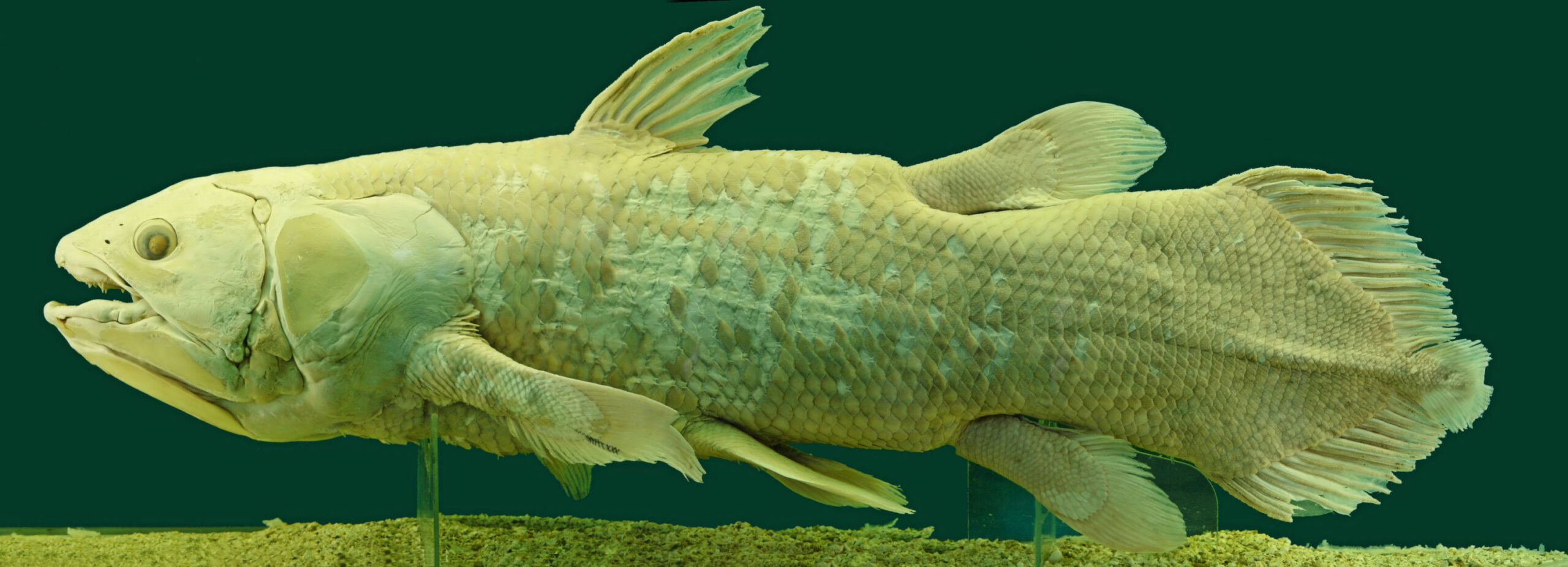
The coelacanth story is often told as if a fossil came back to life. The more interesting version is quieter: the fish had never left. It had simply been living where science was not looking.
In December 1938, a trawler working off South Africa brought an unfamiliar blue fish into East London. The fish had been caught by the crew of the Nerine, under Captain Hendrik Goosen, and was noticed by Marjorie Courtenay-Latimer, the curator of the East London Museum. Courtenay-Latimer could not match it to the fish in her books, so she contacted J. L. B. Smith, an ichthyologist at Rhodes University.
Smith later described the animal formally in Nature in 1939, naming it Latimeria chalumnae after Courtenay-Latimer and the Chalumna River area near where it had been caught. The shock was not that the fish looked odd. It was that coelacanths were known to science almost entirely from fossils and were widely thought to have vanished at the end of the Cretaceous, roughly 65 million years earlier.
That gap made the living coelacanth famous. But the gap is also a warning about how easy it is to mistake absence from the human record for absence from the world.
A fish from the fossil record
Coelacanths belong to the lobe-finned fishes, a group far more closely connected to the deep history of land vertebrates than ordinary aquarium language suggests. Their paired fins are fleshy and jointed, and older evolutionary diagrams often placed coelacanths near the line leading toward four-limbed animals.
Modern genetics has made that picture more precise. A large international team reporting the African coelacanth genome in Nature in 2013 found that lungfish, not coelacanths, are the closest living relatives of tetrapods. Still, coelacanths remain an important branch of the lobe-finned fish story, and their survival gives researchers a living animal to compare with a fossil lineage that stretches back hundreds of millions of years.
Before 1938, however, that living comparison did not exist. Coelacanths were fossils, museum specimens in stone, names in paleontology papers. Their apparent disappearance after the Cretaceous seemed straightforward enough. Many lineages disappeared then. The non-avian dinosaurs did. Ammonites did. Marine reptiles did. Coelacanths seemed to belong to the same finished chapter.
The East London fish broke that neat story. It did not prove that evolution had stopped, and it did not mean the modern coelacanth was identical to every fossil coelacanth before it. The phrase “living fossil” is useful only if handled carefully. Living coelacanths are living animals, with populations, genes, habitats and vulnerabilities of their own. They are not museum labels that happen to breathe.
Why no one had seen it scientifically
The simplest answer is depth. Modern coelacanths are not shoreline fish that would have turned up in ordinary beach collecting. The West Indian Ocean coelacanth is associated with steep, rocky, deep-water habitat. The IUCN Red List assessment for Latimeria chalumnae treats it as a rare, threatened species, and later observations have linked coelacanths with submarine caves, slopes and dim water far below routine coastal life.
That matters because the ocean is not sampled evenly. Human beings are very good at knowing the places they fish, sail, dive and dredge. We are much worse at knowing steep, dark, awkward habitats that are expensive to reach and easy to miss. A species can be rare to science while being familiar, at least occasionally, to local fishers whose gear reaches the right depth.
The coelacanth was not hiding in a magical sense. It was living in a part of the sea that did not regularly hand itself to museum collectors. The 1938 specimen became visible to science only because a deep-water fish entered a commercial catch, a museum curator had asked fishers to show her unusual animals, and she cared enough to preserve what she could of a specimen that no one around her could identify.
The role of chance, and of attention
The discovery is often framed around luck, and luck was certainly part of it. A fish had to be caught. It had to reach port. Courtenay-Latimer had to see it before it was discarded. Smith had to recognize what the specimen meant.
But luck is not the whole story. Courtenay-Latimer had deliberately built relationships with local fishers because she wanted unusual specimens for the museum. Goosen set the fish aside rather than treating it as ordinary waste. Smith had the paleontological and anatomical knowledge to connect a decaying, mounted fish with a fossil group thought lost. Discovery, in this case, was not a single flash. It was a chain of attentiveness.
That chain also shows why “scientists believed it was extinct” needs a careful reading. Scientists were not foolish for thinking coelacanths were gone. The fossil record really did seem to end. No living specimen had been scientifically described. The inference made sense from the evidence available at the time.
What failed was not science itself, but the completeness of the record. Fossils are partial. Collections are partial. Fishing records are partial. The living ocean is larger than the methods used to search it.
One fish became two stories
After the first South African specimen, Smith searched for another. A second scientifically recognized coelacanth was found in the Comoros in 1952, helping show that the 1938 animal was not a one-off oddity. Later work would locate additional West Indian Ocean coelacanths, and in the late 1990s researchers identified a second living species, the Indonesian coelacanth, Latimeria menadoensis. Mark Erdmann and colleagues discussed the evidence for two living species in Proceedings of the National Academy of Sciences.
That second story is not about resurrection but distribution. Coelacanths were not a single ghost from the Cretaceous. They were living, geographically separated lineages, surviving in specific deep-water habitats and being noticed only when human observation finally crossed their path.
This is why the coelacanth remains such a useful animal to think with. It reminds us that extinction is real, but so is under-sampling. A missing fossil record is not always a death certificate. A missing museum specimen is not always proof that a species has gone. Sometimes it means the animal lives beyond the edge of the usual net.
The living animal, not just the symbol
The danger of the coelacanth’s fame is that the fish can become more symbol than organism. It is easy to talk about it as a survivor from deep time and forget that living coelacanths face present-day risks. The West Indian Ocean species is listed as critically endangered, and accidental capture remains a concern because an animal adapted to deep, stable habitats cannot simply absorb unlimited pressure from modern fishing.
It is also easy to let the phrase “unchanged for millions of years” do too much work. Coelacanths have retained features that make them recognizable beside fossil relatives, but they have still been evolving. Their genomes, populations and ecology belong to the present. They are ancient in lineage, not frozen in time.
That distinction makes the 1938 catch more interesting, not less. The coelacanth did not return from extinction. It exposed a blind spot. A fish that science had placed entirely in the past was still moving through dark water, outside the usual reach of nets, dredges and assumptions.
The lesson is not that extinct things are secretly everywhere. Most extinct lineages are gone. The lesson is narrower and better: the natural world is not the same size as the evidence we happen to have collected. Sometimes the map ends before the animal does.