
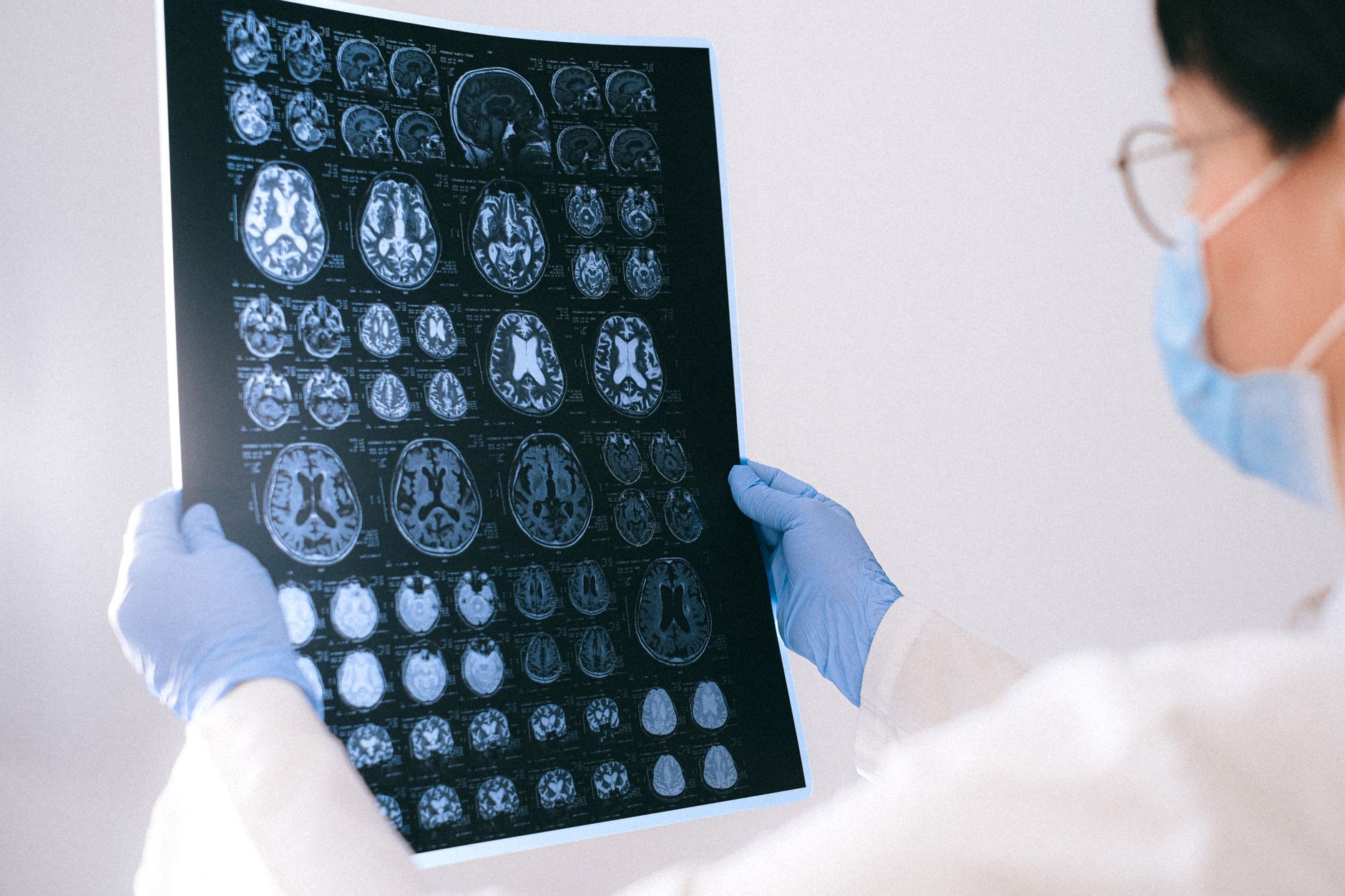
Brain scans carry a kind of visual authority. Put a colored patch over the prefrontal cortex, add a personality label, and a tentative correlation can start to look like a biological verdict.
That is roughly what has happened to a small body of research on introversion. The careful version is interesting: a few structural MRI studies found that people toward the introverted end of a personality scale had greater gray-matter volume or cortical thickness in particular regions. The viral version is much stronger: introverts supposedly have “more gray matter” for thinking, making them more deliberate, better decision-makers or better suited to professional success.
The first statement describes some published results. The second adds abilities and outcomes that those studies never measured.
The 28-person study behind the thickness claim
One important source is a 2006 structural MRI study of 28 healthy, right-handed adults aged 20 to 34. The researchers measured personality and cortical thickness, the estimated distance between the brain’s outer surface and the boundary between gray and white matter.
Higher extraversion was associated with thinner cortex in a region of the right inferior frontal cortex. A similar pattern appeared in the right middle frontal cortex, although the authors treated that result as a trend. Higher extraversion was also associated with thinner right fusiform cortex.
Turn the correlation around and people who scored toward introversion tended to have greater thickness in those regions. That is a legitimate description of the sample. It is not the same as saying “introverts have a thicker prefrontal cortex,” as if the entire front of the brain differed reliably between two biological types.
There is another important boundary. The study correlated anatomy with personality scores. It did not ask participants to make a series of difficult choices, test whether they considered more evidence, measure the quality of their judgments or follow their performance at work. Greater thickness was not shown to produce deliberateness.
A second small study measured volume, not thickness
A 2012 voxel-based morphometry study is the other likely source. The researchers initially scanned 34 healthy men aged 19 to 49. Two were excluded because of excessive movement, leaving 32 in the analysis.
Across the regional findings they reported, extraversion was negatively correlated with gray- and white-matter volume. In plain language, the larger measurements appeared toward the introverted end of the scale. The gray-matter clusters included right prefrontal cortex and cortex around the right temporoparietal junction.
The authors noted that these broad areas had been implicated in behavioral inhibition, introspection and aspects of social-emotional processing, including evaluating social stimuli and reasoning about other people’s mental states. They offered a biological interpretation cautiously, particularly for widespread white-matter correlations that appeared largely related to total white-matter volume.
Those functional descriptions have often been promoted into personal attributes. But identifying a region that participates in behavioral regulation is not evidence that a larger measurement gives someone more regulation. A region can contribute to many processes, and the same process is usually distributed across multiple regions and networks.
“More gray matter” bundles different things together
The two studies did not measure one interchangeable quantity. Cortical thickness is one component of cortical anatomy. Surface area and folding are others. Gray-matter volume reflects a combination of these properties rather than a simple count of useful thinking tissue.
Even “larger” has no universal psychological meaning. A structural MRI scan does not count neurons, measure synaptic efficiency or show how strongly a network is communicating while someone makes a decision. Tissue volume can reflect many biological features, and smaller structure can sometimes coexist with more efficient organization.
ScienceBlog previously examined a rare study in which researchers directly counted neurons and found virtually no relationship with IQ in 50 post-mortem brains. That was a different question and another limited sample, but it illustrates the wider problem: an intuitively appealing anatomical quantity is not automatically a score for cognition.
Age also matters. The cortex changes across development and later life, while personality scores can shift in average level. Scanner settings, image-processing pipelines, the boundaries assigned to regions and the statistical covariates included in an analysis can all affect the resulting map.
Later studies did not produce one stable introvert map
If the early pattern represented a simple and general anatomical signature of introversion, later work should repeatedly point to the same places in the same direction. It has not.
A 2007 study of 29 adults aged 61 to 84 found that greater extraversion was associated with greater thickness in specific lateral prefrontal regions. The authors suggested that age-related structural changes might help explain why personality-anatomy relationships differed from those in their younger sample. Whatever the reason, the result complicates the claim that introversion generally means thicker prefrontal cortex.
In 2010, a study of 116 adults linked greater extraversion with greater volume in medial orbitofrontal cortex, a region involved in representing reward value. The trait associated with lateral prefrontal volume and with planning and voluntary control was conscientiousness, not introversion.
That distinction matters for the popular “deliberate introvert” story. Extraversion and conscientiousness are separate dimensions. A person can be quiet and impulsive, outgoing and highly organized, or any other combination. Pulling a planning-related result for conscientiousness into a claim about introversion blends different traits after the fact.
Larger samples made the associations look smaller and less certain
Personality neuroscience did not stop at samples of a few dozen. A Human Connectome Project investigation eventually analyzed 1,104 people. It reported several associations between Big Five traits and measures of cortical thickness, surface area and volume, but some results did not carry from the original subset into the replication subset. Associations also changed depending on whether researchers statistically controlled for the other personality traits.
An independent 2020 analysis of 1,107 unrelated university students examined cortical thickness, surface area, subcortical volume and white-matter integrity. It failed to identify robust relationships between the Big Five and brain structure, apart from a weak and previously unsupported association involving conscientiousness. None of 15 associations selected from the earlier Human Connectome Project study replicated even at an uncorrected threshold.
The authors did not conclude that personality has no biological basis. Every personality state is produced by a living brain interacting with a body and environment. Their narrower point was that if stable relationships exist between broad personality scores and these gross structural measurements, the effects are probably very small and require much larger samples to detect reliably.
A 2022 systematic review and meta-analysis reached a similarly restrained conclusion. It identified 70 gray-matter-volume studies, 20 cortical-thickness studies and nine surface-area studies across the five traits. Qualitative findings varied widely, and the quantitative meta-analysis produced no replicable structural association for any Big Five trait.
Why a result can look strong in 30 people
Structural MRI studies can compare measurements across thousands of locations. Researchers correct for those multiple comparisons, but a small sample still leaves a large role for sampling variation. Replace a few people and the apparent magnitude, location or even direction of a brain-behavior relationship can change.
This is not a special flaw in the two introversion studies. Their authors used the tools and samples available and reported results that were reasonable to investigate further. The problem arises when an exploratory or early association is treated as a durable fact before independent replication.
A 2022 analysis of brain-wide association studies used major imaging datasets totaling about 50,000 participants. It found that associations between common variation in MRI features and complex psychological characteristics were generally smaller than earlier work assumed. Typical small studies produced unstable estimates and inflated effect sizes; reproducibility improved as samples moved into the thousands.
That broader result helps explain the personality literature without requiring anyone to have done something improper. When the true relationships are small, a study of 28 or 32 people can capture a mixture of signal and chance that looks far cleaner than the population-level pattern.
The career claim has no bridge from scan to outcome
Nothing in the early MRI studies demonstrated a career advantage. They did not measure promotions, pay, leadership effectiveness, entrepreneurship, sales, job performance, creative output or occupational longevity. They did not compare how introverts and extraverts performed in quiet offices, social workplaces or management roles.
They also did not establish a causal chain. Even if a structural association replicated, researchers would still need to show that the anatomical feature predicted a specific cognitive process, that the process improved performance in a defined setting, and that competing explanations did not account for the relationship.
Work environments reward different behaviors. Reserved attention may help in one task; rapid social engagement may help in another. Team composition, expertise, motivation, autonomy, health, discrimination and plain luck can all matter. A broad personality score is not a career destiny, and a regional MRI measurement is even further removed from one.
The same caution applies to the word “deliberate.” Someone can spend a long time deciding because they are reflective, anxious, uncertain, distracted or poorly informed. Speed and quality are different outcomes. Neither can be inferred from the thickness of one cortical patch.
What the evidence supports now
Introversion is not a separate brain type. In mainstream personality research, it is the lower end of a continuous extraversion dimension involving tendencies such as sociability, assertiveness, activity and positive emotionality. People at either end still vary enormously, and their behavior changes with context.
The early MRI findings remain part of the scientific record. They supplied hypotheses about regions and measurements that larger studies could test. Some small, conditional personality-anatomy relationships may eventually prove reproducible, perhaps at the level of narrower trait facets, developmental periods or distributed networks rather than one patch of tissue.
For now, the honest conclusion is modest. Small studies have linked introversion with greater volume or thickness in certain prefrontal and social-processing regions. The anatomical measures were not interchangeable, later maps were inconsistent, and larger analyses found little that survived replication.
Most importantly, nobody in those scanners was shown to be more deliberate or more likely to succeed at work because of the anatomy being measured. A suggestive brain correlation is a starting point for research, not a ranking of personalities.