
From the ground, sunrise feels like something the Sun does. From the International Space Station, it becomes obvious that sunrise is mainly about the observer’s motion.
The station flies roughly 400 kilometres above Earth at close to 7.7 kilometres per second. At that speed it completes one circuit in about 90 minutes, repeatedly carrying its crew out of Earth’s shadow and into sunlight.
Divide 24 hours by roughly 90 minutes and the familiar number appears: about 16 orbits, with a sunrise and sunset on most laps. The Sun has not accelerated. The horizon beneath the astronauts is moving around Earth with them.
It is a simple fact with several useful complications. Sixteen is a rounded average, the station’s orbit is not exactly 90 minutes, and the amount of darkness changes as the orbit turns relative to the Sun.
The station is falling around Earth
An orbit is not a place where gravity stops. Earth’s gravity pulls the station downward while its enormous sideways speed carries it forward. The curved planet falls away beneath it at almost the same rate, so the ISS continually misses the ground.
At an altitude near 400 kilometres, the station is roughly 6,770 kilometres from Earth’s centre. Its circular path is therefore about 42,500 kilometres long, slightly longer than Earth’s circumference at the equator.
Travelling at about 7.7 kilometres per second, or close to 28,000 kilometres per hour, the station covers that loop in a little over 90 minutes. ESA gives a typical orbital period of 92 minutes.
That number is not permanent. Thin gas still exists hundreds of kilometres above the surface, and collisions with it create drag. The station gradually loses altitude until visiting spacecraft or attached engines raise its orbit again.
ScienceBlog has previously examined why the ISS must be periodically reboosted. A lower orbit is slightly faster and shorter; a higher orbit is slightly slower and longer. That is one reason official descriptions use “about 90 minutes.”
Why 16 is a rounded daily average
NASA’s public facts and figures for the station say that it makes 16 orbits in 24 hours, passing through 16 sunrises and sunsets. That is the useful headline version.
The arithmetic works neatly. A day contains 1,440 minutes. Divide that by 90 and the answer is exactly 16.
The actual orbit is usually a little longer. NASA’s more detailed Earth-observation orbit tutorial gives a range of 90 to 93 minutes, depending on altitude, and says the station generally completes between 15.5 and 15.9 orbits per day.
A 24-hour reporting period can also begin partway through one orbit and finish partway through another. Depending on where the station and Earth’s shadow lie at the boundaries, a literal count of transitions can vary.
“About 16 sunrises” is therefore the careful form of the claim. It describes the normal cadence without pretending that sunrise arrives on an exact 90-minute alarm.
What sunrise means when the observer is orbiting
On Earth, dawn is normally explained by the planet rotating a location toward the Sun. Orbital sunrise is the same relationship viewed from a spacecraft whose own motion is much faster.
During orbital night, the solid Earth blocks direct sunlight from reaching the station. The ISS is passing through Earth’s long shadow, even though the Sun continues shining on the far side of the planet.
Sunrise occurs when the station reaches the shadow’s edge. The top of the solar disk clears Earth’s curved limb, direct light strikes the spacecraft again, and the atmosphere along the horizon begins to glow.
The Sun is not rising faster in any physical sense. Its apparent motion against the local horizon is fast because the observer is travelling across the boundary between shadow and sunlight at several kilometres per second.
No city directly beneath the spacecraft needs to be experiencing dawn at precisely that moment. This is sunrise from the station’s moving line of sight, not the morning timetable of the country below.
Each new lap reaches a different part of Earth
The ISS orbit is inclined 51.6 degrees to the equator. That carries it above much of the inhabited world, reaching latitudes just beyond London in the north and the Falkland Islands in the south.
Meanwhile, Earth continues rotating beneath the orbital plane. NASA’s tutorial says the station’s ground track shifts west by about 22.9 degrees of longitude from one revolution to the next.
The following sunrise therefore does not replay the same view. One may emerge over the Atlantic, the next over Africa or Asia, with different clouds, dust, airglow and city lights below.
This is why a station crew can circle Earth nearly 16 times without flying over the same places in the same sequence of local time. The orbital plane, the turning planet and the direction of sunlight all contribute to the view.
The visible transition can last only seconds
Earth rotates once in roughly 24 hours, so a sunrise seen from the surface unfolds slowly enough to watch. The ISS completes almost 16 circuits during the same period.
That compresses the transition dramatically. NASA notes that an ISS sunrise or sunset can last only a few seconds. The broader atmospheric glow can remain visible longer, but the solar disk itself clears the limb quickly.
An astronaut waiting with a camera has little time to adjust exposure or composition. Many polished orbital-sunrise videos are time-lapse sequences assembled from still photographs, turning a very brief event into something viewers can examine.
The Sun then remains visible for a substantial part of the orbit before Earth blocks it again. Daylight and darkness are not necessarily two equal 45-minute halves, because the spacecraft is above the surface and the geometry changes.
Some orbital nights are shorter than others
The station’s orbital plane does not keep one fixed angle to the Sun. Its orientation precesses over time while Earth follows its yearly path around the Sun.
Engineers use the solar beta angle to describe the angle between the direction of incoming sunlight and the station’s orbital plane. This angle helps determine how deeply the spacecraft enters Earth’s shadow.
At low beta angles, the station cuts through a substantial section of the shadow. At high angles it clips less of it, shortening the eclipse. NASA thermal-planning material notes that high-beta conditions can produce very short or even absent eclipses.
Those intervals matter to station operations. Sunlight affects solar-array power, external temperatures and the heating and cooling cycle experienced by hardware on every orbit.
They also supply another reason not to interpret “16” too rigidly. The familiar number describes an ordinary day aboard the ISS, not a promise that Earth will fully hide the Sun on every possible lap.
The colours reveal Earth’s atmosphere edge-on
Direct sunlight above the atmosphere is broadly white. Yet orbital sunrises are famous for intense reds, oranges and blues.
The difference comes from the long, shallow path that sunlight takes through air near Earth’s limb. Shorter blue wavelengths scatter more efficiently. The direct beam becomes richer in red and orange, while scattered blue light outlines higher atmospheric layers.
ScienceBlog previously explored why the Sun is white in space but often looks yellow from Earth. The view from orbit turns the same scattering physics sideways. Instead of looking upward through the atmosphere, astronauts look along its thin edge.
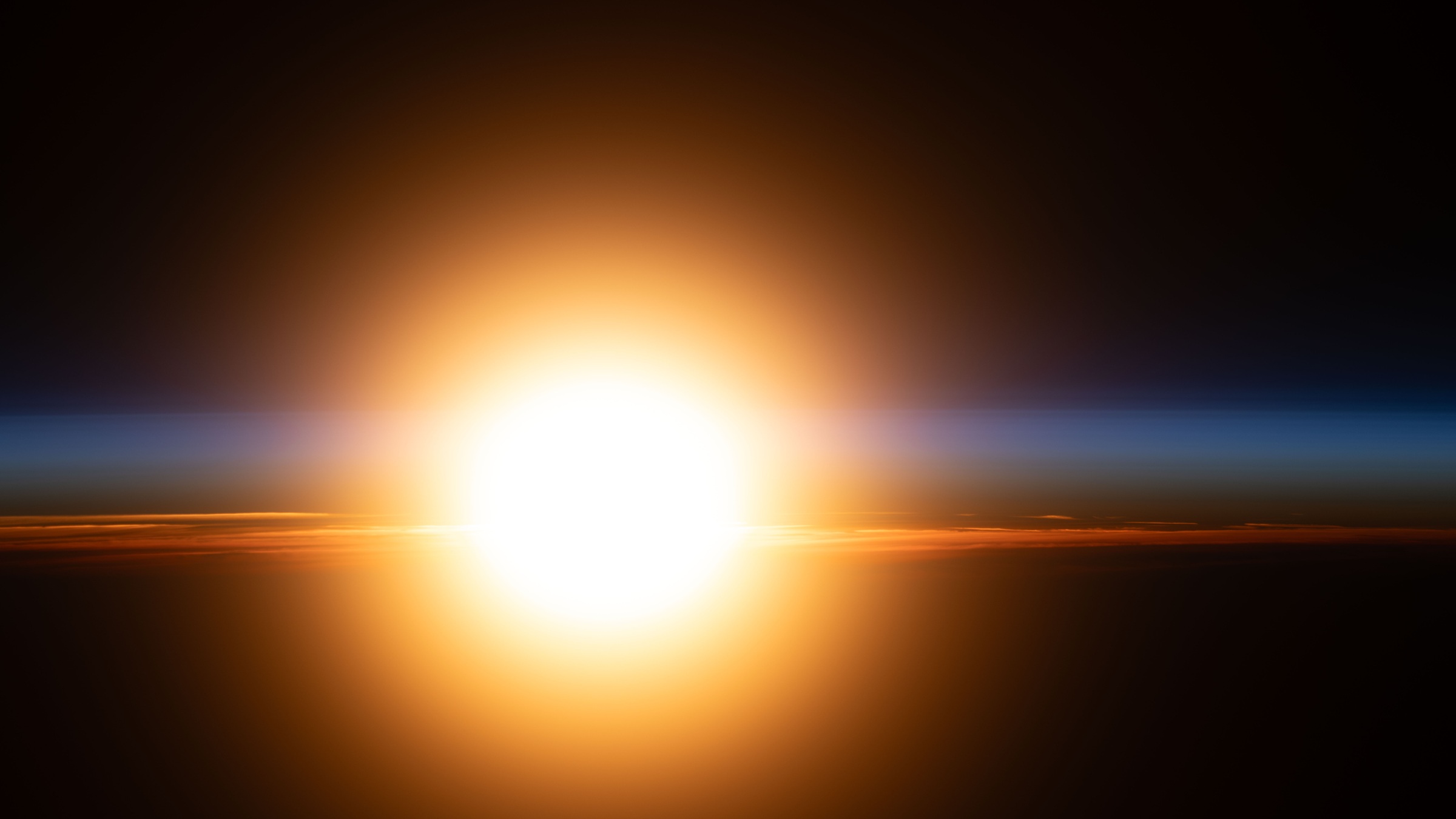
The featured image was photographed by NASA astronaut Chris Williams on 26 June 2026 as the station orbited above the Caucasus Mountains. The bright sunburst sits inside a narrow orange band, with a cooler blue layer above it and black space beyond.
The atmosphere looks broad in the photograph because the line of sight travels tangentially through it. Relative to the size of Earth, the life-supporting lower atmosphere remains startlingly thin.
Sixteen sunrises do not mean 16 human mornings
“Astronauts experience 16 sunrises” does not mean every crew member watches every one. Many occur while people are working inside, sleeping, exercising or facing away from a suitable window.
Nor does the crew start a new workday each time sunlight returns. The station operates on a coordinated 24-hour schedule with planned sleep, meals, work periods and artificial lighting.
ScienceBlog’s earlier report on ISS sunrises and the human body clock explains why a 90-minute light-dark cycle never becomes an astronaut’s biological day. The view outside is spectacular, but it is an unreliable clock.
The repeated dawns are produced by velocity, altitude and shadow geometry. The Sun is behaving normally. It is the laboratory, falling around Earth at nearly eight kilometres per second, that keeps finding morning again.