

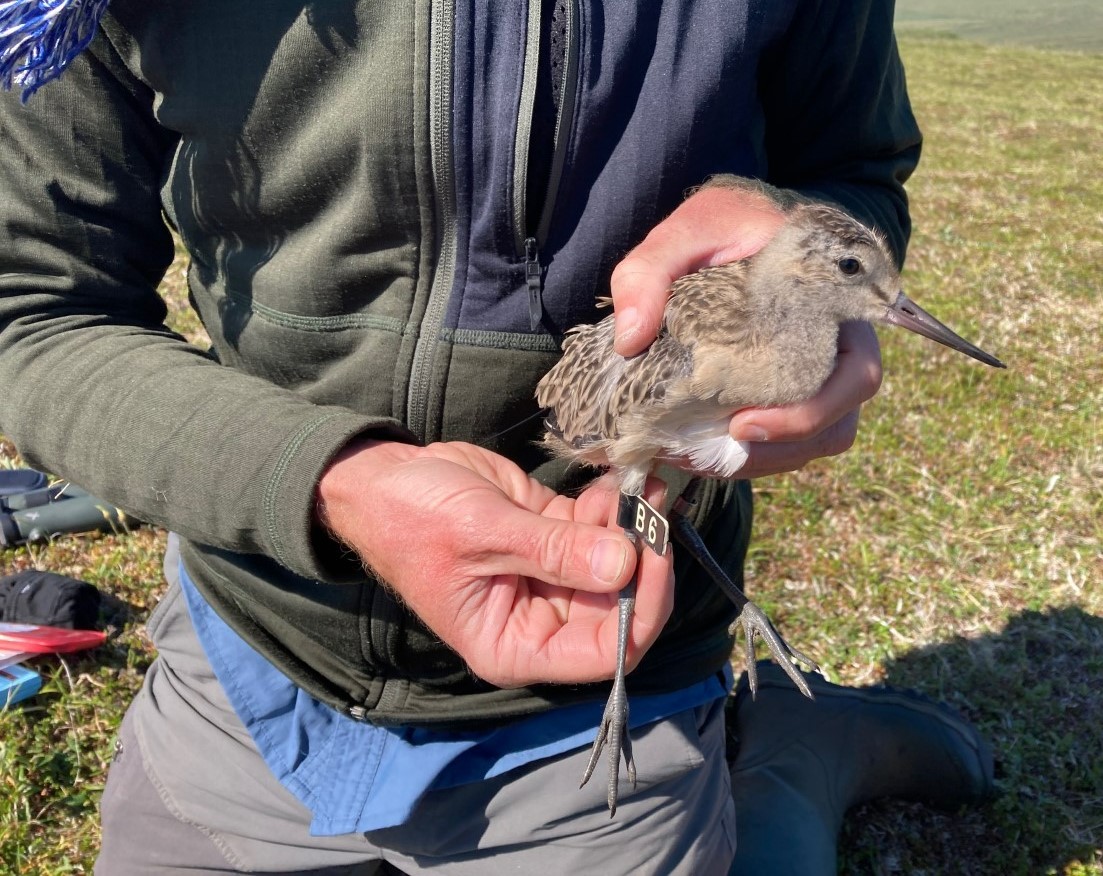
A bird only a few months out of the egg left western Alaska on 13 October 2022 and did not touch land again until 24 October. When the juvenile bar-tailed godwit reached Ansons Bay in north-eastern Tasmania, its satellite track described an uninterrupted trans-Pacific journey lasting 11 days and one hour. Guinness World Records lists the distance as approximately 13,560 kilometres, the longest recorded nonstop migration by a bird.
The individual carried two useful identifiers. Researchers knew it in the field as B6 from the black leg flag visible in photographs. The satellite transmitter on its rump carried the device number 234684, which is the identifier used in some public accounts. B6 was roughly four to five months old, depending on how its age was rounded, and this was its first southbound migration. It had never rehearsed the route.
Five grams of electronics traced an ocean crossing
B6 was one of three chicks fitted with five-gram solar-powered satellite transmitters during a pilot project near Nome, Alaska. Scientists from the Max Planck Institute, the US Geological Survey and the US Fish and Wildlife Service wanted to learn what happens between fledging and the first migration, a poorly observed stage in the lives of most shorebirds.
After leaving the breeding area, B6 moved more than 1,000 kilometres to the Yukon-Kuskokwim Delta. It spent weeks along the coast near the Ninglick River and Kigigak Island, part of the region where Alaska-breeding bar-tailed godwits build fuel reserves before flying south. The USGS account of the tracking project says the bird left Alaska on 13 October and arrived in Australia on 24 October.
The path was not a straight line drawn toward Tasmania. A 2026 paper reporting the juvenile-tracking work reconstructs B6 heading southwest toward the outer Aleutian Islands with strong tailwinds, then turning southeast in the direction of Hawaii. It continued south-southwest through the central Pacific. By 22 October it had reached the Tasman Sea between Australia and New Zealand. Strong easterly winds two days later helped carry it west toward Tasmania, with estimated ground speed near 90 kilometres per hour before landfall.
Why 13,560 kilometres is not the only figure
The headline figure is the distance recognised by Guinness and widely reported after the flight. Later scientific documents give slightly smaller reconstructions. A project report calculated about 13,436 kilometres, while the peer-reviewed 2026 paper gives 13,391 kilometres. These are not three different migrations.
A satellite transmitter supplies a sequence of estimated positions rather than a second-by-second odometer reading. Researchers model the most plausible path between fixes, and revised filtering or movement models can change the summed distance. Even the smallest published reconstruction remains extraordinary and retains the paper’s description of the longest recorded nonstop flight by a landbird.
Using the Guinness distance and the reported 265 hours gives an overall ground speed near 51 kilometres per hour. That average hides large variations. The project report describes speeds above 100 kilometres per hour in powerful winds soon after departure, slower periods across the central ocean and another wind-assisted acceleration near Tasmania.
“No rest” means no landing, not proven sleeplessness
The satellite sequence, flight duration and almost entirely oceanic route support a nonstop crossing. B6 passed potential island landfalls around Oceania without using them. Bar-tailed godwits normally feed by probing coastal mud and shallow water for invertebrates, so an airborne bird over the Pacific had no practical opportunity to eat in its usual way.
That justifies describing the journey as having no stop for food or terrestrial rest. It does not show that the bird was consciously awake every second. The tag measured locations, not brain activity, eye state or wingbeats. Scientists have long noted that extreme flights challenge what is understood about avian sleep, but a major satellite-telemetry study of trans-Pacific godwits treated sleep as an unresolved physiological question rather than a measured behaviour.
The distinction is small in everyday language and important in science. B6 demonstrably did not land for 11 days. Whether it used seconds of reduced alertness, slept in some unknown way or remained continuously awake cannot be recovered from the tracking data. “No rest” in the record means no stopover.
The bird carried its fuel inside its body
Bar-tailed godwits prepare for the Pacific by feeding intensively on Alaska’s coastal wetlands. Fat is the principal energy store, but the transformation involves more than becoming heavier. The body can reduce tissue that will be less useful in the air and allocate lean mass toward organs that support continuous flight.
A study of juvenile Alaska godwits preparing for their first migration compared birds partway through fuelling with birds collected around departure. It supported earlier evidence that digestive organs shrink as departure approaches while flight-related capacity is prioritised. Carrying a smaller gut reduces mass once there will be no feeding, and oxidising stored fat supplies energy as well as metabolic water.
Those are population-level physiological findings, not measurements from B6 before and after its record. Researchers did not recover the bird at Ansons Bay to weigh it, scan its organs or calculate its personal energy budget. Claims that B6 itself lost exactly half its mass, shrank a particular organ by a fixed percentage or went without sleep go beyond what its transmitter recorded.
How does a juvenile navigate a route it has never flown?
The most striking part of the story may be B6’s inexperience. Adult Alaska-breeding godwits already perform annual migrations to New Zealand and eastern Australia. B6 began its first southbound flight without a remembered sequence of landmarks or a previously learned destination.
First-time migration can combine inherited directional programmes with information from the Sun, stars, Earth’s magnetic field, weather and possibly other birds. B6’s track does not separate those influences. It also cannot show whether companions were within sight or calling distance. A satellite point reveals where one tagged bird was, not what the bird perceived or decided.
The route does show flexible responses to conditions. B6 took advantage of favourable winds at departure and turned west after encountering strong easterlies in the southern Tasman Sea. Its arrival in Tasmania rather than the more typical New Zealand destination may reflect that interaction between an inherited migratory heading and the moving atmosphere. The event is evidence of successful first-time navigation, not a complete explanation of the navigation system.
A record that depends on two distant coastlines
Once ashore, a godwit again depends on mudflats, beaches, mangroves and estuaries. BirdLife Australia describes bar-tailed godwits probing those habitats for molluscs, worms and aquatic insects. The organisation lists the species as Near Threatened globally and vulnerable under Australian federal law.
The spectacular ocean leg can obscure the habitat chain that makes it possible. B6 needed productive Alaskan breeding and staging grounds to grow and store fuel, survivable wind across the Pacific, and a suitable coastal destination where feeding could resume. Damage at either end can matter even when the intervening route contains no conventional stopover.
ScienceBlog noted years before B6’s flight that Arctic shorebirds face shrinking breeding habitat. Tracking projects add individual routes and timing to that larger risk picture. The record is therefore more than an endurance anecdote. A five-gram transmitter turned one juvenile’s first migration into a map linking the ecological needs of Alaska, the open Pacific and Tasmania.
B6’s achievement does not require rounding away the uncertainties. The exact modelled distance varies by a little more than one percent, its sleep state was not measured and its navigational cues remain unknown. What the data establish is remarkable enough: a juvenile shorebird took off from Alaska, remained continuously airborne for about 265 hours and reached Tasmania on a journey longer than 13,000 kilometres without ever having flown the route before.