

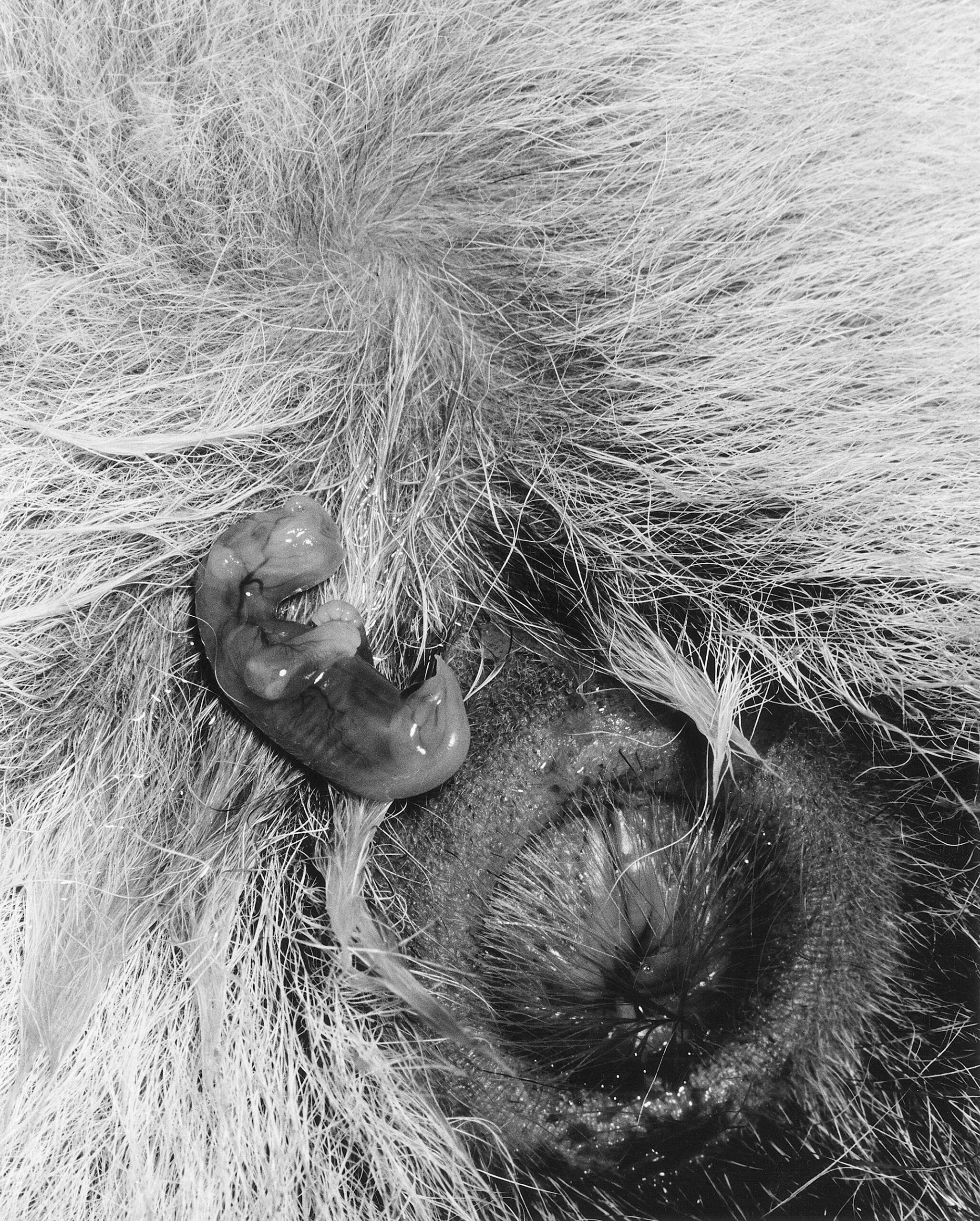
An adult red kangaroo can stand taller than a person, yet its life begins at a scale that seems almost incompatible with the animal it will become. After little more than a month of pregnancy, the newborn emerges hairless, with sealed eyes, an unfinished nervous system and hind limbs that are little more than buds. Its first task is also its most urgent: reach the pouch and attach to a teat.
The familiar jellybean comparison works as a visual shorthand, but the measurements vary among species. A red kangaroo neonate averages about 750 milligrams after a 33-day gestation. An eastern grey arrives at roughly 36 days and still weighs less than one gram. The extraordinary part is not simply how small it is. Development has equipped precisely the structures needed for one short journey.
“Kangaroo” covers several birth schedules
The four living animals commonly called kangaroos are closely related, but they are not identical. The Australian Museum’s eastern grey account gives a 36-day interval after mating and a birth mass below one gram. Western greys gestate for about a month, while the better-studied red kangaroo gives birth after roughly 33 days.
Classic observations of red kangaroo reproduction found newborns weighing about 750 milligrams and taking around three minutes to reach the pouch. The 1964 life-history study reported no evidence that mothers actively carried the young upward.
So “barely a month” and “less than a gram” are accurate for the large kangaroo species, while “jellybean-sized” is an analogy rather than a scientific unit. Body length and posture can make different photographs look larger or smaller than the mass suggests.
The first climb begins at birth
Before delivery, the mother usually settles back and cleans the area between the birth opening and pouch. The neonate emerges through the urogenital opening, often still partly enclosed in membranes. It then begins an alternating, pulling movement with its forelimbs, gripping fur and hauling its body upward.
A remarkable CSIRO film of red kangaroo birth records the journey directly. The hind limbs do not propel the animal. At this stage they are tiny, poorly formed buds that trail behind. The newborn’s tail is also not yet the muscular balancing organ it will become. Nearly all useful locomotor work comes from the shoulders, forearms and clawed digits.
Calling the climb unaided refers to locomotion: the mother does not pick up the joey and place it inside. She still prepares the route through posture and grooming, and her fur supplies the surface the forelimbs grasp. The newborn completes the critical movement under its own power.
Blind does not mean senseless
The joey cannot see the pouch. Its eyes are sealed, and hearing is not available in the way it will be later. Yet it responds to a smaller sensory toolkit. Evidence across marsupials implicates gravity, smell, temperature and touch around the muzzle and mouth. These inputs can orient a highly immature animal without requiring a mature cerebral cortex.
A review of sensory function in newborn mammals describes pouch orientation, climbing, teat finding and oral attachment while distinguishing those responses from sight and hearing. Experiments in quokkas have shown that gravity alone can provide a powerful directional cue, although kangaroos may also use odor and the alignment of the mother’s fur.
It is more accurate to think of the joey as developmentally selective than simply helpless. Many systems are unfinished, but the sensory and motor circuits required for this immediate survival problem are already operating.
Researchers are still separating the relative contributions of those cues, and findings from one marsupial should not automatically be assigned to every kangaroo. Odor may help identify the pouch or teat, gravity supplies a reliable upward direction, and tactile receptors help with final attachment. What the climb demonstrates with certainty is coordinated behavior, not adult-like awareness. A tiny working circuit can solve a narrowly defined task even while most of the brain remains profoundly immature.
The forelimbs get an extraordinary head start
Marsupial development is not merely placental development stopped early. Its timetable is rearranged. The front of the body, including the mouth, shoulders and forelimbs, develops far ahead of the rear. Muscles and bones needed for crawling appear while much of the rest of the body remains embryonic.
Ultrasound work in tammar wallabies found that forelimb climbing movements begin before birth, less than three days before delivery. In other words, the first journey is not improvised after the joey meets the outside world. The motor pattern has already begun rehearsing inside the uterus.
Genetic studies support the same picture. An earlier ScienceBlog report on marsupial embryos explained that forelimb development starts unusually early and draws cells from a larger region of the embryo. The hind-limb program is specified too, but receives fewer of the scarce cells available at that stage. The result is a newborn with functional arms and rubbery, lagging legs.
The pouch takes over much of pregnancy’s work
Reaching the pouch is only the first threshold. The newborn finds one of four teats and fastens its mouth around it. The teat elongates and the joey remains attached through an extended early phase while milk supports the organ growth that placental mammals largely complete before birth.
The pouch is often called an external womb, but that comparison is incomplete. It does not provide a placenta or an amniotic environment. It is a protected lactation chamber, and milk is the developmental supply line. Its composition changes as the joey grows, shifting nutrients and biological signals to suit each stage.
Female kangaroos can make the system even more flexible through embryonic diapause. A newly conceived embryo can pause while an older young occupies the pouch, and a mother may support offspring at different stages. This reproductive strategy moves much of the energetic commitment from gestation into a long, adjustable period of lactation.
That flexibility includes asynchronous lactation. A mother may nurse an older young that returns to the pouch while a much younger joey remains attached inside. Different mammary glands can produce milk suited to those different developmental stages. The reproductive system is therefore not simply shortening pregnancy. It is replacing a single prolonged prenatal investment with a carefully regulated sequence of pause, birth, attachment and changing milk.
A three-minute crawl may shape marsupial evolution
The neonatal journey may have consequences far beyond one birth. Because every successful newborn must use its forelimbs so early, evolution cannot freely redesign those limbs without preserving their first function. This proposal is known as the developmental constraint hypothesis.
A broad 2022 comparison of marsupial limbs found evidence that ecology and early developmental demands both influence adult limb diversity. The proposed constraint may help explain why marsupials have not evolved true powered flight or fully aquatic flippers, although researchers continue to debate how strong and universal the restriction is.
That debate prevents the simplistic conclusion that marsupials are primitive or unfinished versions of placental mammals. They represent a different allocation of development. Placental mammals invest heavily before birth. Kangaroos transfer a remarkably early newborn into a protected milk-based system and front-load the machinery needed to get there.
The climb works because immaturity is not evenly distributed. The joey lacks fur, vision and powerful hind legs, but it arrives with grasping forelimbs, a working rhythm for alternating them and enough sensory information to distinguish upward from wrong. Its body is not ready for the world in general. It is ready for one narrow route through its mother’s fur, and that is enough.