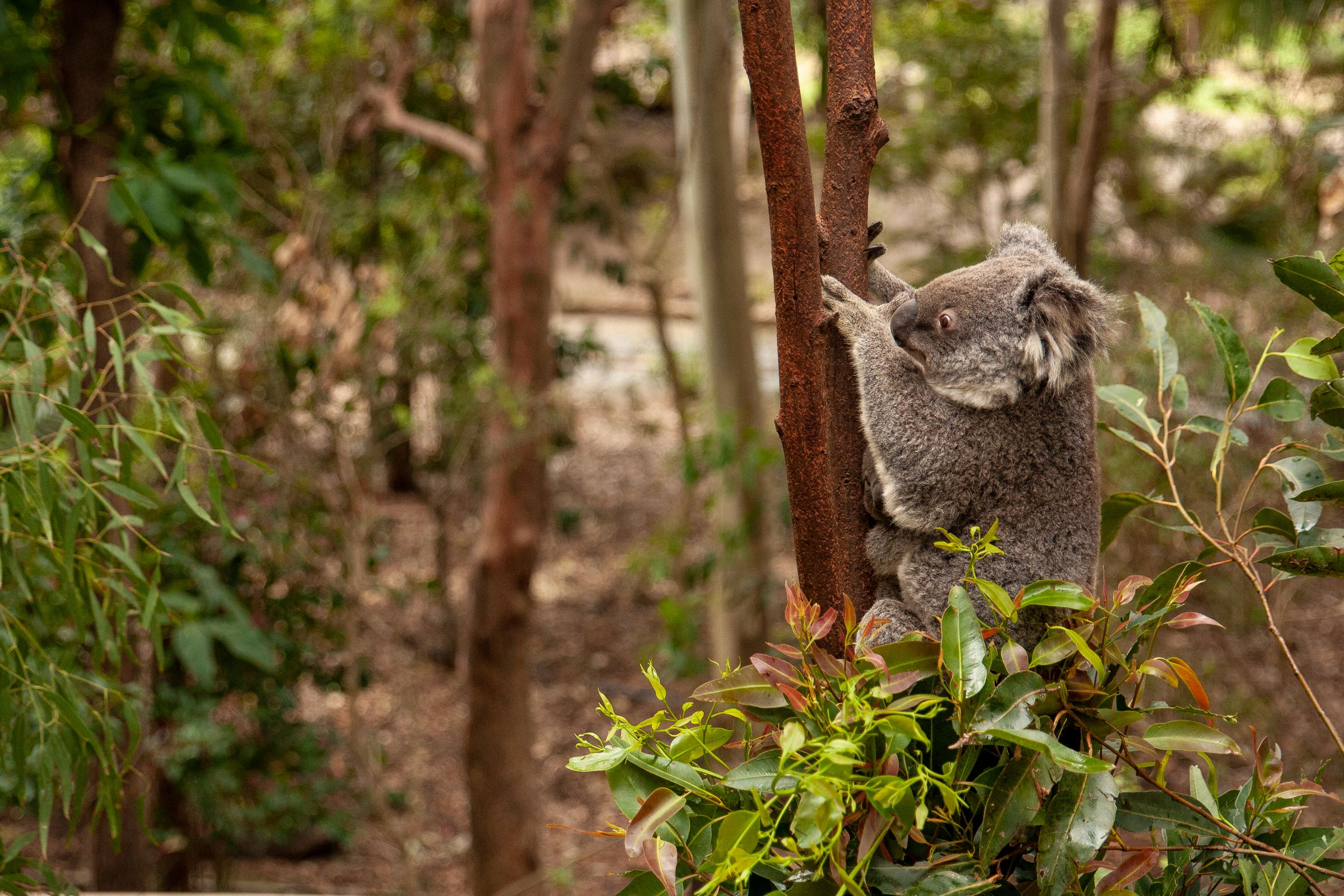
The koala population collapse was already underway long before the first people reached Australia, according to a new reading of the species’ genomes.
Researchers calibrated a genetic clock from koala families, then applied it to 457 wild koala genomes collected across the species’ range. Their reconstruction places the beginning of a large decline at roughly 100,000 years ago. That is tens of thousands of years earlier than the broad 65,000-to-47,000-year window commonly given for modern human arrival on the continent.
The work, published in Molecular Biology and Evolution, also suggests that the bottleneck happened before the ancestors of today’s koalas divided into their five major genetic populations. In the researchers’ account, a western lineage disappeared while a diminished eastern population endured. As conditions improved after the last ice age, that surviving population grew and separated into the groups distributed along eastern Australia today.
This is one study, not settled consensus. A genome is not a fossil census, and DNA alone cannot show an ancient eucalyptus forest drying out. The study reconstructs ancestry with statistical models. Its climate explanation comes from matching that genetic history to independent evidence about Australia’s changing environment.
That distinction does not drain the result of meaning. It shows exactly what the evidence can support, and why a number as basic as the mutation rate can shift an entire chapter of natural history.
A clock built from koala families
Every new generation carries a small number of DNA changes that were absent from both parents. If researchers know how frequently these mutations arise, they can use differences among genomes as a clock. The greater the accumulated difference, the longer ago two genetic lineages generally shared an ancestor.
Earlier koala reconstructions had no directly measured rate for the species. A landmark 2018 koala genome study therefore scaled parts of its demographic analysis with mutation rates from humans and mice. That work placed a sharp decline around 30,000 to 40,000 years ago, after people had arrived.
The 2026 team instead sequenced 12 koalas from three families. One recorded family relationship did not survive the genetic check, leaving four usable parent-offspring trios. Across those offspring, the researchers identified 100 mutations that were not present in either parent.
The resulting mean was 6.12 mutations per billion DNA letters per generation, with a 95 percent confidence interval from 5.03 to 7.45. That is considerably lower per generation than the modern human rate used in previous work. Assuming a seven-year koala generation, the team then used its species-specific rate to put calendar dates on patterns in the wider genomic sample.
What 457 genomes remember
The population data combined 413 animals from the Koala Genome Survey with 44 more from Kangaroo Island and South Australia’s Mount Lofty Ranges. The samples broadly resolved into five recognized genetic populations: northern Queensland, southeast Queensland and northern New South Wales, middle New South Wales, southern New South Wales, and Victoria.
To look backward, the researchers used two related methods that infer how often segments of present-day genomes converge on common ancestors. Their output is an estimate of effective population size. This is the size of an idealized breeding population that would produce the observed genetic pattern, not a count of furry bodies sitting in ancient trees.
The first method, PSMC, suggested that koalas expanded around 700,000 years ago, remained broadly stable until about 120,000 years ago, and then entered a severe, prolonged decline. Their inferred effective population size reached its minimum around 60,000 years ago.
A second method, SMC++, used multiple genomes from each population and produced a smoother story. It placed a more gradual decline between roughly 110,000 and 40,000 years ago, ending near one-tenth of the earlier maximum. The three northern populations showed some recovery beginning about 15,000 years ago; the two southern groups showed less or none in this particular analysis.
The methods therefore agree on an early start but not on the shape of the fall. PSMC makes the bottleneck look sharper. SMC++ allows a long decline whose later portion overlaps with human presence. Any claim that the study proved people had no effect would go beyond its results.
The continent was becoming colder and drier
The revised timing points toward a much older environmental upheaval. During the last glacial period, Australia became cooler, drier, and increasingly arid. Forest habitat contracted, leaving moisture-dependent species concentrated in refuges near the eastern and southwestern coasts.
Koalas are specialists. Eucalyptus foliage is not merely where they happen to live; it is the basis of their food and much of their water intake. A connected belt of suitable trees permits movement and gene flow. When that belt breaks into isolated patches, the demographic consequences can be felt long before the last animal disappears from any one patch.
The Nullarbor is central to the researchers’ interpretation. Fossils indicate that this now-treeless region once supported more wooded habitat and large tree-dwelling animals. By about 70,000 years ago, it had shifted toward semi-arid shrubland, creating a vast barrier between eastern and western koala habitat.
That sequence fits the genomic reconstruction: a decline beginning during glacial cooling, increasing restriction to coastal refuges, and the final separation of the east from a western population that later became extinct. The University of Sydney’s account of the study describes the surviving eastern population as the source of all modern koalas.
Still, timing is not the same thing as a direct demonstration of cause. The genomic methods can also respond to population structure. If forests became fragmented and migration fell, ancestral lineages would meet less often, which can resemble a reduction in effective population size. The authors think declining abundance and declining connectivity probably happened together.
What “every living koala” means here
The phrase is sweeping, but the underlying inference is precise. All five present-day genetic populations carry a shared deep bottleneck. The models place that bottleneck before the five lineages diverged. In other words, their common ancestral population had already been reduced before it generated the modern branches.
This does not mean researchers located one literal last colony or counted its members. Nor does it mean that every survivor lived within the boundary of one present-day state. “Small eastern population” is a demographic and geographic reconstruction from living genomes, interpreted alongside fossils, habitat models, and paleoclimate.
It also avoids a possible map-reading trap. Koalas found in Western Australia today do not preserve a surviving ancient western lineage. Populations there were re-established with animals translocated from the east. The old western population discussed in the paper is gone.
There is another subtlety. Effective population size is usually smaller than census size and is shaped by unequal breeding success, population subdivision, and changes in connectivity. The analysis can reveal a shared ancestral constriction without telling us the exact number of koalas alive at its worst point.
Forests returned, and one lineage became five
The five modern groups are relatively young in this reconstruction. Pairwise estimates put all of their divergences within the past 30,000 years, after the ancient bottleneck had begun to ease in at least part of the range.
The first major divisions were dated to about 15,000 to 16,500 years ago. These produced ancestral northern, central, and southern groupings. The two northernmost populations split from each other around 6,500 years ago, while the two southernmost separated about 7,600 years ago.
Those dates fall as Earth emerged from the Last Glacial Maximum and entered the warmer current interglacial. Habitat modeling cited by the researchers indicates that suitable koala country expanded along the east coast in this period. Trees reconnected landscapes that had been refuges, giving the survivors room to increase and disperse.
Expansion did not restore the vanished western lineage, and it did not erase the genetic mark of the crash. Instead, one eastern ancestral population became the shared trunk from which the five living branches emerged.
Human arrival is not removed from the story
The strongest conclusion is about sequence. Under a seven-year generation time, the decline begins around 110,000 years ago. Even using a shorter six-year generation moves the onset only to about 94,000 years ago, still well before current estimates for human arrival.
The weakest version of the claim would be that humans initiated this particular collapse. The new calibration makes that timing very difficult. A much stronger claim, that humans had no subsequent influence on koalas, is not established.
One of the study’s models carries the decline through the period when people were present. The authors also note that humans have been credited with the loss of the last western koala population. Much later, commercial hunting drove southern populations close to extinction around the turn of the 20th century.
Present-day pressures are more direct still. Land clearing, disease, fire, dog attacks, and vehicle strikes continue to affect koalas, and the study’s recent-history analysis inferred substantial declines in several Queensland and New South Wales populations over the past ten generations. An ancient climate-linked contraction does not make current habitat loss less human-made.
The uncertainty is part of the result
The mutation estimate came from only four usable trios. Generation length is not known to a decimal point. PSMC is weak at recent time scales, while population structure can distort both methods’ estimates of abundance. The sharp and gradual reconstructions do not agree in every detail.
Those limitations are reasons to treat the dates as modeled ranges, not anniversaries. They are not reasons to fall back on the old clock. Directly measuring mutations in the species being studied removes a major borrowed assumption, and the paper shows how strongly that assumption had controlled the answer.
Koala DNA is not a diary of droughts, forests, or encounters with people. It is a record of inheritance. Calibrated with mutations observed in real koala families, that record now points to a population crisis that began in a colder, drier Australia about 100,000 years ago.
The survivors appear to have held on in the east until forests spread again. Every living koala, from Queensland to Victoria and in populations moved farther afield, carries part of that survival story.