
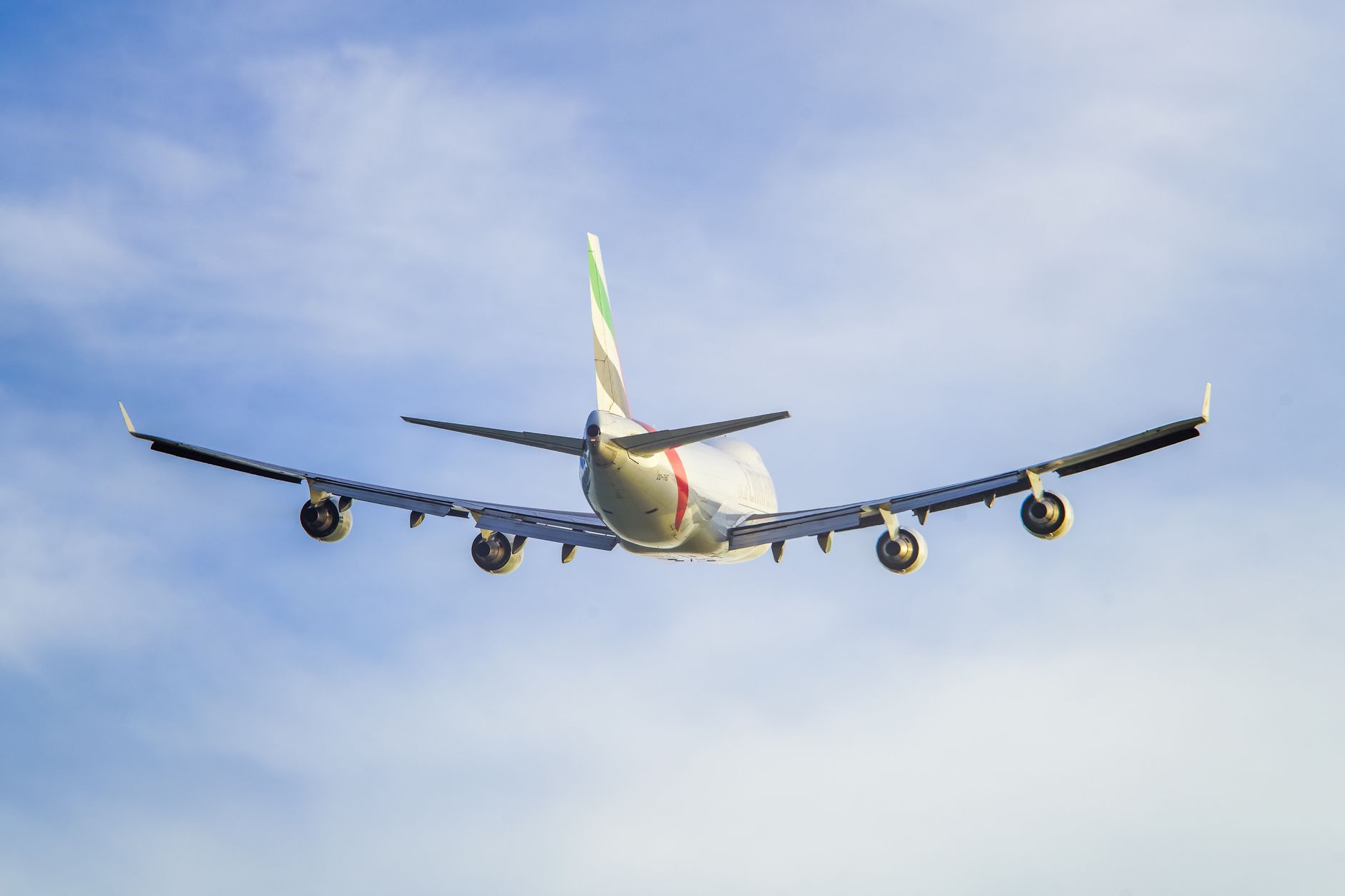
Picture the scene. A jumbo jet is cruising high above the clouds when every engine goes quiet.
In a film, this is where the aeroplane points at the ground, the cabin lights flicker and the soundtrack discovers an urgent new drum section. Real aerodynamics is less theatrical. An intact airliner does not suddenly become a grand piano. It becomes a glider. Admittedly, it is a glider with hundreds of seats, several kitchens and a rather pressing customer-service problem, but a glider all the same.
Now add the genuinely peculiar part. If two otherwise identical aircraft begin at the same altitude in still air, one light and one heavily loaded, both can cover essentially the same horizontal distance when flown correctly. The heavier one does not take a steeper shortcut to Earth. It flies faster along almost the same downhill path and arrives sooner.
That sounds like weight has stopped mattering. It has not. Weight has simply been assigned a different job from the one our intuition gives it.
An engineless aeroplane is not a falling object
Cut the thrust and gravity becomes the aircraft’s energy source. As the plane loses altitude, some gravitational potential energy pays for the airspeed needed to keep air flowing over the wings. The nose sits below the horizon, but the flight path is much shallower than a dive.
Three forces matter in a steady, unpowered glide. Weight points down. Lift acts mostly upward, at right angles to the flight path. Drag points backward along that path. Resolve those arrows and a simple relationship appears: the slope of the glide is controlled by the ratio of drag to lift.
NASA’s force balance for a gliding aircraft writes it as the tangent of the glide angle equalling drag divided by lift. Turn that fraction upside down and you have the familiar lift-to-drag ratio, usually written L/D.
A 15-to-1 glide ratio means about 15 units forward for every unit of altitude lost in calm air. A machine starting 10,000 feet above its landing point would have a theoretical straight-line reach of roughly 150,000 feet, before allowing for turns, wind, safety margins or the awkward fact that runways rarely arrange themselves at the edge of a neat geometry problem.
Weight changes the speed, not the slope
Here is why the heavy aircraft can use the same glide angle. At a particular angle of attack and configuration, the wing has one lift coefficient and the whole aircraft has a corresponding drag coefficient. Increase airspeed and both lift and drag rise. The forces get larger, but their ratio stays about the same.
A heavier aeroplane needs those larger forces. It must generate more lift to balance the larger component of weight, so it has to move faster through the air. NASA’s lift equation contains the clue: lift rises with the square of velocity. The speed needed at the same efficient angle of attack therefore rises with the square root of weight.
Suppose one version of an aircraft is 44 percent heavier than another. The square root of 1.44 is 1.2, so its best-glide airspeed will be about 20 percent higher under the same conditions. Because both aircraft are descending along the same angle, the heavier one also moves downward about 20 percent faster. Its time aloft from a fixed height is about one-sixth shorter.
Nothing has been cheated. The heavy jet loses gravitational potential energy more quickly because it has more weight and is descending faster. That extra energy is dissipated through the larger aerodynamic forces acting at the higher speed.
A useful picture is two cyclists rolling down identical hills in matching aerodynamic crouches. One watches the scenery. The other has somehow been given the fast-forward button. The hill has not become steeper; the second journey simply happens at a higher tempo.
Glider pilots carry extra water for exactly this reason
This principle is not confined to emergency checklists and hypothetical jumbo jets. Competitive sailplanes often carry water ballast in their wings.
The FAA’s current Glider Flying Handbook explains that adding ballast shifts a glider’s performance curve toward higher airspeeds. Minimum sink becomes worse and happens faster, while the best glide ratio remains about the same and is achieved at a higher speed.
Why would a glider pilot deliberately make a glider sink faster? Because a competition is measured against a clock. On a day with strong thermals, the pilot can climb rapidly in rising air, then use the added weight to cross the dead or sinking air between thermals more quickly without giving away the aircraft’s best glide angle.
The ballast does not make the wings magically more efficient. It moves the same peak efficiency to a faster part of the speedometer. On weak days, when climbing is difficult, the water becomes a liability and pilots can dump it. A sparkling trail of jettisoned ballast is the sailplane equivalent of admitting that today’s weather has rejected your clever plan.
Best range and longest time are different contests
This is where ordinary intuition gets tangled. We often use “glides better” to mean two different things.
Best glide means the greatest distance for a given loss of height. Minimum sink means staying aloft for the greatest time. Those points are not usually at the same speed. Even ScienceBlog’s account of flying fish in a wind tunnel describes glide performance through lift-to-drag ratio, which is fundamentally a distance-for-height measure.
Adding weight can leave the best distance ratio nearly unchanged while making minimum sink worse. That is why the loaded jet can reach the same theoretical point but gets fewer minutes to do it. The passengers do not receive extra range from being heavier, and the pilots definitely do not receive extra thinking time.
For another numerical feel, imagine the extreme thought experiment of doubling an aircraft’s weight without changing its structure or configuration. The best-glide speed would rise by the square root of two, about 41 percent. The geometric range would remain nearly the same, but the flight would take only about 71 percent as long. Real aircraft, of course, have strict weight, speed and structural limits, so this is algebra, not a loading recommendation.
The words “still air” are carrying a lot of luggage
The elegant result describes motion through an unmoving body of air. We live at the bottom of an atmosphere that refuses to sit still.
A headwind reduces distance over the ground because it subtracts from the aircraft’s forward groundspeed. A tailwind increases it. Rising air can extend a glide; sinking air steals height. The heavier aircraft’s greater airspeed and shorter flight time can sometimes help it punch through a headwind or a patch of sinking air, while the lighter aircraft has more time to benefit from a tailwind or rising air. The best speed over the ground therefore changes with conditions.
The FAA handbook teaches glider pilots to adjust speed for headwind and atmospheric lift or sink. It also warns that performance varies between individual gliders because of such tiny indignities as rough wing surfaces, imperfect control-surface seals and bugs on the leading edge. Aerodynamics is happy to produce a clean equation and then let one squashed insect edit the answer.
Altitude adds another wrinkle. The speed that matters to the wing is its speed relative to the surrounding air. Indicated and true airspeed diverge as air density falls, while large jets must also respect Mach limits and high-altitude handling margins. This is one reason actual flight crews use the aircraft’s calculated or published engine-out speeds instead of doing square roots on a napkin.
A real powerless jet is not the tidy classroom version
“Same aircraft” and “same configuration” matter just as much as still air. Landing gear, flaps and speed brakes add drag and steepen the glide. A windmilling engine can create different drag from one that has stopped or been configured according to the checklist. Ice, hail or structural damage can spoil the shape that produced the original lift-to-drag ratio. Every turn also costs some height.
The FAA’s analysis of US Airways Flight 1549 makes the operational point clearly. After the Airbus A320 lost thrust from both engines, the crew tried to maintain its green-dot speed, the best clean glide speed used when an engine restart is impossible. For that aircraft’s weight and configuration, the optimum was around 223 knots indicated. Flying either faster or slower would have reduced the attainable distance.
That number is not a universal “jets glide at this speed” answer. A flight computer or handbook adjusts the target for type, weight, altitude and configuration. And reaching a patch of ground is only the first half of the problem. The crew must identify somewhere survivable, attempt restarts, manage electrical and hydraulic systems, communicate, turn toward the site and preserve enough energy for the flare.
The FAA’s best-glide safety guidance exists because pilots who try to stretch a glide by pulling the nose up can make things worse. Slowing below the recommended speed increases induced drag, steepens the descent and can end in a stall. Hope is not an aerodynamic control surface.
The same destination can still be a very different arrival
So yes, the central claim is real, but only inside well-marked boundaries. Take the same rigid-wing aircraft, keep its shape and condition unchanged, place it at the same height in calm air, and fly each weight at the correct best-glide speed. The heavier version can follow essentially the same glide angle and cover essentially the same air distance.
It will also descend faster, reach the ground sooner and arrive carrying more kinetic energy. Those are not footnotes in an emergency. They affect how much time the crew has and how much energy must be managed at touchdown.
The lovely counterintuitive lesson is that gravity does not charge a heavier aeroplane an extra distance tax. It turns up the playback speed. The wing chooses the slope; the weight chooses how urgently the aircraft travels down it.