

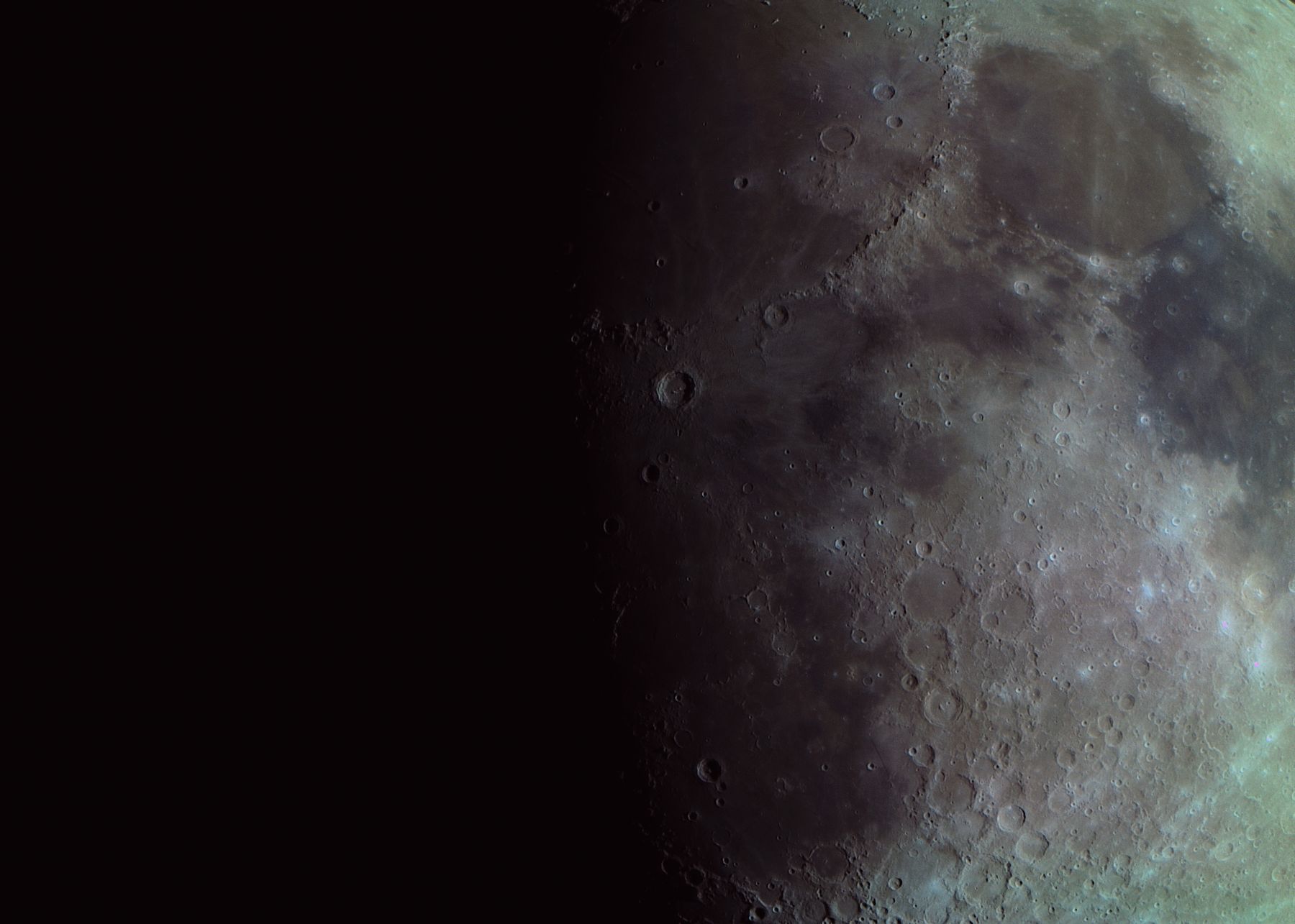
Some permanently shaded parts of lunar pits may avoid almost all of the temperature swing that makes the Moon’s open surface so hard on people and machines. In a 2022 peer-reviewed study, orbital infrared observations showed that two prominent pits remained unusually warm at night. Computer models constrained by those data put the temperature of areas beyond direct sunlight in the Mare Tranquillitatis pit near 290 kelvins, or 17 degrees Celsius.
The 17-degree figure is a modeling result, not a thermometer reading taken inside a lunar cave. NASA’s Diviner radiometer measured thermal radiation from orbit, but the pit was smaller than one detector footprint and a cave beneath an overhang would be hidden from view. The researchers inferred pit-floor temperatures from the mixed signal, tested models against those observations, then calculated the conditions in the permanently shaded recess.
This is one study, not settled consensus. It gives a physically grounded estimate for a specific, well-studied pit near the lunar equator. It does not establish that every lunar pit, or every part of this one, stays at room temperature.
The open surface endures a month-long cycle
The Moon’s solar day, measured from one local noon to the next, lasts about 29.5 Earth days. At many locations that means nearly two weeks of sunlight and another two weeks of darkness. NASA gives about 127 degrees Celsius in sunlight and minus 173 degrees Celsius in darkness to illustrate the range on exposed ground.
Those endpoints are not universal temperatures. Slope, latitude, soil properties, local time and shadow all matter. But they capture the engineering problem: a surface base must tolerate long heating followed by long radiative cooling. ScienceBlog’s earlier explanation of the lunar day-night cycle covers why the timing is so unlike an Earth day.
There is no substantial lunar atmosphere to spread heat between day and night. Sunlit soil absorbs energy, while dark ground loses energy to space. Rock and regolith have some thermal inertia, but the near-surface layer does not preserve daytime warmth through the lunar night.
A deep pit rewrites that energy budget through geometry alone.
What Diviner could see from orbit
The study in Geophysical Research Letters, led by UCLA planetary scientist Tyler Horvath, analyzed the Mare Tranquillitatis and Mare Ingenii pits using the Diviner Lunar Radiometer aboard NASA’s Lunar Reconnaissance Orbiter. Diviner records reflected sunlight and thermal infrared emission across nine spectral channels.
From an orbital altitude of 50 kilometers, one Diviner field of view spans roughly 160 by 320 meters. The Tranquillitatis opening is only about 100 meters across and about 100 meters deep. The detector therefore saw the pit and surrounding terrain blended together, rather than a clean temperature map of the hole.
Horvath’s team modeled the detector’s response and the colder background around the pit to recover the warm component inside each pixel. In 19 nighttime observations, the best-fitting pit-floor temperatures mostly fell between 250 and 290 kelvins, or roughly minus 23 to 17 degrees Celsius. They remained more than 100 kelvins above the nearby surface late in the lunar night.
The thermal models included the approximate pit shape derived from camera images, the properties of exposed rock and insulating regolith, changing sunlight, heat conducted through the ground, and infrared energy exchanged among the walls and floor. Models of several plausible floor materials and cave depths were then compared with the orbital measurements.
This combination is stronger than an unconstrained simulation, but it remains indirect. Diviner cannot spatially resolve the pit, and its observations do not provide a temperature reading from behind the overhang.
Why permanent shade there is mild, not frigid
Permanent shadow is often associated with the intensely cold craters near the lunar poles. The shaded recess at Mare Tranquillitatis is a different thermal environment. It lies only about eight degrees north of the equator, and the surfaces around its opening receive abundant solar energy over a lunar month.
Sunlight does not reach beneath the overhang, but warmer walls and floor surfaces nearer the opening radiate infrared energy inward. Inside a sufficiently large cavity with a relatively small opening, that energy is absorbed and reradiated among the surfaces many times before it can escape to space. The system approaches the radiative equilibrium of a blackbody cavity.
In the team’s two-dimensional equilibrium model, regions that the Sun could not illuminate directly remained near 290 kelvins with less than 1 degree Celsius of variation over a lunar day. At the same time, modeled sunlit regolith on the pit floor could exceed 420 kelvins, or about 147 degrees Celsius. The useful thermal refuge is therefore the deeply shaded zone, not the rim and not necessarily the entire pit floor.
The poorly conducting regolith above a cave creates another complication for remote sensing. The paper calculated that even a warm void below ground would raise the surface temperature above it by only about 0.1 kelvin. An infrared instrument in orbit can detect a pit’s warm nighttime mixture, but heat alone does not disclose whether a long passage continues underground.
There is now radar evidence for a passage
At the time of the thermal study, camera images showed an overhang at the Tranquillitatis pit, but the extent of any cave behind it remained uncertain. The Lunar Reconnaissance Orbiter Camera team’s pit-morphology study, published the same year, documented steep walls, collapse debris and overhangs while emphasizing that hidden spaces were difficult to map from overhead images.
A different line of evidence arrived in 2024. Leonardo Carrer and colleagues reanalyzed Mini-RF radar observations collected by the Lunar Reconnaissance Orbiter in 2010. Their Nature Astronomy paper found that part of the radar return from Mare Tranquillitatis is best explained by a subsurface cave conduit extending tens of meters beyond the pit wall.
The radar result strengthens the case that this pit opens into an accessible passage. It does not independently confirm the 17-degree estimate, because radar addressed geometry rather than heat. Taken together, one paper constrains the pit’s thermal environment while the other supports the cave-shaped space to which the model could apply.
They still do not amount to a complete site survey.
What 17°C would change for a lunar base
Thermal control consumes mass, power and design margin. Electronics, batteries, seals, pressure vessels and structural joints must be protected from temperatures outside their operating limits. Repeated heating and cooling also make materials expand and contract, placing stress on connections and interfaces.
A location that varies by less than a degree around 17 degrees Celsius would remove most of the external thermal cycle. Compared with exposed surface equipment facing hundreds of degrees of variation, a sheltered habitat could need far less energy for heating through the lunar night and less capacity to reject solar heat during the day. That is the basis for describing the reduction as dramatic.
Stable surroundings would not eliminate thermal-control hardware. People, computers, lights and life-support equipment generate heat that a pressurized habitat must remove. A cave is also a vacuum filled with abrasive dust and uncharacterized rock, not a ready-made room. Any base would still need pressure, air, power, illumination, communications, fire safety and redundant environmental controls.
Access may be one of the hardest problems. The Tranquillitatis pit is about as deep as it is wide, its floor contains collapse debris, and its walls include steep or overhanging sections. Before placing equipment below, mission planners would need detailed maps, rock-strength measurements and a safe way to move people and cargo between the surface and the protected zone.
There are potential benefits beyond temperature. Rock overhead could reduce exposure to solar radiation, galactic cosmic rays and micrometeorites. The amount of shielding would depend on the thickness and composition of the roof, so the protection cannot be assigned a reliable number from orbital imagery alone.
One pit cannot stand in for all lunar caves
Latitude and shape determine what permanent shade means. At the poles, some open crater floors receive so little direct or indirect energy that they become cold enough to preserve water ice. An enclosed pit at a similar latitude may behave differently because its walls exchange infrared radiation efficiently.
A 2023 three-dimensional modeling study led by A. X. Wilcoski examined pits and hypothetical caves across several latitudes and geometries. It found that many high-latitude pits would be warmer than nearby crater shadows and poor cold traps for ice. Some special configurations could remain cold enough, but enclosure alone did not guarantee it.
That later work does not overturn the Tranquillitatis estimate. It shows why the estimate should not be copied from one pit to another without accounting for sunlight, latitude, opening size and internal geometry.
The next decisive measurements must come from inside. A rover could record temperature through a full lunar day, map the passage with lidar or radar, measure radiation, examine the floor and test the stability of the roof. Orbital data have narrowed the possibilities enough to make such a mission useful; only local instruments can establish the conditions a base would actually inherit.