

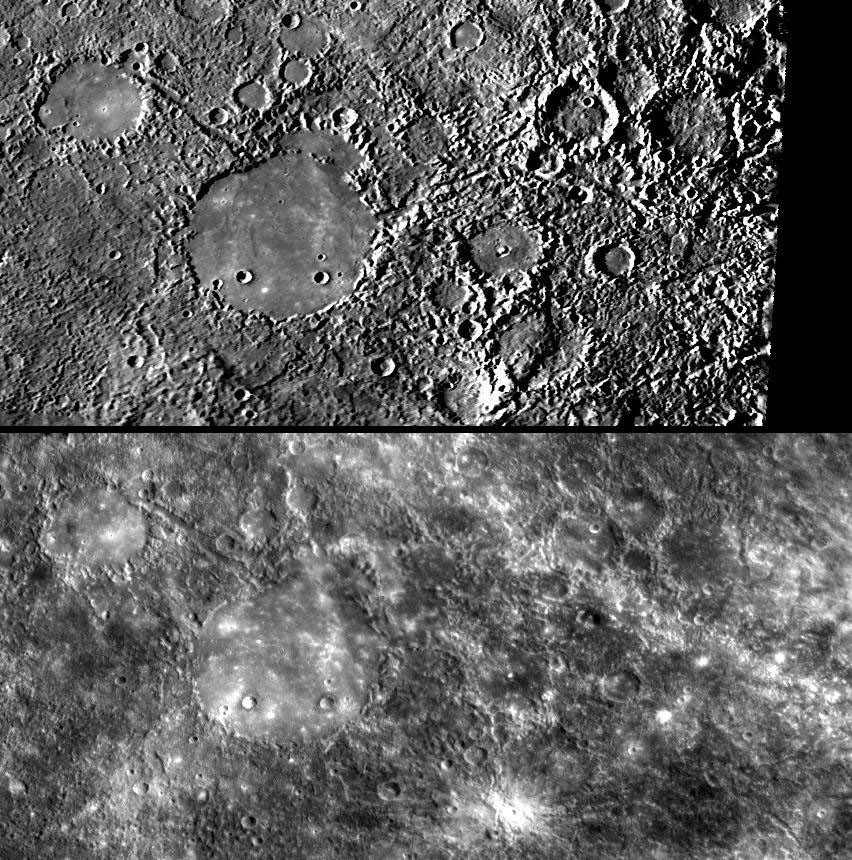
Mercury looks almost designed to make the word “habitable” sound absurd. The planet has no substantial atmosphere to move heat around, its sunlit surface can reach 430°C, and temperatures on the night side can fall to −180°C.
But habitability is not always a statement about the surface seen today. A 2020 analysis of data returned by NASA’s MESSENGER spacecraft argued that parts of Mercury’s ancient upper crust once held a thick layer rich in material that could vaporise or otherwise escape. The authors then considered whether that layer might have included hydrated minerals, ice and organic compounds.
That final step is intriguing, but it is also the most uncertain one. MESSENGER did not detect a buried Mercurian aquifer, did not identify organics in the chaotic terrains, and did not find a biosignature. The paper inferred a lost volatile-rich layer from geology, proposed several possible compositions, and suggested that some mixtures could briefly have supported water and chemistry underground.
Mercury’s extremes are surface conditions
Mercury’s thermal contrast comes from its proximity to the Sun, slow rotation and lack of an insulating atmosphere. A solar day lasts 176 Earth days, giving the surface a long time to heat under sunlight and cool when darkness arrives.
NASA’s Mercury overview lists daytime highs of about 800°F, or 430°C, and night-time lows near −290°F, or −180°C. Those are extremes across different places and times, not the temperature of every point on Mercury.
The planet is more accurately described as almost airless than completely airless. It possesses an extremely thin exosphere of atoms knocked from the surface by solar-wind particles and meteoroid impacts. That exosphere is far too tenuous to behave like Earth’s atmosphere or smooth out the day-night temperature swing.
Subsurface rock is different. Even a modest covering can damp daily temperature oscillations, while deeper material is controlled more by heat flowing from the interior. The question raised by the study was therefore not whether microbes could sit on Mercury’s exposed equator. It was whether buried volatile-bearing material could once have encountered local conditions less hostile than the modern surface.
MESSENGER overturned the volatile-poor picture
Older accounts of Mercury’s formation often invoked intense heating. The planet’s large metallic core seemed compatible with scenarios in which a giant impact or the young Sun removed much of its rocky exterior. Those scenarios appeared likely to remove easily vaporised substances too.
MESSENGER complicated that story. Its X-ray and gamma-ray measurements found surprisingly high surface abundances of sulfur, chlorine, potassium and other moderately volatile elements. Mercury formed under strongly reducing, oxygen-poor chemical conditions, but it was not simply baked dry of everything volatile.
The spacecraft also strengthened the case for water ice inside permanently shadowed polar craters. Sunlight never reaches the deepest parts of those cold traps, allowing temperatures low enough for ice to survive despite Mercury’s scorching daytime maximum.
In 2012, NASA reported converging radar, neutron and laser-altimeter evidence that water ice dominates many north-polar deposits. Most of the ice appeared covered by unusually dark material consistent with complex organic compounds delivered by comets or volatile-rich asteroids. “Consistent with” remains important: MESSENGER did not scoop up and chemically analyse that dark layer.
Hollows showed that material was still being lost
Another surprise was a population of bright, shallow, irregular depressions that the MESSENGER team named hollows. They occur across a wide range of latitudes and often cluster on crater floors, walls and central peaks where impacts have exposed material from depth.
Many hollows have bright interiors and halos, lack small superposed craters and appear young compared with the landscapes around them. Their shape does not fit erosion by rain or wind because Mercury has neither. The leading family of explanations instead involves the loss of an unstable component from near-surface rock.
NASA’s review of the hollows stresses that their precise cause remains unresolved. Heat, solar-wind bombardment and impacts may expose or remove volatile-bearing material, leaving a porous lag and a depression behind.
Hollows established that volatile loss could sculpt Mercury on a scale of tens of metres. They did not reveal how thick volatile-bearing zones might be or whether such material was distributed through larger parts of the crust. For that, researchers turned to a far more extensive ruined landscape.
The “weird terrain” had an old explanation
During its 1974 flybys, Mariner 10 photographed a vast field of knobs, grooves and broken crater remnants on the side of Mercury opposite the Caloris basin. The region became known informally as weird terrain and more formally as hilly and lineated or chaotic terrain.
Caloris is a roughly 1,550-kilometre impact basin. For decades, the leading explanation held that the collision sent seismic waves around Mercury, concentrating energy near the antipode, the point directly opposite the impact. Violent shaking, landslides and falling ejecta could then have disrupted the landscape.
That interpretation had an appealing geometry: giant impact on one side, wrecked ground on the other. MESSENGER supplied the higher-resolution images and laser-altimeter topography needed to test whether the landforms actually recorded one ancient catastrophe.
The 2020 study in Scientific Reports, led by J. Alexis P. Rodriguez of the Planetary Science Institute, mapped the Caloris-antipodal terrain in detail. The team compared surviving crater shapes, elevation changes, grooves, later plains and crater populations across the region.
The landscape’s clock did not match Caloris
Caloris probably formed about 3.8 billion years ago. If its impact had created the chaotic terrain almost immediately, the disruption and the basin should carry broadly matching geological ages.
The researchers instead found that collapse continued much later. Craters unaffected by the degradation indicated that the main activity had mostly ceased about 1.8 billion years ago, roughly two billion years after Caloris formed. Crater-count ages are model-dependent, and the onset and total duration of collapse remain uncertain, but the mismatch is too large to treat as a small dating error.
The geography also weakened a Caloris-only explanation. The team identified smaller examples of chaotic terrain elsewhere on Mercury without suitable impact basins at their antipodes. A single focused shock could not readily explain every occurrence.
The Caloris impact may still matter. It could have left pervasive fractures that later gave escaping material pathways to the surface. The study rejected the impact as the complete, immediate cause of the terrain, not as an event with no role in its later evolution.
Kilometres of missing elevation point to deep loss
The most striking evidence was topographic. Parts of crater rims and intervening plains had lost kilometres of elevation. Yet the knobby remnants sometimes preserved the circular outlines of craters that had occupied the ground before collapse.
That combination suggests removal from below rather than simple burial by ejecta. The landscape subsided and broke apart while retaining a ghost of its earlier organisation. The team estimated that the main chaotic terrain covers roughly 500,000 square kilometres.
The proposed source was a multi-kilometre-thick volatile-rich layer in the upper crust. Heat from intrusive magma bodies could have mobilised part of that material, allowing gases or other volatile components to escape through fractures. The unsupported ground above would then settle gradually, producing grooves, knobs and uneven relief loss.
Later lavas appear to embay some collapsed terrain, linking the episode to a geothermal disturbance while also sealing parts of the volatile-bearing unit. Increasing solar luminosity may have driven slower top-down loss where the layer reached close to the surface. These are elements of a geological model, not directly observed vents connecting a known reservoir to space.
“Volatile-rich” does not identify the lost material
In planetary science, volatile describes behaviour under a set of temperatures and pressures. It is not another word for water. Sulfur compounds, salts, carbon-bearing molecules and several other materials can be volatile under Mercurian conditions.
The paper explicitly notes that MESSENGER’s spectroscopy did not provide diagnostic mineral identifications for the proposed unit. Chemical measurements constrain what is plausible, but they do not turn the vanished material into a measured recipe.
Under Mercury’s highly reducing conditions, sulfides are strong candidates. Some visible and near-infrared spectra of hollows have been interpreted as indicating magnesium sulfide, although the authors argued that refractory magnesium sulfide may be a residue left after a more volatile component escaped.
The origin offers another fork. The volatile-rich material could have formed from Mercury’s own building blocks and internal differentiation. Alternatively, a later veneer of carbonaceous impactors could have contributed chlorides, sulfates, carbonates, salt hydrates, hydrocarbons and clay-like phyllosilicates. The study presented this second family as a possibility needing tests, not a detection.
Water, organics and ice enter as possible constituents
Mercury’s polar deposits prove that water ice can survive on the planet where permanent shadow provides a cold trap. They also show that organic-rich impact material could have reached the innermost planet. Neither fact demonstrates that the ancient chaotic-terrain layer contained the same substances.
The authors nevertheless concluded that early crust could have held mixtures of hydrated phases, organics and ices. Hydrated phases bind water within their mineral structure; they are not underground lakes. Heating can dehydrate them, and solar or magmatic processes can alter organics without leaving an obvious present-day signature.
The distinction separates evidence from reconstruction. Evidence includes elemental abundances, polar ice, hollows, kilometres of topographic loss, crater ages and dispersed chaotic terrains. The reconstructed volatile unit explains several of those observations. Its suggested water-bearing and organic components occupy a further, less certain layer of interpretation.
Even the known polar organics are inferred remotely. NASA’s end-of-mission assessment of MESSENGER described the dark cover over polar ice as supporting delivery of organic compounds from the outer Solar System. It did not equate those cold-trap deposits with the non-polar crust examined in the chaotic-terrain paper.
A habitable niche requires more than ingredients
Habitability usually requires liquid water, useful chemical energy, essential elements and conditions that persist long enough for relevant chemistry. A mixture containing ice, hydrated minerals and organics supplies possibilities, not a functioning environment.
A buried volatile layer could be insulated from Mercury’s daily surface extremes. If magmatic heat warmed local ice or released water from minerals without immediately boiling everything away, short-lived pockets of liquid or brine might have formed. Rock-water reactions could provide chemical gradients.
But the study did not calculate the temperature, pressure, salinity or lifetime of a confirmed pocket. It did not show that liquid water existed continuously, identify a metabolism that could operate there, or search for life. It did not mean Mercury had life. The phrase “metastable and potentially habitable conditions” was a speculative implication of the geological model.
“Transient niches” is therefore the right scale of claim. It means local environments might episodically have crossed a habitability threshold beneath the surface. It does not turn Mercury into an ancient ocean world, and it does not show that biology ever used the opportunity.
The next test is mineralogical, not biological
The most useful next step is to establish what Mercury’s volatile-bearing units are made of. Better compositional maps could test whether hollows, low-reflectance material and chaotic terrains share minerals or chemical residues. Improved topography and thermal models could refine how much material vanished and what heat source drove the loss.
A future lander would be especially valuable because orbital spectra struggle to identify minerals on Mercury’s dark, space-weathered surface. Sampling exposed material in or near a hollow could separate sulfides from salts, hydrated phases and carbon-bearing compounds. No such sample exists today.
The robust conclusion is geological. Mercury retained far more volatile material than its position near the Sun once seemed to permit, and large landscapes may record gradual collapse above volatile-rich crust extending to considerable depth.
The habitability claim begins after that conclusion. It asks what the missing material was, whether water ever became liquid, and how long sheltered conditions lasted. Those are legitimate questions raised by MESSENGER’s data, but they remain questions. Mercury’s underground niches are possible history, not detected habitats.