

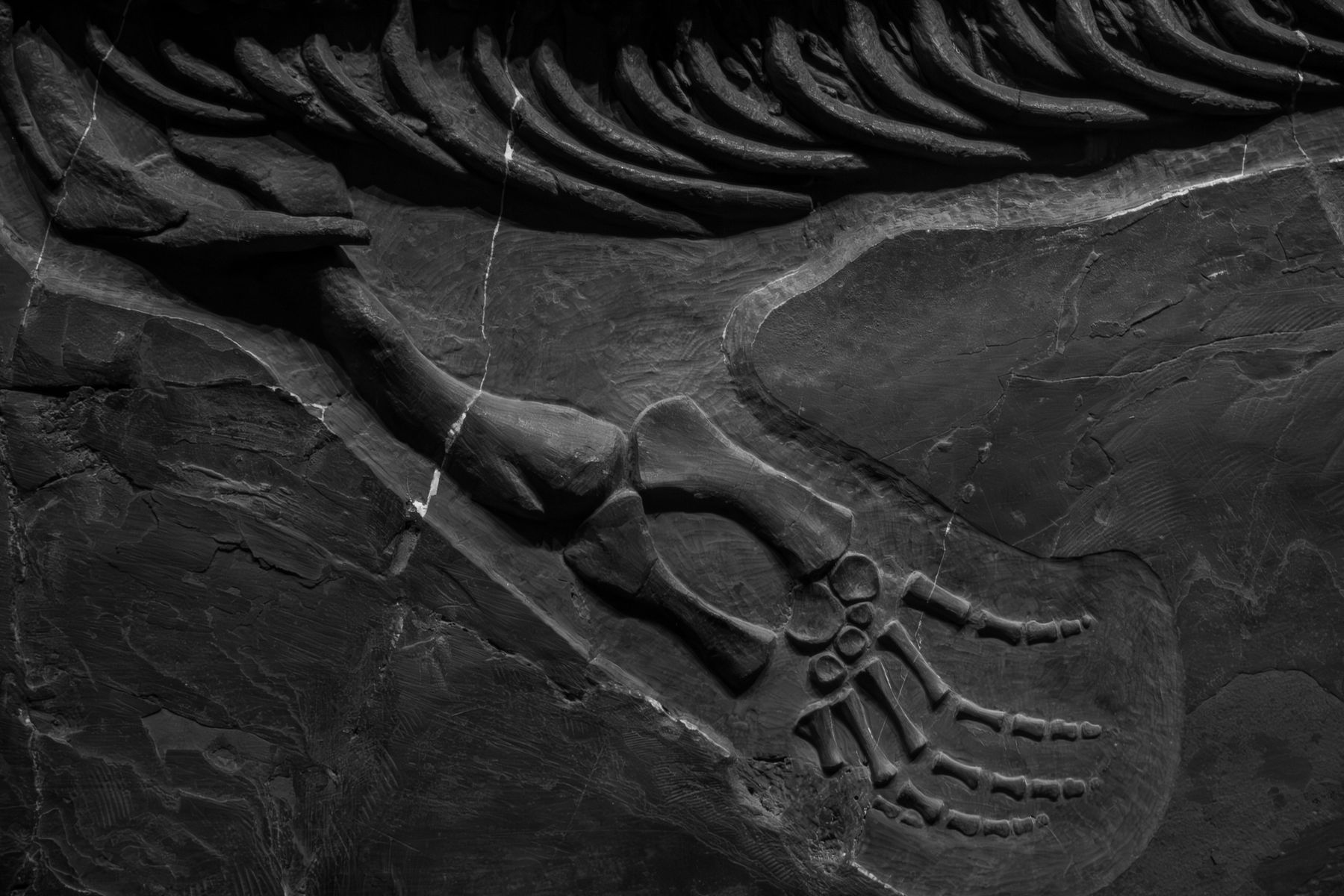
For more than three decades, one of dinosaur paleontology’s most stubborn arguments revolved around a small skull found in Montana in 1942. Was it the adult skull of a distinct predator called Nanotyrannus lancensis, or merely the narrow, lightly built skull of a young Tyrannosaurus rex?
The difference was much larger than a label. If the skull came from a juvenile T. rex, it offered a rare window into how the world’s most famous tyrannosaur transformed as it grew. If it belonged to an adult Nanotyrannus, then the last dinosaur ecosystems of North America supported two very different tyrannosaur-shaped predators at the same time.
Within exactly five weeks in late 2025, independent teams reached the same basic answer by examining different fossils and different bones. Both found evidence of maturity. Nanotyrannus was not simply a teenage T. rex.
A name caught between age and identity
The original specimen, CMNH 7541, was collected during a Cleveland Museum of Natural History expedition to the Hell Creek Formation. It consists chiefly of a beautifully preserved skull and associated throat bones. Charles Gilmore initially named it Gorgosaurus lancensis in 1946. In 1988, another team judged it distinctive enough to establish the genus Nanotyrannus, meaning “tiny tyrant.”
The skull was far smaller and more lightly constructed than that of a large T. rex. It was long and low, contained more teeth and showed fused bones that its describers regarded as signs of adulthood. Yet interpreting age from dinosaur anatomy is treacherous. Young animals are not scaled-down adults, and tyrannosaurs changed dramatically through adolescence.
Young T. rex individuals had narrower heads, more gracile bodies and proportionally longer legs than mature adults. As additional specimens emerged, many specialists concluded that the supposed differences of Nanotyrannus simply captured an earlier stage in that transformation.
A 2020 study in Science Advances appeared to strengthen the juvenile interpretation. Bone tissue from two famous small-bodied specimens, including “Jane,” showed active growth and no external fundamental system, the tightly packed outer growth marks associated with an animal approaching its final size. The authors argued that the fossils represented teenage T. rex individuals occupying a different ecological niche from adults.
But immaturity in those two animals could not, by itself, prove that every small tyrannosaur from Hell Creek belonged to T. rex. The unresolved question was whether any Nanotyrannus-like specimen had reached adulthood without becoming enormous.
The Dueling Dinosaurs supplied a nearly complete body
The first decisive 2025 evidence came from a celebrated fossil known as the Dueling Dinosaurs. Discovered in Montana in 2006, it preserves a small tyrannosaur and a Triceratops in the same block of sediment. Their close burial inspired the idea that they died fighting, although the association alone cannot prove the final moments of either animal.
The tyrannosaur, catalogued as NCSM 40000, preserved far more of the skeleton than the isolated Cleveland skull. In a Nature paper published online on October 30, 2025, Lindsay Zanno and James Napoli combined comparative anatomy, limb-bone histology, spinal fusion, growth modelling and a new evolutionary dataset.
Growth rings indicated that the animal was about 20 years old. Its rate of growth had slowed sharply, and parts of its vertebral column were approaching full fusion. The authors described it as near somatic maturity, meaning it was close to its adult body size even if some skeletal development was not absolutely complete.
That adult size was nothing like a full-grown T. rex. The researchers estimated a mass around 700 kilograms, approximately one-tenth that of a large adult T. rex, and a body about half as long. To turn into T. rex, the animal would have needed an unprecedented late growth surge accompanied by the reversal of multiple anatomical features.
Its differences included proportionally larger forelimbs and hands, more teeth, fewer tail vertebrae, and distinct patterns in skull nerves and sinuses. Some of those traits form early in development and are not expected to switch wholesale with age. Zanno and Napoli identified the skeleton as mature Nanotyrannus lancensis.
A tiny throat bone tested the original skull
The Nature study answered whether one remarkably complete Nanotyrannus-like animal was nearly grown. It did not directly determine the age of CMNH 7541, the holotype that anchors the name Nanotyrannus lancensis. In taxonomy, that distinction matters. Similarity to another skeleton is persuasive, but the name ultimately follows its defining specimen.
A second team led by Christopher Griffin found a way to age the holotype itself. Stored beside the Cleveland skull was a slender ceratobranchial, part of the hyoid apparatus that supported tissues in the throat. Long bones are normally preferred for dinosaur growth studies, but no limb bones from this individual had been found.
The researchers first had to establish that hyoid tissue records age reliably. They examined equivalent bones from living alligators, caimans and ostriches, as well as hyoids from T. rex, Allosaurus, Coelophysis and other dinosaurs. The microscopic signals agreed with maturity estimates based on more familiar bones.
When the team sectioned the Nanotyrannus hyoid, it found an external fundamental system. These closely spaced lines near the outer edge form when bone growth has slowed almost to a stop. The animal represented by the skull was approaching or had reached skeletal maturity.
The resulting Science paper appeared online on December 4, 2025, exactly 35 days after the Nature study. A full-grown animal with that small, distinctive skull could not be an adolescent waiting to develop into a giant, deep-headed T. rex.
Two studies converged without repeating each other
The timing made the papers look like a coordinated one-two result, but their evidence was genuinely independent. The Nature team studied a newly accessible, articulated skeleton and asked whether its overall growth trajectory and anatomy could lead to T. rex. The Science team examined a different individual, the 1942 holotype, and asked whether a rarely studied throat bone preserved a reliable maturity signal.
One analysis worked from the nearly complete body toward the name. The other worked from the name-bearing skull toward its age. Their convergence is therefore more informative than two teams counting the same rings in the same leg bone.
The Cleveland Museum of Natural History’s account notes that the small hyoid fragment had remained with the skull for almost 80 years. No new expedition was needed to answer the final age question. The crucial evidence was already protected in a collection, waiting for someone to recognize that a throat bone might preserve growth history.
A more crowded predator landscape
The fossils place Nanotyrannus in the same Hell Creek world as T. rex around 67 million years ago, within roughly the final million years before the asteroid impact ended the age of non-avian dinosaurs. That changes the ecological picture. T. rex was not the only medium-to-large tyrannosaur-like predator moving through those floodplains.
Nanotyrannus appears to have been a leaner animal with longer forelimbs, larger grasping hands and a more lightly built skull. T. rex was vastly heavier, with a deep skull and bone-crushing bite. Those contrasts suggest different hunting styles and perhaps different prey, reducing direct competition while still allowing the predators to overlap.
“Hunted alongside” should be read as coexistence in the same ecosystem, not eyewitness-level proof of coordinated hunting or a particular chase. Anatomy can constrain what an animal was capable of doing, but fossils rarely preserve behaviour directly. Even the Dueling Dinosaurs’ close association does not demonstrate beyond doubt that the tyrannosaur and Triceratops killed one another.
Still, the North Carolina Museum of Natural Sciences is on firm ground in describing greater predator diversity near the end of the Cretaceous. A large apex predator and a much smaller, more agile hunter occupied the same broad environment.
Confirmation opens a new set of arguments
The two papers make a strong case that Nanotyrannus lancensis was a mature, distinct animal. They do not settle every classification surrounding it. The Nature study recognized a second species, Nanotyrannus lethaeus, among fossils previously interpreted as young T. rex, and placed Nanotyrannus outside Tyrannosauridae. The Science analysis confirmed the holotype’s maturity but did not independently test every species assignment or the same family-tree placement.
Researchers must now re-examine specimens used to construct T. rex growth curves. Some small tyrannosaurs were unquestionably still growing. The hard part is deciding which are young T. rex, which are Nanotyrannus, and whether the Nanotyrannus sample contains one species or two. A recent ScienceBlog article looks more closely at how the hyoid analysis changed the identity of the Cleveland skull.
The deeper lesson is methodological. Dinosaur growth can imitate taxonomic difference, while incomplete skeletons can hide adulthood. Stronger conclusions arrived only when two unusual records became available: a nearly complete skeleton preserved beside another dinosaur, and a tiny bone that had spent decades in a museum box.
Nanotyrannus did not reappear because the old debate was pointless. It reappeared because paleontology finally obtained two independent ways to separate being small from being young.