

Hold a finger beneath your nostrils and breathe normally. Unless you have just exercised or cleared your nose, the air may feel stronger on one side. The difference is often real, and it may reverse later without you noticing.
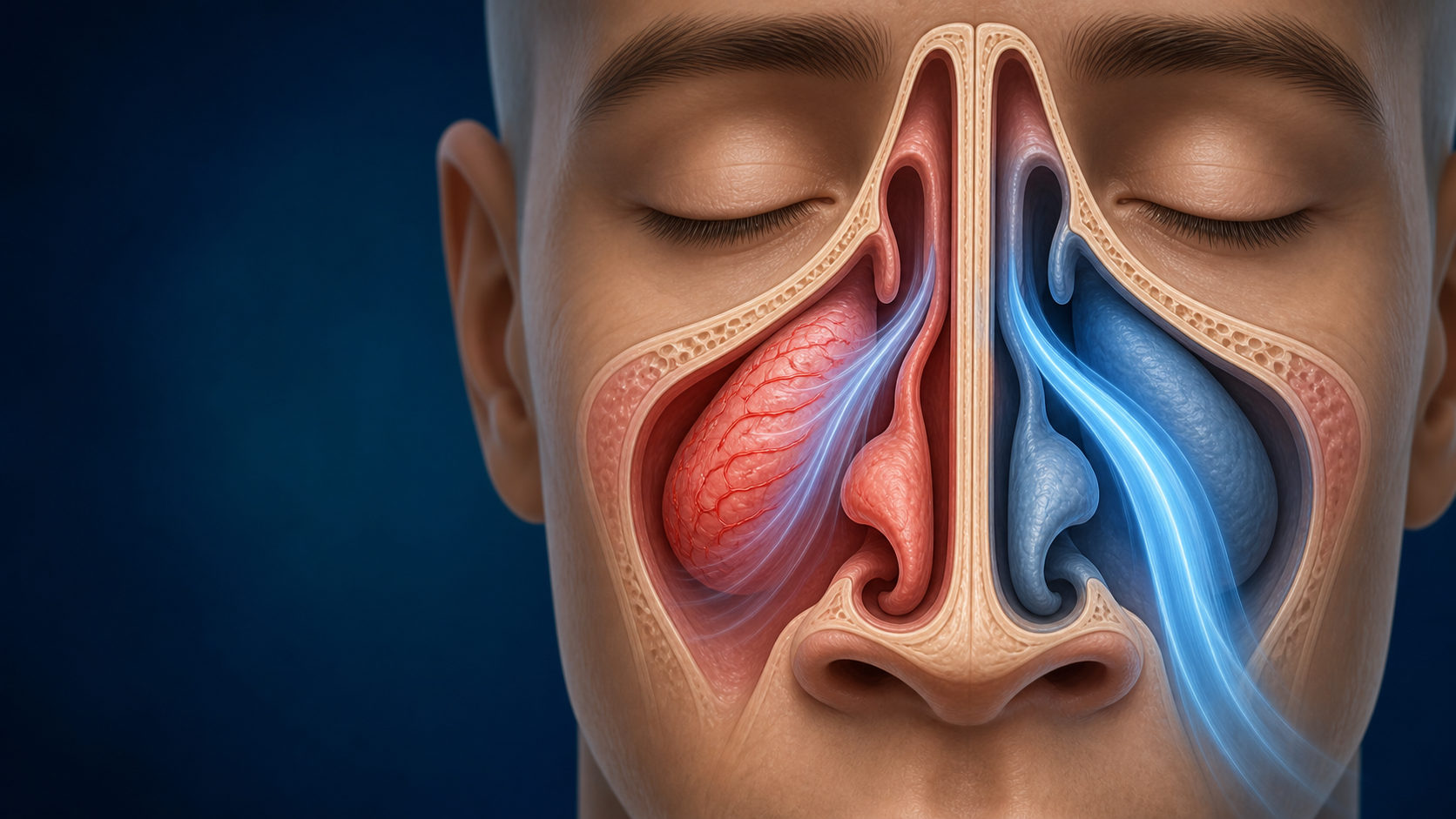
This ordinary rhythm is called the nasal cycle. One side becomes relatively congested while the other decongests, then the balance shifts. The mechanism is not mucus moving from side to side. It is mostly a change in how much blood is held in expandable vascular tissue inside the nose.
The cycle is normal physiology, not a diagnosis, and it is neither perfectly regular nor equally obvious in everyone.
The turbinates are not fixed shelves
Inside each nasal passage are curved bony projections called turbinates, or nasal conchae. They increase the surface area available to warm, humidify and filter incoming air. The inferior turbinate, the largest and lowest of the three main pairs, has an especially thick covering of mucosa.
That covering includes a submucosal layer of erectile tissue containing venous sinusoids. As the NCBI’s anatomy overview explains, these blood-holding spaces can swell or shrink, changing the turbinate’s volume and the resistance of the airway around it. Similar vascular tissue is present toward the front of the nasal septum.
“Erectile” is therefore an anatomical description, not a metaphor. When the venous spaces on one side hold more blood, the lining thickens and leaves less room for air. On the other side, vasoconstriction reduces the tissue volume and opens the passage. The narrower side is not necessarily sealed; it simply carries a smaller share of the total flow.
Most people do not feel this as a serious interruption because the two passages compensate for one another. As resistance rises on one side and falls on the other, total nasal airflow can remain relatively steady. The asymmetry often becomes obvious only when someone deliberately compares the two nostrils, lies down, or develops additional swelling from a cold or allergy.
A cycle can last minutes or hours
The title’s “hours later” captures the usual scale without promising a clock. A 2018 comprehensive review placed the length of a phase between about 30 minutes and six hours. It found that a recognizable nasal cycle occurs in roughly 70 to 80 percent of healthy adults, while a perfectly reciprocal and periodic pattern is much less common.
That distinction matters. Textbook diagrams often imply that airflow crosses over neatly from left to right at fixed intervals. Real recordings include asymmetric phases, irregular switches and periods when both sides change together.
In a 2016 study of 33 healthy adults, continuous 24-hour recordings produced average dominance periods of 2.63 hours for the left nostril and 2.17 hours for the right. During sleep, the mean cycle was longer, about 4.5 hours, compared with roughly two hours while awake. The sample was small, so those averages describe the group rather than a schedule every nose follows.
Autonomic signals adjust the blood vessels
The sympathetic and parasympathetic branches of the autonomic nervous system help control the nasal vasculature. Sympathetic signalling constricts vessels and encourages decongestion. Parasympathetic influence favours vasodilation and secretion. Differences between the two sides can therefore create the alternating resistance pattern.
The plumbing is better understood than the pacemaker. A detailed review of the nasal erectile apparatus describes arteriovenous connections, expandable sinusoids and small “throttle” veins that regulate how blood enters and leaves the mucosa. By contrast, the full neural control system remains uncertain. The cycle can persist after some nerve pathways are interrupted, suggesting that no single switch explains it.
Research has also reported left-right differences in the expression of biological-clock genes in nasal tissue. The authors of that 2018 study proposed that local timing mechanisms might contribute, but this does not establish that clock genes are the master controller.
Rolling onto your side can change the pattern
Body position can alter which nostril carries more air. In the 24-hour study, lying on one side was associated with greater flow through the opposite nostril. This helps explain why nasal stuffiness can seem to migrate when someone turns over in bed.
Exercise, sleep, temperature, hormones, inflammation and some medicines can also alter the size of the nasal lining. These effects may strengthen, weaken or temporarily override the underlying rhythm. A cold or allergy does not create the nasal cycle, but swollen mucosa can make a normal asymmetry far easier to notice.
The cycle is not a new observation. In a 1977 Mayo Clinic Proceedings study, researchers measured 50 healthy people at 15-minute intervals for about seven hours and found a clearly defined alternating cycle in 72 percent. The phenomenon itself was described in medical literature in the nineteenth century.
Its purpose is plausible, not settled
The turbinates condition the air before it reaches the lungs. One proposal is that alternating the higher-flow side lets the relatively congested lining recover moisture and carry out mucociliary clearance while the other passage handles more ventilation. Another is that different flow rates alter how odor molecules are deposited, potentially broadening what the nose detects.
Both ideas have experimental support, but neither closes the question. The 2018 review concluded that understanding of the cycle remained limited despite more than a century of study. It is safer to say the alternation changes air conditioning and odor delivery than to assign it one proven evolutionary purpose.
ScienceBlog has previously covered research showing that a person’s broader breathing pattern can be surprisingly distinctive. The nasal cycle adds another layer of variability: even within the same person, the route taken by each breath changes across the day.
A switching nostril is different from a persistently blocked one
Normal nasal cycling changes sides and often passes unnoticed. A nostril that remains obstructed, recurrently bleeds or is accompanied by facial pain belongs to a different question. Allergic or infectious inflammation, a deviated septum, polyps and enlarged turbinates can all interfere with airflow. Persistent or troubling symptoms are better assessed by a clinician than explained away as the cycle.
For an otherwise comfortable nose, however, unequal airflow is usually not evidence that one passage has failed. It reflects an airway made from living, vascular tissue rather than two rigid tubes. One side quietly narrows, the other takes more of the air, and later the balance changes again.