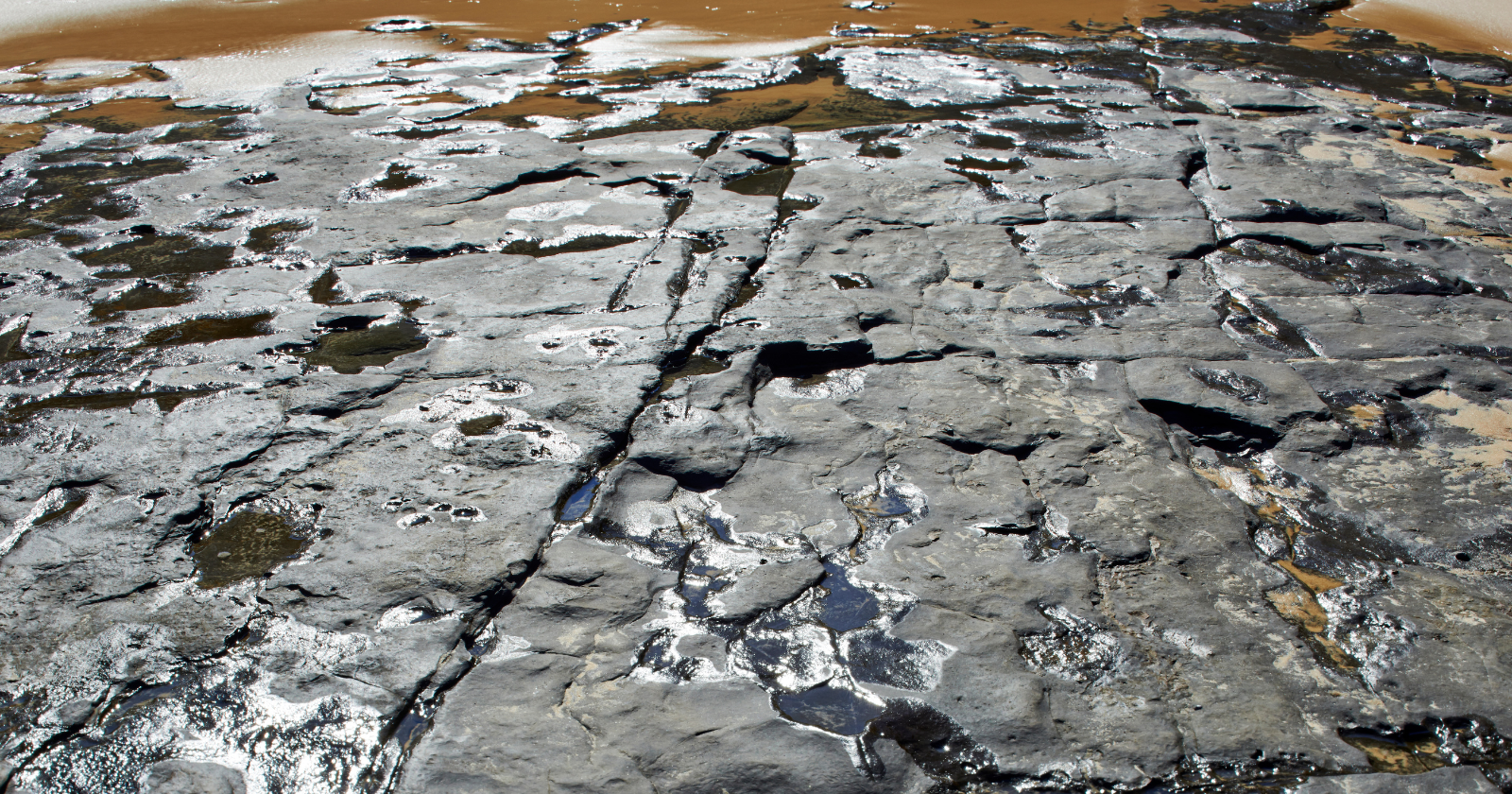
Somewhere under northern Ontario, a crack in the rock is weeping brine that has never seen the sun.
It smells musty and faintly sulphurous. It is thick with salt, and it has been sealed inside the Canadian Shield since long before anything on this planet had a spine or a leaf. Miners walk past it on the way to the ore. Geochemists have spent decades walking towards it.
The site is Kidd Creek, a copper, zinc and silver mine near Timmins that drops more than three kilometres into volcanic rock that was once ocean floor, roughly 2.7 billion years ago. Barbara Sherwood Lollar of the University of Toronto first went underground there in 1992, and as Maclean’s has documented, the method for finding the ancient water is gloriously low-tech. You trace the smell through the tunnels until it leads you to the exact fracture where the stuff is seeping out.
What the rock had been keeping
In 2013, Greg Holland and colleagues put numbers to it in Nature. Fracture water at 2.4 kilometres carried the most radiogenic helium, neon and argon signatures ever measured in groundwater. Its xenon told a stranger story. The gas set a minimum average isolation time of about 1.5 billion years, and left a chemical fingerprint traceable to fluids moving through the rock around 2.64 billion years ago, when the ore body itself was forming.
Then the mine went deeper, and the science went with it.
By late 2016 the team was sampling fractures near three kilometres down and dating that water to roughly two billion years, a result Oliver Warr and Sherwood Lollar presented at the American Geophysical Union meeting in San Francisco. Warr told CBC News that the isotope signals were unlike anything measured anywhere else, and that water left alone for that long holds information about the ancient atmosphere which nothing at the surface has preserved. He also volunteered that it runs up to eight times saltier than seawater and would not kill you, though drinking it would be an appalling experience.
How you date water nobody has seen before
Noble gases do the work. Helium, neon, argon, krypton and xenon accumulate in trapped water over time, some produced by the decay of radioactive elements in the surrounding rock, others carrying faint signatures left by Earth’s early atmosphere. Measure the mix, and you have a residence time. As Sherwood Lollar put it to Maclean’s, the gases accumulate in the trapped water “like passengers getting on a train.”
Volume caught everyone out. This was never a few millilitres locked inside a mineral crystal. It pours from the boreholes at litres per minute under its own pressure, in quantities well beyond what the models had predicted.
Something down there is eating rock
Ancient water with nothing living in it would be a fine curiosity. Put a functioning ecosystem inside it and the stakes climb, which is why the chemistry had to be nailed down first.
Hydrogen is the fuel. It comes from two sources: radiation splitting water molecules apart, and certain minerals reacting with water in a process called serpentinisation. Microbes that live on hydrogen also need something to breathe, and here that turned out to be sulphate. In 2016, Li and co-authors reported in Nature Communications that the dissolved sulphate is manufactured on site, as oxidants generated by that same radiation attack Archaean sulphide minerals in the fracture walls. One process, both halves of the meal.
Evidence of actual residents came later. Cultivation work published in the Geomicrobiology Journal in 2019 recovered sulphate-reducing microbes from the 2.4 kilometre fluids. The Scientist reported it as the first direct confirmation of a resident population, rather than contamination carried down from mining operations. In a 2020 paper in Life, researchers grew salt-loving bacteria on sterile samplers lowered into the boreholes. In 2024, a genomic survey in Communications Earth and Environment found the community dominated by one lineage, informally named Candidatus Frackibacter.
Cell counts run in the thousands per millilitre, which is close to nothing. Life at that depth is idling at the lowest sustainable rate rather than thriving.
Why Mars keeps coming up
Rock of roughly this age and composition makes up a large slice of the continental crust, so Kidd Creek functions less as a freak site than as a keyhole. Sherwood Lollar has argued for years that comparable chemistry could be running under the surface of Mars, where liquid water has vanished from the open ground but not necessarily from the rock beneath it.
That case rests on analogy, and one shield in one country is a thin evidence base for a planet nobody has drilled.
What the Ontario brine settles is a question that used to be purely theoretical. Leave water, rock and radiation alone together for long enough and they will assemble a habitat that never needs sunlight at all. Two billion years was enough here. Mars has had longer.
Correction, 15 September 2026: The excerpt was revised to describe ancient fracture water and its life-supporting chemistry without claiming that researchers found an underground ocean or directly observed ancient living microbes.