

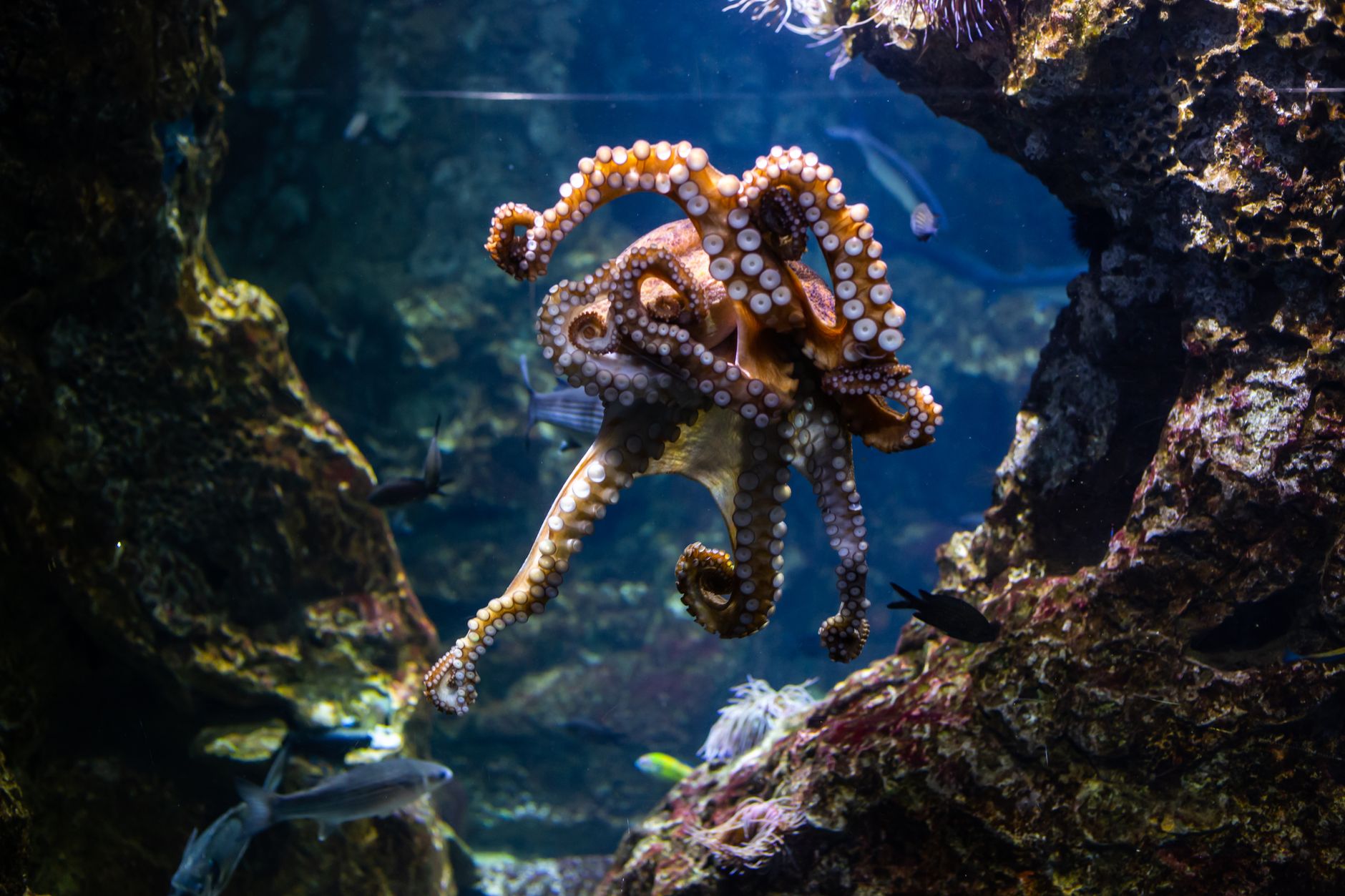
The mirror part is what makes the story memorable. An octopus sees food in a reflection, does not simply attack the glass, and learns to move through the tank toward the real location of the food it cannot directly see.
That is not the same as saying the octopus recognised itself in the mirror.
The Dartmouth work described in public reporting is more specific and, in some ways, more interesting: octopuses in Peter Tse’s lab were reported to learn that a reflected crab was a reflected object, then use that information to find the crab elsewhere in the tank. Time reported the work in 2019 while profiling octopus research and the ethics of octopus farming.
The specific Dartmouth mirror task does not appear, from the public record we could find, to have a peer-reviewed paper of its own. The finding is worth taking seriously, but it should not be read as the final word. What follows is a careful reading of the reported lab result, set beside peer-reviewed work on mirror use and octopus cognition.
Mirror use is not the same as self-recognition
The mirror test has a famous place in animal cognition because it is often used to ask whether an animal can recognise its own body as the body in the reflection. A mark is placed somewhere the animal cannot normally see. If the animal uses the mirror to inspect or touch the mark on itself, researchers may interpret that as evidence of mirror self-recognition.
That is not what the Dartmouth octopus claim is about.
Using a mirror to locate hidden food is a different skill. It asks whether an animal can understand that the image in the mirror corresponds to a real object in a real place outside the mirror. The animal does not need to think, “That is me.” It needs to think something closer to, “That image points to something over there.”
That distinction matters because it keeps the claim from becoming larger than the evidence. A mirror can test self-recognition, but it can also test spatial understanding, learning, object location and the ability to treat reflected information as useful rather than meaningless.
For a human, this is ordinary. We use mirrors to reverse cars, shave, find something behind us, check a room, or see around a corner. But the task is cognitively odd. A mirror image is not where it appears to be. It is a visual event that has to be mapped back into the real world.
What the Dartmouth report described
In Time’s account, Tse said that when octopuses first encounter a mirror, they may run away or try to attack it. That initial response is not surprising. A reflected octopus can look like another animal in the tank.
With experience, the animals reportedly stopped treating the reflection simply as another octopus. Some sat in front of the mirror and groomed. More importantly for the food-location task, Tse’s lab found that with practice the octopuses could use the reflection of a crab to find the actual crab elsewhere in the tank.
That is the narrow claim: learned use of reflected visual information to solve a spatial problem.
It is also why the result is striking if it holds up under fuller publication and replication. Mirror-mediated food finding has been demonstrated in vertebrates. A 2009 Animal Behaviour paper by Donald Broom, Hilana Sena and Kiera Moynihan reported that pigs learned what a mirror image represented and used it to locate hidden food. The pigs that had mirror experience performed differently from pigs without that experience, which tended to search behind the mirror rather than use it as information about another location.
In that sense, the octopus report does not place octopuses in a human category. It places them in a small group of animals that can learn a particular representational trick: the thing in the mirror is not inside the mirror, but it can still tell you where something is.
Why an octopus makes the question different
Octopuses are not mammals with a strange body plan. They are molluscs. Their lineage split from ours deep in animal history, long before brains like ours existed.
That makes their intelligence scientifically awkward in the best way. If a pig uses a mirror, the comparison is still within vertebrates. If an octopus uses a mirror, the comparison jumps across a much deeper evolutionary divide.
The 2015 Nature paper on the California two-spot octopus genome described coleoid cephalopods, the group that includes octopuses, squid and cuttlefish, as active predators with the largest nervous systems among invertebrates. The same paper noted that the octopus nervous system contains nearly half a billion neurons, distributed across the brain, optic lobes and nerve cords in the arms.
That nervous system is not built like ours. Much of an octopus’s neural machinery is involved in arms that can move, taste, touch and explore with a degree of local control that is hard to compare with a vertebrate limb. The animal’s body is soft, flexible and sensory in a way that makes cognition look less like command from a central brain and more like coordination across a living body.
So when an octopus solves a visual-spatial problem, it is not simply performing a mammal-like trick with a smaller mammal-like brain. It is arriving at useful behaviour through a nervous system organised on a different plan.
A separate route to intelligence
This is why octopuses keep unsettling human assumptions about mind.
They open jars, learn visual discriminations, explore objects, change tactics, recognise individual situations and behave in ways that are difficult to reduce to simple reflex. None of that means they think like humans. It may mean almost the opposite: complex behaviour does not require a human-style architecture.
The Nature genome paper made a similar point at the molecular level. It found expansions in gene families related to neural development and organisation, including protocadherins, that had also expanded in vertebrates by independent routes. The authors described this as convergent evolution between cephalopods and vertebrates.
Convergence is the important word. It does not mean octopuses are close to us. It means distant animals can arrive at partly comparable capacities through different evolutionary paths.
Mirror-mediated food finding, if confirmed in the formal literature, would belong in that category. It would not show that octopuses have human-like self-awareness. It would show that a mollusc with an alien body plan can learn to treat a mirror as a source of spatial information.
The gap narrows, but it does not vanish
The title says the finding narrows the gap between us and octopuses. That should be understood carefully.
The gap is still enormous. Humans use language, build institutions, write mathematics and imagine futures across generations. Octopuses live short, mostly solitary lives, solving the practical problems of hunting, hiding, moving and surviving in a body that has no bones and eight highly capable arms.
But the gap narrows in another sense. The old habit was to treat complex cognition as something that climbed a vertebrate ladder toward humans. Octopuses make that ladder look too simple. They are not on our branch, yet they repeatedly show capacities that force researchers to widen the map.
A mirror is a particularly good test of that widening. It takes an everyday object and turns it into a problem about representation. Is the animal reacting to an image, or using the image? Does it search in the mirror, behind the mirror, or in the real space the mirror reveals?
If an octopus learns the last of those, then the experiment is not only about an octopus finding food. It is about a nervous system very different from ours discovering that an image can stand for a hidden place.
What still needs to be shown
The next step is not a bigger headline. It is a cleaner public record.
A peer-reviewed account would need to describe the species, sample size, training procedure, controls, success rates, alternative explanations and individual variation. Did the animals follow reflected visual information, or could they use smell, water movement or previous learning? How quickly did they learn? Did naive octopuses make the same mistakes naive pigs made, such as searching behind the mirror? Did individuals differ sharply?
Those details matter because octopuses are famously variable. One animal may be bold, another cautious. One may explore a setup, another may hide. The intelligence of the species cannot be cleanly read from one dramatic behaviour without the slower work of testing.
Even with those cautions, the reported Dartmouth result is valuable because it asks the right kind of question. It does not ask whether octopuses are secretly little people. It asks how a very different animal can learn to use information about space.
That is where the real interest lies. Half a billion years after our lineages parted, a mirror in a lab tank may show two kinds of distance at once: the evolutionary distance between us and octopuses, and the shorter cognitive distance that appears when both animals can use a reflection to infer what cannot be seen directly.
Sources
- Time: Inside the Race to Build the World’s First Commercial Octopus Farm
- Broom et al., Animal Behaviour: Pigs learn what a mirror image represents and use it to obtain information
- Albertin et al., Nature: The octopus genome and the evolution of cephalopod neural and morphological novelties
- Mather and Kuba, Canadian Journal of Zoology: The cephalopod specialties: complex nervous system, learning, and cognition