

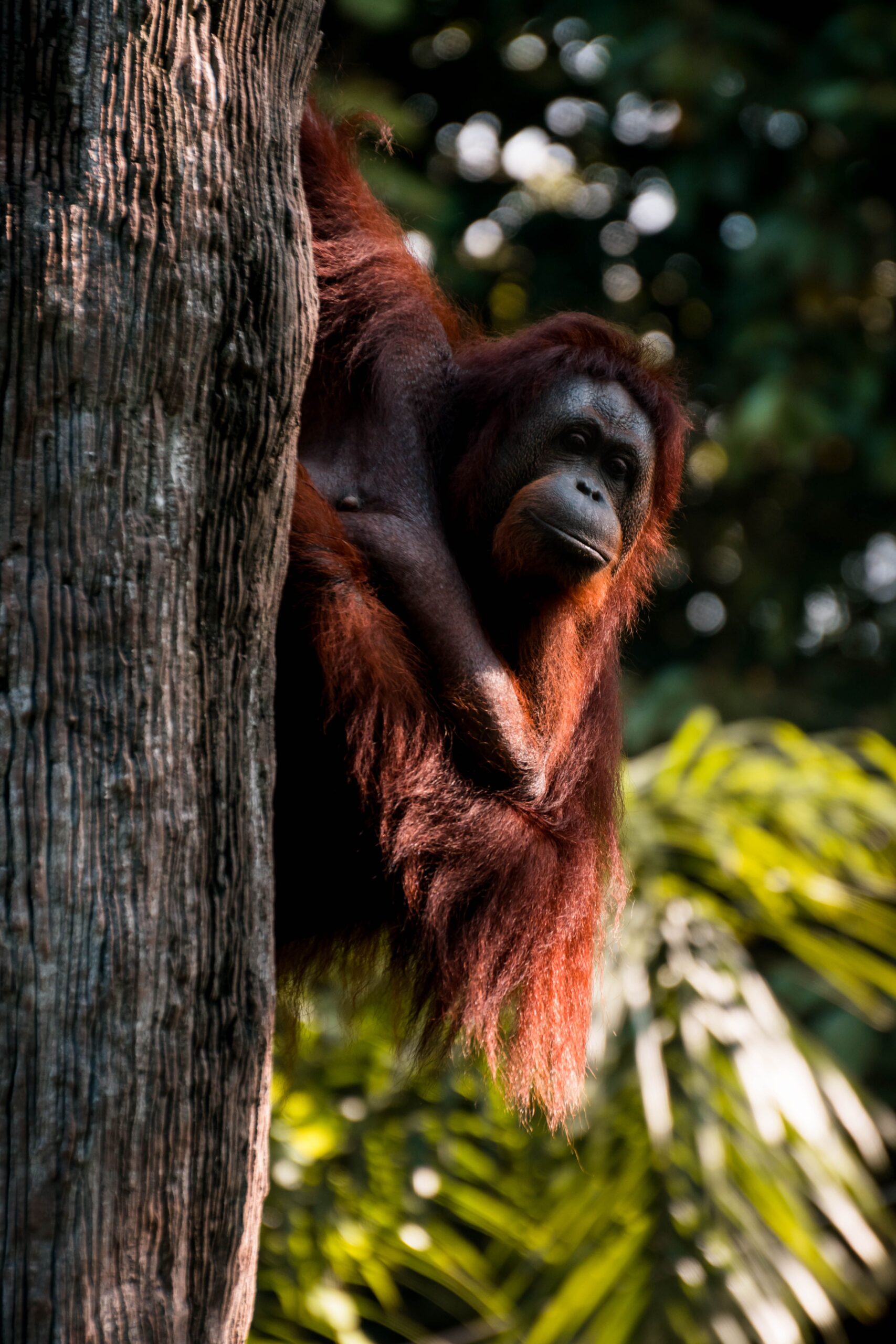
A Bornean orangutan can spend much of a day moving between food trees, selecting fruit, leaves, bark, pith, flowers or sap. If two plants with useful chemistry appear in that day’s diet, the combination could mean many things. Both may be abundant, both may grow along the same route, or the ape may simply like them.
There is also a more provocative possibility: the plants could be serving a therapeutic function together.
A 2026 study in Scientific Reports searched 20 years of wild orangutan feeding records for precisely that pattern. Certain plants with local ethnomedicinal uses repeatedly appeared beside other resources more often than expected if their consumption were statistically independent.
The finding is intriguing because it moves beyond a single dramatic incident. It looks for structure across thousands of ordinary feeding observations. Yet it stops well short of showing an ape diagnosing itself, choosing ingredients for their interaction, or recovering because of them.
What the study found is a set of candidate combinations. Calling them medicine remains a hypothesis to test.
Twenty years became 12,236 feeding events
The records came from a three-by-three-kilometre study area in Sebangau National Park, a peat-swamp forest in Central Kalimantan, Indonesia. The Orangutan Behaviour Project has operated there since 2003, accumulating more than 20,000 hours of focal observation across more than 100 orangutans.
For this analysis, the researchers extracted 12,236 distinct feeding events involving 55 Bornean orangutans on 2,419 days between 2003 and 2023. The animals consumed 202 recorded plant species.
Two-person field teams could follow one focal orangutan for as many as ten consecutive days. A follow began when the animal left its morning nest and ended at its night nest. Feeding was recorded continuously through 2011 and at five-minute intervals thereafter.
The observers noted not only the plant but the part eaten. Leaves, bark and sap are chemically different materials even when they come from the same species, so treating them as interchangeable would blur the question.
The resulting archive was not originally a clinical study. It contained detailed diet and behaviour, but not a systematic diagnosis before every meal or a medical outcome afterward. That distinction shapes everything the later analysis can establish.
“Medicinal” began with Dayak knowledge
To decide which foods merited special attention, the team drew on published ethnobotanical records and interviews with co-authors Hendri Shagara and Iwan Shinyo. Both are long-serving field staff and botanical guides whose knowledge reflects that of local Dayak communities.
The cross-reference found 64 plant species that appeared in the orangutan feeding archive and had reported medicinal significance locally. Researchers then selected 19 resources of interest representing particular parts from nine plant taxa.
The matching rule was deliberately strict. If people used a plant’s leaves in an orally consumed treatment, an orangutan observation qualified only when the ape ate those leaves. A report about an external poultice did not make ingestion of the plant a matching case.
Even so, “documented medicinal properties” does not mean clinical proof of efficacy in an orangutan. Ethnomedicinal use supplies an informed lead. Pharmacology can identify active compounds or laboratory effects. Neither alone establishes the dose, benefit or purpose of a wild ape’s meal.
Taxonomy introduces another caveat. Six of the 19 selected plant-part resources, representing three of the nine taxa, were identified only to genus. Related species can contain different compounds at different concentrations. The authors therefore treat these as candidates, not chemically confirmed ingredients.
One analysis read sequences like sentences
The first statistical method has roots in language research. Multiple distinctive collocation analysis asks whether items occur next to one another more often than expected, much as a linguist might test whether two words form a distinctive phrase.
The researchers ordered each orangutan’s foods by day and sequence. They then generated pairs containing at least one medicinal resource of interest. This method captured the short-timescale structure of feeding bouts, what the paper calls the recipe level.
Across the archive, the analysis produced 16,569 distinct paired combinations. Of those, 324 passed the study’s significance threshold. The strongest association joined Mezzettia parviflora and Fibraurea tinctoria.
That does not necessarily mean an animal mixed the plants in its mouth or ate them simultaneously. It means the ordered records linked the resources more frequently than expected under the analysis. “Combining” here includes structured sequential consumption.
The approach was adapted from methods previously applied to chimpanzee diets. Its advantage is that rare feeding choices can be examined across a long archive rather than waiting for an observer to witness a visibly sick animal choose an obvious remedy.
A second analysis treated each day like a basket
The second method, APRIORI, comes from association-rule or market-basket analysis. A retailer might use it to learn that customers buying items A and B also tend to buy C. Here, a “basket” was an orangutan’s ordered daily food list.
The algorithm returned seven association rules meeting the selected support, confidence and lift thresholds. These involved between two and five resources. The rule with the highest lift connected Alyxia and Willughbeia with F. tinctoria, with a lift of 5.72 and confidence of 62.5 percent.
Lift compares observed co-occurrence with the rate expected from each item’s baseline frequency. A value above one signals positive association. It helps prevent a common food from looking special merely because it appears in many meals.
F. tinctoria was the conspicuous centre of the result. It appeared in every one of the seven APRIORI rules and in 72 percent of the top 25 pairwise associations from the first analysis.
The plant contains berberine, an alkaloid studied for antimicrobial and anti-inflammatory activity. It also has a remarkable independent history: in 2022, a male Sumatran orangutan was observed chewing its leaves and applying the material to a facial wound, which then closed without signs of infection.
That case supports the plant’s relevance to orangutan behaviour, but it does not prove why Bornean orangutans ingested it in the 20-year dataset. Topical use on an injury is different from swallowing a plant as part of a daily diet.
The analysis cannot see intention or recovery
The strongest evidence for animal self-medication normally forms a chain. An individual is ill or injured, selects an unusual substance, receives a plausible dose, and then shows a measurable improvement. Parasite counts, symptoms or healing can help connect behaviour to benefit.
This study did not have that chain. It did not match each candidate combination to illness, test whether healthy and sick animals chose it differently, measure compounds in the eaten portions, or document recovery caused by consumption.
Nor did it test whether several ingredients work better together than separately. Anti-inflammatory, antimicrobial or other activities reported for individual plants do not automatically add up to a safe or effective mixture.
The statistical null is narrower than everyday chance. It asks whether foods co-occurred more than expected from their observed consumption frequencies. It cannot exclude every ecological reason they might travel together through a diet.
Plants growing near each other can be encountered together. Species fruiting in the same season can enter many daily lists together. The researchers lacked fine-scale spatial data and complete phenological records, so they could not build a null model that fully represented co-availability.
Thirteen of the 19 taxa in the leading combinations overlapped with seasonally important foods, suggesting season mattered. On the other hand, ten were not dominant dietary components and only three overlapped with the forest’s highest-density taxa. Simple abundance does not obviously explain the whole pattern.
Orangutans already have a suggestive medical record
The idea that orangutans can use biologically active plants did not begin with this dataset. In Sebangau, adult females have chewed Dracaena cantleyi leaves into a foamy lather and rubbed it onto parts of their bodies.
Laboratory work found that extracts from the leaves inhibited several inflammatory signals, while local people use the plant as a poultice for pain. The published observations were consistent with topical self-treatment, although the animals could not report what they felt.
Other cases include selective plant eating by an injured juvenile and the facial-wound treatment involving F. tinctoria. These rare events show that the general hypothesis is biologically plausible. They do not convert every statistically unusual food pairing into medicine.
The new study asks a different question. Instead of beginning with a visible wound or unusual act, it searches the background diet for repeated organization that observers might otherwise miss.
That strategy can reveal promising plants, but it reverses the usual evidentiary direction. The pattern generates a medical hypothesis; the pattern is not itself its confirmation.
The next test must reconnect diet with health
The value of the work lies in making future research more targeted. Rather than screening hundreds of forest foods without guidance, investigators can concentrate on F. tinctoria, Alyxia, Willughbeia, Gnetum and M. parviflora.
Botanists first need species-level identifications and chemical profiles for the actual plant parts eaten. Laboratory experiments could then compare each resource alone with the combinations, looking for complementary, synergistic or antagonistic effects at realistic doses.
Field teams would ideally record wounds, parasite indicators, changes in appetite and other health measures alongside feeding. If a combination rises when an individual is unwell and falls after recovery, intentional self-treatment becomes a stronger explanation.
Researchers must also map plants and their seasonal availability. That would help distinguish a chosen sequence from two foods that happen to be neighbours in space or time.
None of this diminishes the achievement of the long-term field teams or the importance of Dayak knowledge. Without two decades of patient observation and locally grounded plant identification, the candidate pattern would remain invisible.
The careful conclusion is also the interesting one. Wild orangutans do not eat these plants as though every choice were independent. Their diets contain repeated, structured associations around resources with medicinal promise. Whether that structure amounts to a multi-ingredient treatment is not the answer the study supplies. It is the sharper question the study leaves behind.