

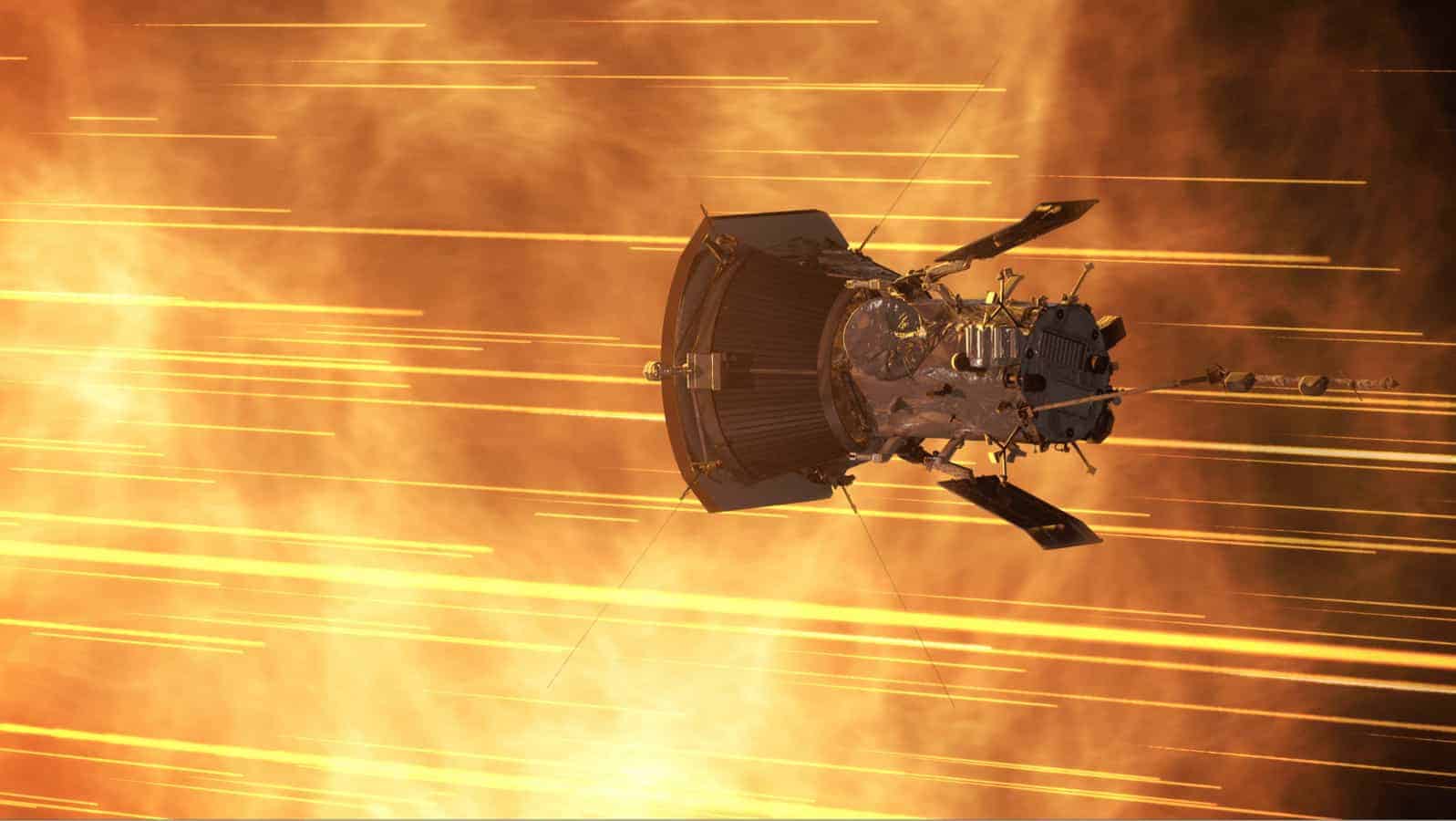
Parker Solar Probe became the fastest human-made object by first arranging to become slower. On December 24, 2024, it passed about 3.8 million miles above the Sun’s visible surface at roughly 430,000 miles per hour, or 692,000 kilometers per hour, relative to the Sun.
There was no enormous engine burn at the closest point. The record was the payoff from a six-year sequence in which seven encounters with Venus removed orbital energy and angular momentum from the probe. That let Parker fall progressively deeper into the Sun’s gravity well, converting more gravitational potential energy into motion on every close pass.
This is easy to misread as an ordinary planetary slingshot. It was almost the reverse. Spacecraft commonly use a moving planet to gain heliocentric speed on the way to the outer Solar System. Parker was routed past Venus on the side that made it lose speed relative to the Sun.
Every spacecraft launched from Earth starts with sideways speed
A rocket sitting on its pad may look stationary, but relative to the Sun it is already racing sideways with Earth at about 67,000 miles per hour. A spacecraft carries that motion with it after launch. Pointing toward the Sun does not make the sideways component disappear.
Without cancelling much of it, the craft misses. It falls inward for a time, curves around the Sun and eventually climbs outward again on another orbit. A direct plunge would require removing most of Earth’s orbital velocity, which is much harder than simply adding enough speed to escape Earth.
NASA describes getting to the Sun as requiring 55 times more energy than getting to Mars. Parker launched on a powerful Delta IV Heavy, aimed partly against Earth’s direction of travel so that the launch could cancel some of the velocity inherited from our planet.
That got the probe moving inward. It did not get it nearly close enough.
Venus became an orbital brake seven times
Parker met Venus on October 3, 2018; December 26, 2019; July 11, 2020; February 20, 2021; October 16, 2021; August 21, 2023; and November 6, 2024. NASA’s chronology of Venus exploration records all seven successful flybys.
A gravity assist is best understood as an exchange, not a free push. Venus was moving around the Sun while its gravity bent Parker’s path. In the planet’s own reference frame, the probe left the encounter at nearly the same speed with which it arrived, but in a different direction. In the Sun’s frame, that redirected velocity amounted to a loss of energy for Parker.
The missing energy went into Venus’s orbit. The planet gained such a minuscule amount that no practical measurement would reveal it, while the effect on the much smaller spacecraft was large.
NASA reported that the first Venus encounter alone reduced Parker’s heliocentric speed by about 7,000 miles per hour, or 10 percent at that point in the flight. It moved the probe’s next closest approach to the Sun inward by about 4 million miles.
Calling this a loss of “sideways motion” is a useful shortcut. More precisely, the encounters changed Parker’s orbital energy and angular momentum. Venus did not pull the spacecraft toward the Sun like a tow truck. It turned Parker onto a new ellipse whose inner end lay closer to the star.
Why slowing down far away makes Parker faster near the Sun
Parker’s orbit is a stretched ellipse. It moves slowest around aphelion, the far end, and fastest around perihelion, the point nearest the Sun. Those two speeds are linked by the energy of the whole orbit, not by a rule saying that a spacecraft must be faster or slower everywhere.
When a Venus flyby slowed Parker near the outer part of its path, the far side could no longer support the same high inner orbit. The next perihelion dropped closer to the Sun. During the inward fall, solar gravity accelerated Parker across a larger change in gravitational potential.
This is the counterintuitive part: a lower speed at the distant end of the ellipse can produce a higher speed at the close end.
NASA’s guide to reading Parker’s orbit plots makes this sequence visible. Each step down in speed near aphelion tightened the orbit; each tighter orbit led to a faster perihelion. The Sun supplied the acceleration, but Venus made the deeper fall possible.
The engines mattered, just not in the obvious way
The headline distinction needs one qualification. Parker could not have reached its trajectory without a rocket. The Delta IV Heavy provided the initial launch energy, and the probe’s onboard thrusters made the precise corrections needed to arrive at Venus on the correct side, at the correct height, at the correct second.
Those onboard burns were steering adjustments rather than the source of the speed record. Before the seventh flyby, Parker fired small directional thrusters for about 17 seconds. The correction changed its velocity by less than one mile per hour but moved the targeted encounter point by roughly 386 miles.
After the final Venus pass, the probe followed the new orbit under gravity. Near the Sun it did not ignite an engine and leap to 692,000 kilometers per hour. It coasted into the fastest portion of an orbit designed over years.
The record depends on where and relative to what
The familiar 692,000-kilometer-per-hour figure is Parker’s speed relative to the Sun around perihelion. Speed always needs a reference frame. It would have a different value relative to Earth, Venus or the center of the Milky Way.
Nor does Parker maintain that pace throughout its orbit. At the December 2024 record point it was covering about 192 kilometers each second. A previous Science Blog explainer put that speed at an Australia-sized distance every 21 seconds. As Parker climbs away from the Sun, however, it gives kinetic energy back and slows.
The probe is also not the fastest spacecraft on an escape path. It remains in a bound solar orbit. Voyager 1 moves much more slowly relative to the Sun, but it has enough energy to continue outward into interstellar space.
NASA confirmed the record after the December 24, 2024 encounter, when Parker came within 3.8 million miles of the visible surface. The agency quotes about 430,000 miles per hour. That converts to roughly 692,000 kilometers per hour, although some NASA mission pages round it to 700,000.
The speed was the price of reaching the science
Parker was not designed as a racing machine. Its instruments were sent inward to measure particles, plasma, magnetic and electric fields, and the young solar wind before those conditions are altered on the long journey to Earth.
Moving so quickly makes each nearest pass brief, while the carbon-composite shield must keep the spacecraft’s instruments protected and pointed away from direct sunlight. The velocity record is therefore not a separate stunt attached to the mission. It is a consequence of working at that depth in the Sun’s gravitational field.
The real engineering achievement was creating the orbit. A powerful launch cancelled part of Earth’s inherited motion. Tiny thruster corrections arranged meetings across six years. Venus then served seven times as an orbital brake.
Only after all that carefully managed slowing could the Sun make Parker the fastest object humans have built.