

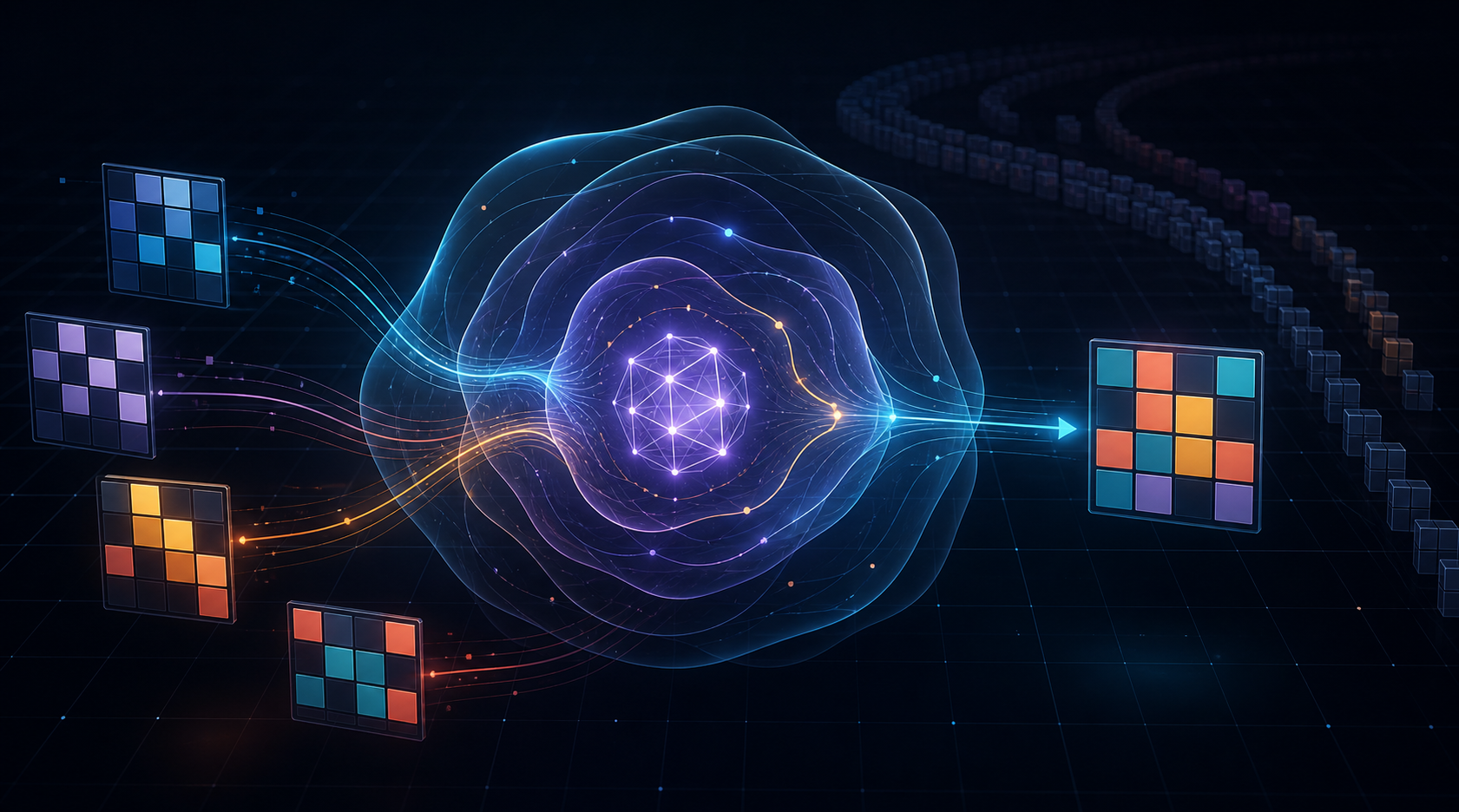
Pathway researchers report that a 150-million-parameter model reached 29.5 percent pass@2 on the public ARC-AGI-1 evaluation set while using about 0.85 seconds of NVIDIA H200 time per puzzle. In a new paper released as an arXiv preprint, they convert that runtime to an estimated inference cost of $0.00070.
That result is a cost-efficiency claim, not an accuracy win. ARC Prize reports that OpenAI’s GPT-5.6 Luna at low reasoning effort scored 34.2 percent on the same public benchmark. Pathway says BDH-CQ was about 11 times cheaper after adjusting Luna’s comparison cost for OpenAI’s July price cut.
This is one preprint on one public benchmark, not settled evidence that recurrent latent reasoning will outperform transformer systems across ordinary language, mathematics or software work.
ARC-AGI-1 tests rules expressed through colored grids
ARC tasks present a few input-output examples and then ask a system to infer the transformation that should be applied to a new grid. The rules can involve counting, symmetry, object relations, movement or composition. Answers are exact, so a nearly correct grid still fails.
Pass@2 means a task counts as solved if either of two submitted candidates is exactly right. BDH-CQ solved 118 of the 400 public evaluation tasks under that rule. Its first candidate alone solved 97 tasks, or 24.25 percent.
The benchmark is useful because the puzzles require little factual knowledge and every output can be checked. It should not be read as a direct measurement of general intelligence. Models can also be trained on public ARC-style material, making private or newly generated tasks important for testing whether a method generalizes.
The model keeps its intermediate work in a latent state
Many current reasoning systems allocate more computation by generating intermediate tokens. Those tokens form a serial scratchpad that can be read back into the model before it produces a final answer. The method can work well, but longer traces add output generation, computation and latency.
BDH-CQ is organized differently. Björn Engdahl and eight co-authors describe two recurrent components. Demonstrations update a persistent contextual memory, while a separate high-dimensional workspace is transformed repeatedly to solve the query. The model’s parameters do not change during the test, and its intermediate states are not decoded into language.
That distinction matters. A token-based chain has to project each intermediate step through a discrete vocabulary before the next step. A continuous latent state can preserve partial candidate transformations without turning each one into a sentence. It does not make the computation free, but it changes where the computation occurs.
The exact dimensions and update rules remain proprietary. The paper also defines BDH-CQ as a complete system with input transformations, candidate construction and ranking. Its benchmark score therefore cannot yet be attributed to one architectural component alone.
The $0.00070 figure is a hardware-time calculation
Pathway reports 0.85 H200 GPU-seconds per task. At an assumed rental rate of $3 per H200-hour, that becomes roughly $0.000708 per task. The arithmetic is clear, but this is not a complete estimate of what it would cost to operate a supported service. It excludes development, idle capacity, orchestration and other data-centre overhead.
The Luna comparison uses a different accounting basis. The paper took a $0.040-per-task figure from ARC Prize data collected in early August, then reduced it by 80 percent to reflect OpenAI’s July 30 price cut. That produces about $0.008 per task, a little more than 11 times BDH-CQ’s computed hardware cost.
This makes the 11-fold figure an estimate assembled from a measured GPU runtime, an assumed hourly H200 price and a commercial API price adjustment. It is reasonable as a plotted comparison, but it is not a same-provider invoice for two interchangeable services. Pathway’s own announcement describes the figure as a computed cost.
Luna still solved more public tasks
The ARC Prize results page lists Luna Low at 34.2 percent on ARC-AGI-1. BDH-CQ’s 29.5 percent trails it by 4.7 percentage points. A lower-cost point can improve a cost-accuracy frontier without being the most accurate model on the chart.
The comparison is also narrow. BDH-CQ was trained for visual ARC-style tasks. Luna is a general-purpose model that handles language, images and tools. ARC-AGI-1 measures the ability to infer transformations in small colored grids, not the full range of work either system may be asked to do.
The public-set score was reproduced in a black-box audit conducted by co-authors from Bielik and New York University, according to the paper. They did not have access to the model weights. That supports the reported deployed-system score, but it is not the same as an independent team rebuilding the architecture from a complete training recipe.
The failure pattern matters more than one percentage
The paper’s controlled tests suggest that BDH-CQ can bind new mappings from demonstrations and repeat some simple operations at larger scales. It solved every tested propagation and copying output across the reported ranges. Performance dropped much more sharply on longer ordering problems and deeper nesting.
For ordering eight objects, pass@2 fell to one correct output among 24 when the demonstrations stopped below that complexity. Adding an example at the target length recovered 13 of 24. For depth-five nesting, matched support raised the score from 19 of 24 to 24 of 24. The context helped, but the two tasks exposed different limits.
On ConceptARC, the system reached about 60 percent pass@2, with results varying widely by concept family. The authors caution that ten tasks per family are too few for a stable ranking. The behavioral tests are more informative than a single leaderboard point because they show where performance breaks and when an extra demonstration repairs it.
Latent reasoning now needs broader tests
The underlying direction predates BDH-CQ. Earlier work such as the Coconut preprint explored continuous thought inside language models, while recurrent-depth systems have tested additional computation without a long visible trace. ScienceBlog has also covered how extended reasoning-token budgets behave on Humanity’s Last Exam, another reminder that benchmark gains do not transfer automatically.
Pathway says it plans to test mathematics, language reasoning and later ARC benchmarks. The next decisive evidence would include released weights or enough implementation detail for independent reproduction, cost comparisons made under the same accounting rules, and results on harder private evaluations. Those tests will show whether this low-cost point is specific to familiar grid puzzles or reflects a more general way to allocate reasoning computation.