

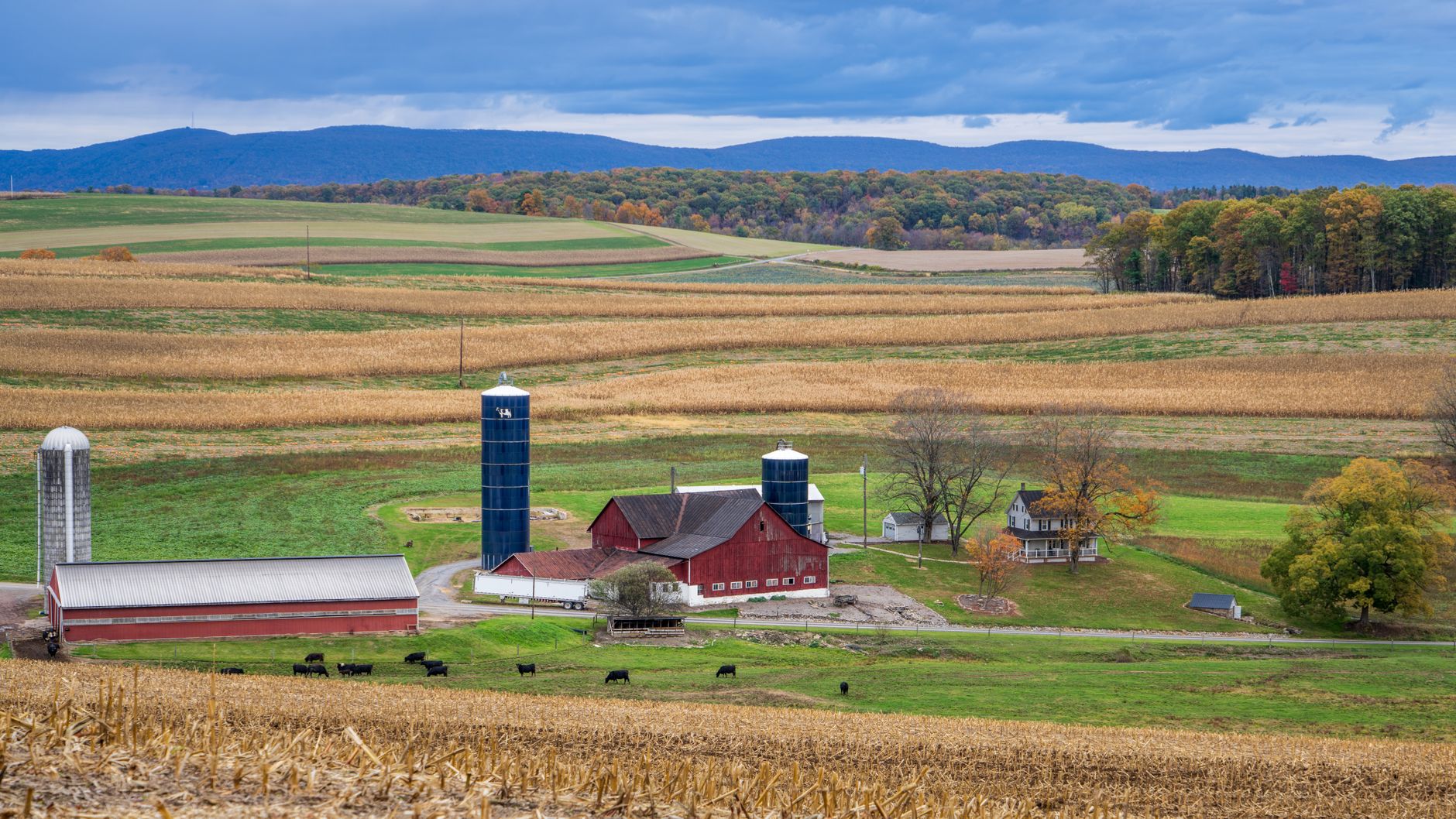
An 86-year-old Pennsylvania farmer looked at a reported offer worth roughly $15.7 million and chose a very different bargain. Mervin Raudabaugh did not transfer his 261 acres to data-centre developers at the offered rate of $60,000 per acre. Instead, he accepted just under $1.9 million through a local preservation program that placed permanent restrictions on the land.
The story is tempting to compress into a $13.8 million sacrifice. That comparison misses the legal and economic structure of the choice. The developers wanted the land for a new use. The public program paid for an agricultural conservation easement, often described as the development rights. Raudabaugh kept the farms and their remaining value. The easement removed a lucrative option from the property, then bound later owners to the same limits.
The arithmetic behind $15.7 million
The two contiguous farms lie in Silver Spring Township, Cumberland County. Lancaster Farming’s account, republished by WeConservePA, says Raudabaugh received offers of more than $15 million from data-centre interests and recalls an offer of $60,000 an acre. Multiplying that rate by 261 acres gives $15.66 million, which rounds to $15.7 million.
That calculation verifies the headline number, but it does not turn the offer into a completed contract. Public records document the preservation transaction. The higher number comes from the farmer’s account of developers’ approaches. It is best understood as a reported acquisition offer rather than a sale price tested at closing.
The $60,000 figure also reflects a proposed change in use, not a neutral reappraisal of the farms as farms. A data-centre buyer could pay for the future earning power of an industrial campus. An agricultural buyer would have to justify the price with crops, livestock or another permitted rural use. The same soil can therefore carry radically different market values depending on what the buyer expects to build.
Raudabaugh had spent much of his life on the properties. He milked cows for 51 years, later raised beef cattle until 2022, and continued growing corn and soybeans. The farms are also more than a private workplace. Their road frontage, proximity to Interstate 81 and position beside other large parcels make them useful to anyone trying to assemble a development site.
He did not sell 261 acres for $1.9 million
The preservation payment was roughly $7,200 per acre, or about one-eighth of the reported developer rate. Yet it did not buy the same asset. Raudabaugh retained the land. He could continue farming it, keep its agricultural value, pass it to heirs or sell it to another owner. The buyer of development rights acquired a permanent restriction, not the fee-simple title to every acre.
This is why subtracting $1.9 million from $15.7 million does not measure a straightforward donation. Property ownership is a bundle of rights. One transaction would have transferred that bundle to a developer. The other separated out the right to pursue ordinary development, paid the owner for surrendering it, and left the rest of the bundle in his hands.
The Lancaster Farmland Trust describes the two Raudabaugh farms as approximately 102 and 160 acres. Those rounded parcel descriptions produce 262 acres, while the transaction is reported as 261 acres overall. Both farms produce cash crops. One has 1,189 feet of stream, and the trust notes that unpaved ground helps water soak into soil rather than running rapidly into drains and waterways.
A public fund made the alternative possible
Silver Spring Township voters created the preservation route in 2013. A referendum dedicated part of the township’s earned-income tax to protecting farmland, forests and open space. The average cost has been reported at about $120 per household a year. The township enlisted Lancaster Farmland Trust to administer the program and to hold and enforce its easements.
For these farms, the township offered the full appraised value of the easement plus an incentive of $2,500 per acre. That incentive could not match a data-centre developer’s land price. It did turn an owner’s wish to keep farming into a financially real alternative rather than a purely symbolic preference.
The farms were officially preserved on December 30, 2025. An official township newsletter says they enlarged a block of protected land that includes three previously preserved farms, Stony Ridge Park and Appalachian Trail ground. The program had protected more than 1,384 acres across 23 properties since 2014.
What permanent preservation actually permits
A conservation easement is recorded with the deed and follows the land when ownership changes. The trust monitors the properties and can enforce the agreement against a future owner. This is the sense in which preservation is permanent: the next buyer cannot simply repay the grant and recover an unrestricted data-centre site.
Permanent does not mean that the landscape is frozen exactly as it appeared at closing. The properties remain private, not public parks. They may be owned, inherited, mortgaged, sold and farmed. Agricultural buildings and uses can continue within the easement’s terms, and any reserved rights or exceptions depend on the recorded agreement. What is barred is the ordinary commercial, industrial or residential conversion that the owner was paid to relinquish.
That structure spreads responsibility across generations. Raudabaugh made the initial decision, voters supplied the preservation fund, the township completed the purchase, and the trust accepted the continuing duty to monitor the land. Permanence depends not only on a signature in 2025, but also on keeping the easement visible, understood and enforceable whenever the properties change hands.
The local records also show how the transaction was completed. February 2026 county preservation-board minutes note that the Melvin Raudabaugh farm preservation had settled through Silver Spring Township and Lancaster Farmland Trust, and that the resulting publicity might encourage interest in the county program. The transaction was therefore a locally funded easement arrangement rather than a generic federal or statewide land purchase.
Why data centres wanted this corridor
Data centres are not weightless clouds. They require large sites, high-capacity electric connections, cooling systems, fibre routes, access roads and construction space. Operators often need several neighbouring parcels to build at campus scale. That is why rural land near highways and utility infrastructure can command a price far removed from its value for corn, soybeans or cattle.
The Raudabaugh offer belongs to a much larger physical build-out. A previous ScienceBlog examination of data centres’ projected electricity and water footprint showed how digital demand is becoming an infrastructure and resource question. Land is the first visible layer of that expansion, before a server hall draws its first watt or consumes its first litre of cooling water.
That context does not prove that every proposed data centre is harmful or that every farm must remain agricultural. New computing capacity supports services with real economic value, and landowners normally have strong reasons to accept a premium. It does explain the imbalance confronting conservation programs. Agricultural returns are spread across years, while a developer assembling a strategically located site can capitalize future infrastructure value immediately.
One farm cannot settle the infrastructure debate
Conservation easements offer a middle route between public acquisition and unrestricted conversion. As ScienceBlog has previously noted in a broader discussion of financial tools for conservation, buying an easement can protect land at lower public cost than purchasing the property outright. The owner receives compensation, retains possession and accepts restrictions that survive a later sale.
The model also raises legitimate questions. Taxpayers finance the payment. An easement reduces the range of future land uses, even if local housing, business or infrastructure needs later change. Its benefits depend on where preservation occurs, how restrictions are drafted, how consistently they are enforced and whether the protected acres contribute to a coherent landscape rather than isolated fragments.
In Silver Spring Township, voters decided that protecting farmland, forests and open space justified a dedicated tax. Raudabaugh supplied the landowner’s half of that decision. The resulting deal joined his farms to an existing protected area and removed a large development site from the market, while leaving the properties in private agricultural ownership.
Raudabaugh did not choose $1.9 million instead of $15.7 million for the same thing. He sold one bundle of rights, kept the land, and used a voter-funded easement to decide which uses the next owner will never be allowed to buy back.