
The striking part of the University of Surrey study is not that every adult musician emerged with perfect pitch. Most did not.
It is that two people crossed a performance threshold long treated as the product of rare biology and musical training begun during a narrow window in childhood. After eight weeks, they could rapidly name all 12 Western pitch classes without an external reference.
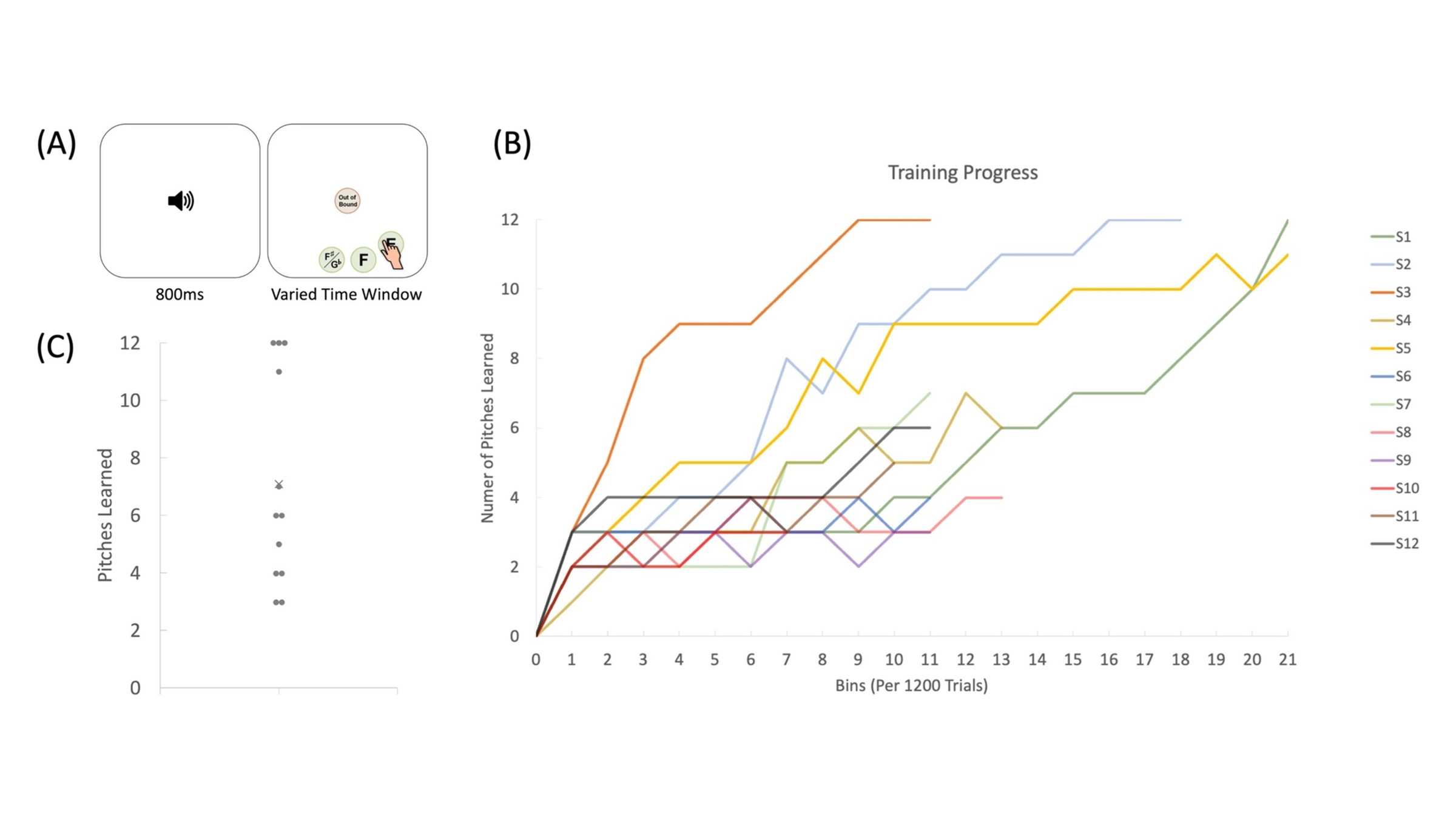
Across the whole group, the change was less dramatic but still meaningful. Participants learned an average of 7.08 pitch names at 90 percent accuracy or better. Every person reached at least three.
The result challenges a hard version of the “critical period” account of perfect pitch. It does not show that the skill is easy, universal or independent of prior musical experience.
Perfect pitch is a naming skill, not simply good hearing
Absolute pitch, commonly called perfect pitch, is the ability to hear an isolated tone and label it as C, F-sharp or another note without first hearing a reference tone.
That differs from relative pitch. A musician using relative pitch identifies the interval between notes, perhaps recognising that a second tone lies a perfect fifth above the first. If the starting note is known, the second can then be calculated.
The distinction is important because relative pitch can imitate absolute pitch in a test. Someone may remember one reliable internal reference, compare every new tone with it and work out the label.
The Surrey-led study focused on pitch class, also called chroma. Every C belongs to the same pitch class across octaves even though each octave doubles or halves the sound frequency. Genuine absolute naming should follow the C-ness of the sound, not one memorised frequency.
The final 12 were experienced and unusually committed
The peer-reviewed brief report, highlighted in a University of Surrey research release and published in Psychonomic Bulletin & Review on 12 February 2025, analysed 12 musicians aged 19 to 44. Their average age was 27.8.
These were not musical beginners. Participants averaged 12.8 years of training and about 5.1 hours of musical practice each week. Entry required at least Grade 6 in a recognised music examination or substantial performance experience.
They were also volunteers who expressed a strong interest in learning absolute pitch and a willingness to commit the necessary time. The training took place online during the pandemic.
Attrition was substantial. Ten recruits withdrew after starting. Another 25 did not keep up with the expected commitment. Thirteen people who completed at least ten hours were invited to the post-test, and one was excluded after a recording showed her listening to two reference tones on an iPad during a break.
The resulting 12-person sample therefore answers a narrow but valuable question: what can highly motivated adult musicians learn through sustained, specialised practice? It cannot show how often an unselected adult would finish the programme or reach the same level.
Eight weeks meant more than casual ear training
Participants averaged 21.4 hours of training, with individual totals ranging from 12.6 to 26.5 hours. They completed an average of 15,327 trials. This was an intensive perceptual-learning experiment, not a few minutes with a phone app.
The programme contained 288 levels, 24 for each additional pitch class. Training began with F. E was added next, followed by F-sharp, as the set gradually expanded outward until all 12 classes could be introduced.
Each trial played an 800-millisecond tone. The participant clicked a note name within a limited response window. Early levels offered feedback and generous timing; later levels removed feedback, raised the required accuracy as high as 90 percent and shortened the allowed response time.
Piano tones spanned three octaves, from C4 to B6. That forced learners to attach one label to acoustically different versions of the same pitch class rather than memorising twelve individual sound frequencies.
The final criterion was deliberately hard to pass by luck. A participant had to complete the last level three times consecutively, wait at least 12 hours without training, then pass it again on the first attempt.
The researchers designed against shortcuts
Earlier adult-training studies faced a persistent doubt: perhaps participants were using relative pitch, short-term memory or the height of a small set of tones rather than learning absolute pitch classes.
The new protocol attacked those alternatives in several ways. In the pre-test and post-test, successive tones were always more than an octave apart. Large jumps make it harder to calculate a new label from the previous note.
There was no feedback anywhere in the post-test. During training, a 20-second Shepard tone preceded some no-feedback levels, disrupting the memory of sample tones without providing an obvious new reference.
The tests contained 144 trials across three octaves and two timbres. Training used one digital piano, while testing used a different piano and synthetic guitar. Exactly correct names had to be given within five seconds; a one-semitone miss counted as wrong.
The study was preregistered, and the researchers made the analysed dataset available through the Open Science Framework.
Because the experiment ran online, the team required headphones, video of the testing area, screen sharing and recorded faces. These measures could not make an online room identical to a laboratory, but they allowed the researchers to identify the participant who used an outside reference.
The group result was broad but far from perfect
By the end of training, the 12 participants could rapidly name an average of 7.08 pitch classes at 90 percent accuracy or better. Individual achievements ranged from three to all 12.
On the separate post-test with the trained piano timbre, mean exact accuracy rose from 13.9 percent before training to 31.7 percent afterward. That is a relative increase of 128.1 percent, though the absolute change was 17.8 percentage points.
Average error fell from 2.62 semitones to 1.50, a reduction of 42.7 percent. Ten of the 12 participants improved numerically in exact accuracy, and 11 of 12 reduced the size of their errors.
The group effect was not created solely by the two best learners. Statistical results remained similar when those two were removed.
Transfer to the untrained guitar timbre was partial. Average error became smaller, but the rise in exactly correct labels was statistically clear only for the trained piano timbre. The learning reached beyond one particular piano sample, yet it was not fully independent of timbre.
Two people reached the headline threshold
Two participants completed the training with fast, accurate naming across all 12 pitch classes. One was a pianist and non-tonal-language speaker; the other was a violinist and tonal-language speaker.
Both had scored 36 percent correct before training, above chance but well below ordinary objective thresholds for absolute pitch. They needed 18 and 21 hours respectively to complete the programme, improving gradually rather than arriving with an already finished skill.
In the post-test with the trained timbre, their exact accuracies were 89 and 78 percent. Their average errors were 0.42 and 0.31 semitones, and correct responses arrived in 1.586 and 1.502 seconds.
Those figures are not literally flawless. “Comparable” means their combined speed and accuracy resembled published samples of naturally acquired absolute-pitch possessors. According to the paper, both would meet the objective definition of “true” absolute pitch used by more than 80 percent of studies that set such a definition.
A third participant passed every training level but performed poorly in the reference-free post-test. He later said he had used remembered samples and relative-pitch calculations to “legally game” the training. His failure became an informative demonstration that the independent test could expose that shortcut.
What the experiment does not establish
This was a small, one-group pre-post study without a control-training group. The authors argued that decades of exposure ordinarily do not produce absolute pitch and cited earlier work showing little change from repeated testing alone. Even so, a randomised comparison would provide a stronger estimate of the programme’s specific effect.
The sample was filtered by motivation, previous musical attainment and the ability to keep practising. Thirty-five people who began or intended to train did not reach the analysed post-test. That makes the headline two of 12 very different from two of every 12 adults who might try.
The two strongest learners also began with the best pre-test scores. Their gradual improvement argues against fully pre-existing perfect pitch, but their success does not prove that predisposition is irrelevant. A sample this small cannot identify which abilities or experiences predict success.
The study measured note naming. It did not establish that the new skill felt effortless or automatic, that participants could sing any requested note, or that they could detect every mistuned tone in ordinary music. Researchers do not share one universally accepted definition of “true” perfect pitch.
There was also no long-term retention test reported. The experiment shows what participants could do immediately after eight weeks, not whether the skill remained unchanged months or years later.
A sensitive period looks more plausible than a locked door
The study did not appear from nowhere. A 2019 adult-training experiment in PLOS ONE had already shown that some adults could reach high-level absolute-pitch performance after eight weeks. The Surrey-led team designed its stricter protocol around objections raised by that and other earlier work.
The newer evidence weakens the claim that childhood is an absolute deadline. It does not erase the strong association between early musical training and naturally acquired perfect pitch.
A sensitive period may fit the observations better than a sealed critical period. Early experience could make pitch labels easier to establish while the adult auditory system retains enough plasticity for difficult learning later.
The results also suggest that absolute-pitch ability may be a continuum. Every analysed participant learned to name at least a subset of notes quickly and accurately, while only two reached all 12. The boundary between having and not having perfect pitch depends partly on where a test draws its line.
Perfect pitch is not required for musicianship, and relative pitch remains central to harmony, melody and playing with other musicians. What this study changes is the developmental claim: for at least some trained and committed adults, the door was difficult to open, but it was not locked.