

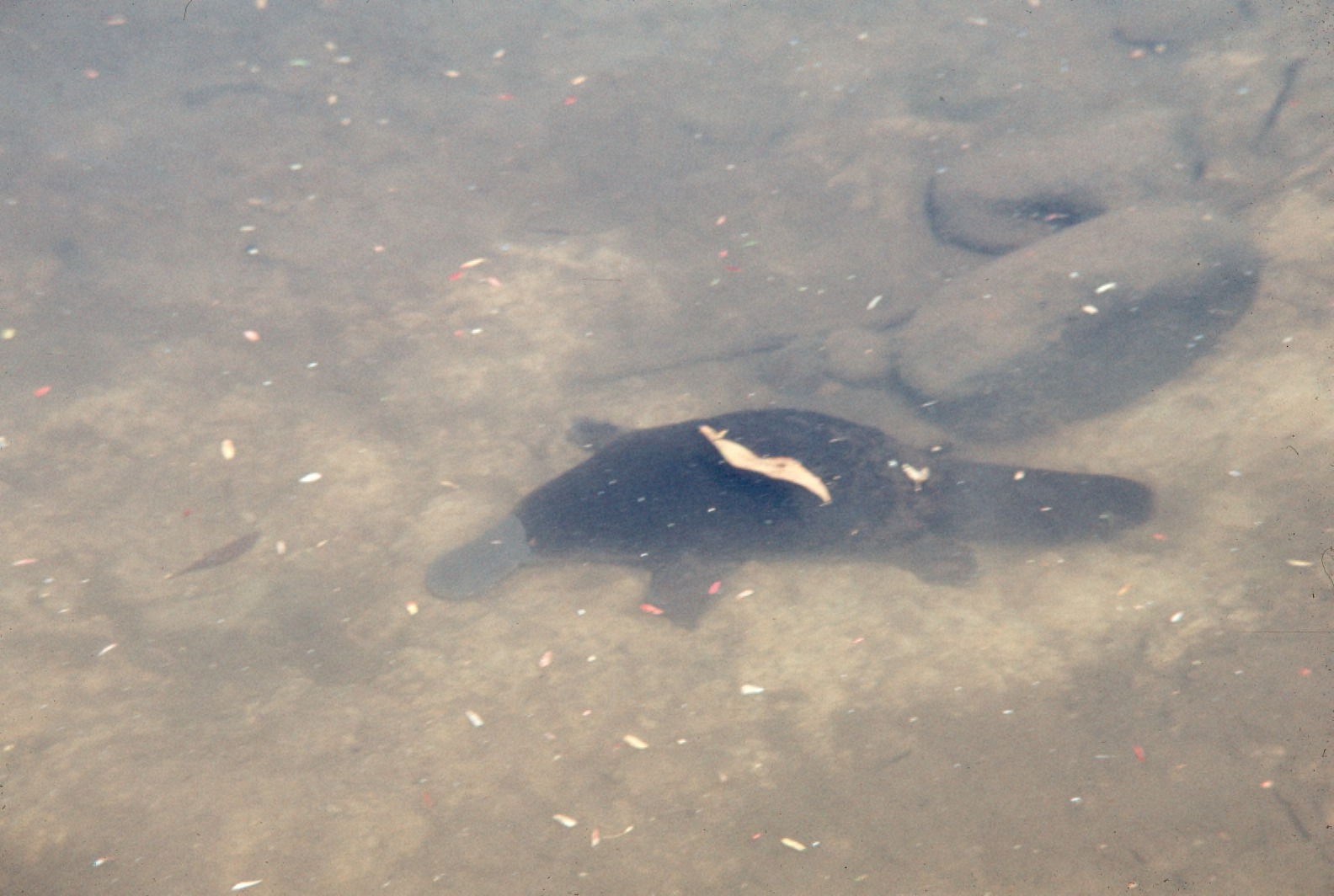
A platypus slips beneath the surface and closes the openings that would guide most mammals. The eyes shut. Skin grooves cover the ear openings. The nostrils at the top of the bill seal against the water.
In a muddy stream at night, the result looks like sensory isolation. The animal cannot watch a shrimp move, follow an underwater scent with an open nose or listen through exposed ears. Yet it continues to forage, sweeping its broad bill from side to side and finding small prey in gravel and silt.
The bill is how. Its skin contains tens of thousands of receptors sensitive to two different disturbances made by moving animals: faint electrical fields and minute movements of water.
The first decisive experiments appeared in a 1986 Nature paper. Platypuses located or avoided submerged sources using electrical fields, and recordings from the cortex responded at sensitivities around tens of microvolts per centimetre. A mammal had an electric sense.
Later work produced an elegant account of how that sense may become a position. The receptor array supplies direction. The delay between an almost immediate electrical event and a later hydrodynamic disturbance may supply distance. Together, the signals can support what researchers called a three-dimensional “fix” on prey.
Closing the familiar senses is part of the design
Platypuses are not generally blind, deaf or unable to smell. Their eyes can guide them in air, their hearing works and their olfactory system samples airborne odours. Underwater foraging imposes a different set of conditions.
Closing the eyes protects them and removes limited visual information in dark, turbid water. A muscular valve seals each nostril. A fold of skin in a groove behind each eye covers the external ear opening as the animal dives.
The words “hunts blind” are therefore true in a narrow sense and misleading in a broader one. The platypus does not enter a sensory void. It changes instruments. Its head is carried low, the bill sweeps the substrate, and a sensory surface unlike any human organ becomes the animal’s main interface with the water.
This helps explain why the bill is soft and pliable rather than a rigid duck-like beak. Beneath its skin lies an exceptionally dense trigeminal nerve supply, carrying information toward large regions of the somatosensory brain.
The bill contains two interleaved maps
An influential 1998 review of the platypus sensory world described roughly 40,000 electroreceptors and about 60,000 mechanoreceptors. The precise totals are anatomical estimates, not a count made in every animal, but they convey the scale of the array.
The electroreceptors are associated with ducts of modified mucous glands. Rows of their openings run from front to back across the upper and lower bill. Unlike the ampullae used by sharks and rays, the platypus structures do not rely on the same specialized sensory cell design. The lineage built electroreception independently.
Mechanoreceptors are distributed more uniformly. Many sit around a structure researchers call a push rod: a tiny column of epidermal cells whose exposed tip can shift when touched or when nearby water moves. Sensory endings at and around its base convert that displacement into nerve activity.
Direct recordings from trigeminal nerve fibres confirmed that these are distinct receptor classes. In the 1988 receptor study, electrical units responded to weak voltage changes while remaining insensitive to moderate mechanical stimulation. Mechanical units included slowly adapting, rapidly adapting and vibration-sensitive types, with some following vibration as high as 600 hertz.
These maps remain separate at the surface but meet centrally. In the primary somatosensory cortex, electrical and mechanical inputs occupy interlocking stripe-like territories. Individual bimodal neurons can receive information from both.
A living animal leaks a detectable electrical signature
Nerves and muscles operate through changes in electrical potential. When a shrimp flicks its tail, a worm contracts or an insect larva struggles, a tiny part of that activity creates an electric field in the surrounding conductive water.
The platypus is a passive electroreceptor. It does not broadcast a field and inspect the distortions, as weakly electric fish do. It listens electrically for fields produced elsewhere.
That distinction matters because a stone and a living shrimp may cause similar mechanical contact at the bill, but only the active animal carries a muscle-generated electrical pattern. Electroreception can help separate animate prey from gravel while the platypus digs through a bottom full of mechanical noise.
In controlled feeding experiments published in 1995, platypuses showed interest around electrodes delivering waveforms designed to imitate fleeing prey. Electrical pulses also evoked a rapid reflexive turn of the head toward their source.
The measured behavioural threshold was about 50 microvolts per centimetre under those test conditions. Natural performance may be more sensitive than one laboratory threshold suggests, because the brain can compare synchronized activity across an array of roughly 40,000 receptors rather than waiting for one receptor to announce the prey alone.
Direction is reconstructed across the width of the bill
The head response to an electrical pulse was not a generic startle. A source above the platypus produced an upward movement. A source to the right produced a movement toward the right. The animal could orient from a brief presentation rather than following an electric gradient by trial and error.
Sensitivity also depended strongly on the direction of the field relative to the bill. In the preferred axis, the response could be about 40 times more sensitive than in poorly aligned directions. That anisotropy matches the front-to-back stripes of electroreceptors.
Researchers proposed that the nervous system reconstructs lines of equal electric-field strength across the bill. If several receptors along one strip report a similar value while neighbouring strips differ, the pattern reveals how the field decays and therefore the direction from which it came.
The familiar side-to-side sweep of a foraging platypus may add samples from slightly different positions. It is tempting to call that radar, but the analogy breaks down. Radar emits a signal and times its reflection. The platypus passively samples a field generated by prey and combines spatial differences across its bill.
Direction alone is not enough for a strike. A predator also needs distance. That is where the second map may become essential.
A shrimp gives itself away twice, separated by milliseconds
A tail flick generates both electrical activity in muscle and a mechanical disturbance in water. The electrical change is available to the bill first. The water displacement arrives later, and its delay increases broadly with separation from the source.
The 1998 researchers tested this with crayfish tail flicks, an electrode and a compliant mechanical sensor. At a separation of 15 centimetres, water displacement appeared about 10 milliseconds after the electrical activity. Across tested distances from 5 to 60 centimetres, delays varied between roughly 5 and 50 milliseconds.
The relationship was noisy. Reflections from the tank, depth, nearby walls and whether the disturbance broke the surface all changed the mechanical arrival. That is more realistic than a perfectly travelling sound wave. The bill’s push rods appear suited to local hydrodynamic displacement, not simply to pressure in the textbook acoustic sense.
Bimodal cortical neurons respond to both electrical and mechanical input, and their responses change with relative timing. This led to the proposal that neurons tuned to different inter-signal intervals could encode different distances. Direction from the field pattern, plus distance from the delay, yields azimuth, elevation and range.
Here the evidence has a boundary. The authors said the direct experiment had not been done because suitable animals were unavailable. No one had recorded the full delay calculation from the cortex of a freely hunting platypus during a strike. The three-dimensional fix was a synthesis supported by anatomy, behaviour, signal timing and cortical convergence, not a finished neural algorithm watched in operation.
A later paper on electrolocation properly called parts of the account speculation still awaiting fuller tests. The platypus’s ability to locate prey without sight, smell or exposed hearing is not in doubt. Exactly how much distance information comes from timing, signal strength, head motion or direct touch remains less settled.
Evolution reached electricity more than once
Electroreception is widespread among aquatic vertebrates, but it is not one inherited device shared unchanged across all of them. Sharks and rays use ampullae of Lorenzini. Paddlefish carry receptors across a long rostrum. Weakly electric fishes add an active field of their own.
As ScienceBlog previously reported when Attenborough’s long-beaked echidna was rediscovered after more than 60 years, the platypus belongs to the monotremes, a tiny surviving branch of egg-laying mammals. Its electrical sense is not simply a generic mammalian system.
Monotreme electroreceptors are another independent solution. Echidnas retain a more limited version associated with their beaks, while the aquatic platypus has expanded the system dramatically and woven it together with mechanoreception.
Humans naturally imagine an animal’s world by subtracting our own senses. Close the eyes, ears and nose, and darkness seems complete. The platypus shows why that approach fails. Its underwater world is not a blank scene navigated by touch at the last instant.
It is a field of gradients, water displacements and millisecond offsets, gathered by the bill and arranged into enough of a place to hunt.