

The human brain seems built to vanish. It is soft, wet, rich in fat and crowded with enzymes that begin dismantling cells soon after circulation stops. In an ordinary burial, microbes and chemical reactions should erase it quickly.
That expectation shaped archaeology for a long time. Preserved brains were treated as macabre exceptions, memorable precisely because almost no one expected to find one.
Then an Oxford-led team assembled the scattered record. In a 2024 study in Proceedings of the Royal Society B, Alexandra Morton-Hayward and her colleagues catalogued exactly 4,405 preserved human brains reported from archaeological sites.
The oldest recognisable neural tissue in their archive dated back about 12,000 years. Even stranger, more than 1,300 brains had survived as the only soft tissue inside bodies that were otherwise reduced to bone.
Those figures do not mean that archaeologists uncovered thousands of pristine brains in one dig. They describe a literature archive, and “preserved” covers tissue that may be shrunken, discoloured and profoundly transformed. The discovery is compelling because it turns a supposed curiosity into a repeatable scientific problem.
A catalogue assembled from centuries of reports
The Oxford team did not excavate 4,405 individuals. It searched archaeological and historical literature, including reports in more than ten languages, and brought cases that had been dispersed through books, papers and site records into one standardised dataset.
Those cases came from 213 unique sources and every world region except Antarctica. They included finds from a Stone Age lakebed in Sweden, a Predynastic cemetery in Upper Egypt, high-altitude Inca sacrifices and a Spanish Civil War mass grave.
Some reports had been known for generations. What was new was the scale at which they could be compared. Age, climate, burial environment, associated tissues and proposed preservation process could now be considered together.
That shift matters. A single preserved brain can be dismissed as an oddity. Thousands of cases spread across climates and millennia demand an explanation, even if the archive is incomplete.
The result was less a discovery of a new object than a discovery of a forgotten population of objects. The evidence had existed, but not in a form that made its pattern visible.
“Preserved” does not mean pristine
The word can create the wrong mental picture. These are not pink, freshly removed organs waiting in ancient skulls. The reports in the catalogue universally described brains as discoloured and shrunken, although the degree of alteration varied.
Some retained a recognisable overall shape, folds or internal structures. Others had become compact masses whose identity depended on where they were found, their gross anatomy and, in a smaller number of cases, microscopy or chemical analysis.
Preservation is therefore a continuum. A specimen can be recognisably neural tissue while its cells, proteins and fats have been heavily modified. Fossilisation is not the same thing as freezing life in place.
Nothing in the study suggests that thoughts, memories or personality survive. Memory depends on living circuits and dynamic connections, not merely on the continued presence of altered tissue. The scientific promise lies in physical and molecular traces, not in recovering a mind.
This distinction also makes the headline number more meaningful. The 4,405 cases were not judged against a fantasy of perfect preservation. They were evidence that nervous tissue can leave a durable record under a wider range of conditions than expected.
Five roads away from ordinary decay
The researchers sorted the cases into five broad preservation types. Four were already familiar to archaeologists: dehydration, freezing, saponification and tanning.
Dehydration accounted for 1,667 brains, or 37.8 percent of the archive. Rapid drying can deprive microbes of the water they need and slow the reactions that break tissue apart. Dry tombs, deserts and well-ventilated burials can all help.
Seventy brains, 1.6 percent, were frozen. Persistent cold slows both microbial activity and chemical decay, although freezing and thawing can still damage tissue. Thirty-two, 0.7 percent, were tanned, typically in acidic, oxygen-poor peat that preserves tissue in a way loosely comparable to leather-making.
Another 1,308 brains, 29.7 percent, were saponified. In wet, low-oxygen conditions, body fats can change into adipocere, a waxy substance sometimes called grave wax. This process can preserve the shape of soft tissues long after burial.
These mechanisms generally preserved the brain alongside skin, muscle or other organs. They were also mostly represented among remains younger than roughly 4,000 years. The fifth group did not follow that pattern.
The 1,300 cases that do not fit
The team labelled 1,328 brains, 30.1 percent of the archive, as having an unknown preservation type. In 1,308 of those cases, the brain was the only soft tissue remaining among otherwise skeletonised remains.
That numerical coincidence can be confusing. There were 1,308 saponified brains and, separately, 1,308 brain-only cases within the unknown group. They are different sets of specimens that happen to have the same count.
The brain-only group was also unusually persistent. Its frequency declined more slowly with age than the familiar preservation types, and it included tissue extending back towards the end of the last Ice Age.
Neither a protective skull nor one special burial environment seemed sufficient to explain it. These brains appeared in varied settings, while other soft organs from the same bodies had disappeared.
That pattern led the researchers to suspect that something intrinsic to the chemistry of nervous tissue can occasionally make it the most durable soft organ, despite its reputation as the first to decay.
A chemical explanation, but not yet an answer
Brain tissue is chemically unusual. It contains abundant lipids, including fats associated with cell membranes and myelin, as well as proteins with reactive amino-acid side chains. After death, those ingredients can take part in reactions that do not occur in a healthy living brain.
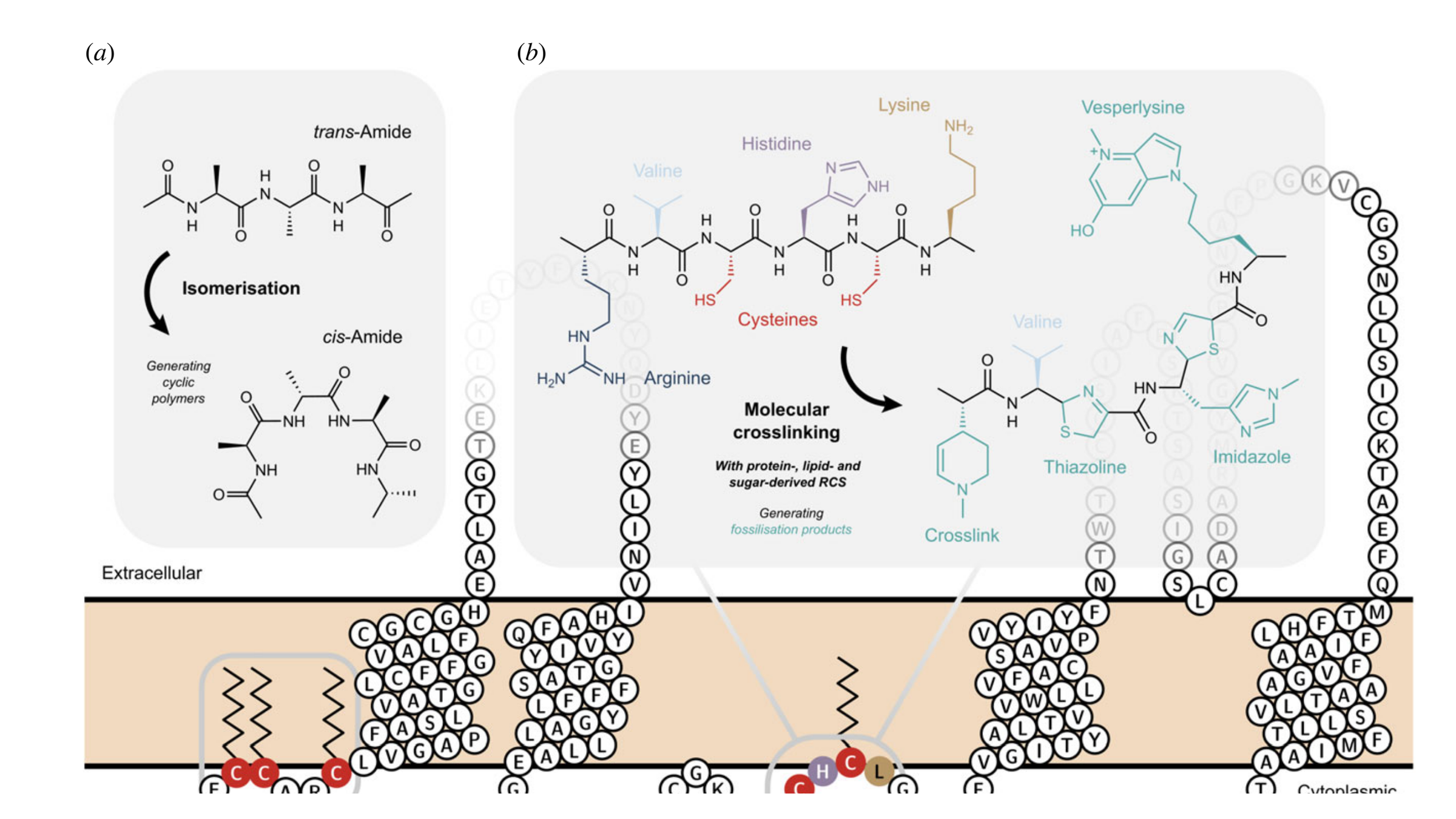
One possibility is molecular crosslinking. Reactive products made as fats and sugars degrade may bind neighbouring proteins and lipids together. The resulting network could become less soluble, less accessible to enzymes and harder for microbes to consume.
The authors compared the broad idea to processes that stabilise ancient materials, but they did not claim to have demonstrated a single reaction responsible for every specimen. The featured diagram shows candidate pathways, not a completed recipe for fossilising a brain.
Metals may offer another route. Iron is abundant in blood and can drive reactive chemistry. Over longer periods, iron or other metals might bind with tissue, promote crosslinking or help minerals nucleate within the remains.
These mechanisms are plausible, not proven. Different sites may preserve brains in different ways, and the word “unknown” is a useful acknowledgement of that uncertainty. The catalogue identifies the mystery more clearly than it solves it.
Why 4,405 is not a prevalence rate
A large number can look more representative than it is. The archive tells researchers where preserved brains have been reported. It cannot say what proportion of all ancient burials once contained them.
Several filters intervene. Tissue must survive, a burial must be excavated, the material must be recognised as possible brain, someone must document it, and the report must remain accessible. Language, collection practices and research fashions all affect what reaches a modern catalogue.
One site shows how strongly the totals can cluster. Of the 1,308 saponified brains, 1,200 came from a single large cemetery in Paris. That one cemetery supplied more than a quarter of every brain in the full archive.
The global map is therefore partly a map of human attention. Europe is densely represented not necessarily because its soils are uniquely favourable, but because it has a long, heavily published tradition of excavation and museum collecting.
The careful conclusion is not that preserved brains are common. It is that they are substantially more numerous, older and more geographically diverse than the conventional story allowed.
What ancient neural tissue may still reveal
The archive matters because transformed tissue can still carry information. Proteins, lipids, DNA, minerals and microscopic structures do not all decay at the same speed. Each can preserve a different part of a person’s biological history.
When the catalogue appeared, the University of Oxford noted that fewer than one percent of the specimens had been investigated for ancient biomolecules. Most of the scientific value had not yet been tested.
Reliable molecules could help researchers study ancestry, disease, diet, infection and population movement. Brain tissue may be especially useful for conditions whose signatures are weak or absent in bone, although preservation and contamination have to be assessed for every specimen.
The potential is beginning to become practical. In 2025, an Oxford team reported a method for extracting proteins from archaeological brains, including tissue about two centuries old. That work does not prove that every ancient brain will yield readable molecules, but it shows why the archive is worth revisiting.
There are ethical questions too. These are human remains, often taken from graves under standards very different from those used today. Scientific opportunity does not erase obligations to descendant communities, institutions or the people whose bodies became collections.
The quieter lesson in the archive
The Oxford study did not show that the brain is indestructible. Most brains still disappear, and even the survivors are chemically altered remnants. What it challenged was the certainty that neural tissue must always vanish first.
It also showed how rarity can be manufactured by fragmented knowledge. A specimen reported in Swedish, another described in an old excavation monograph and hundreds stored under inconsistent museum labels can remain isolated curiosities until someone builds the catalogue that connects them.
Once connected, the cases reveal a useful reversal. Under certain conditions, the organ expected to disappear earliest may outlast skin, muscle, gut and every other soft tissue.
The 4,405 brains are not an answer to how that happens. They are something more productive: a well-defined archive of evidence, a warning against easy assumptions and an invitation to ask what ancient nervous tissue has been preserving all along.