

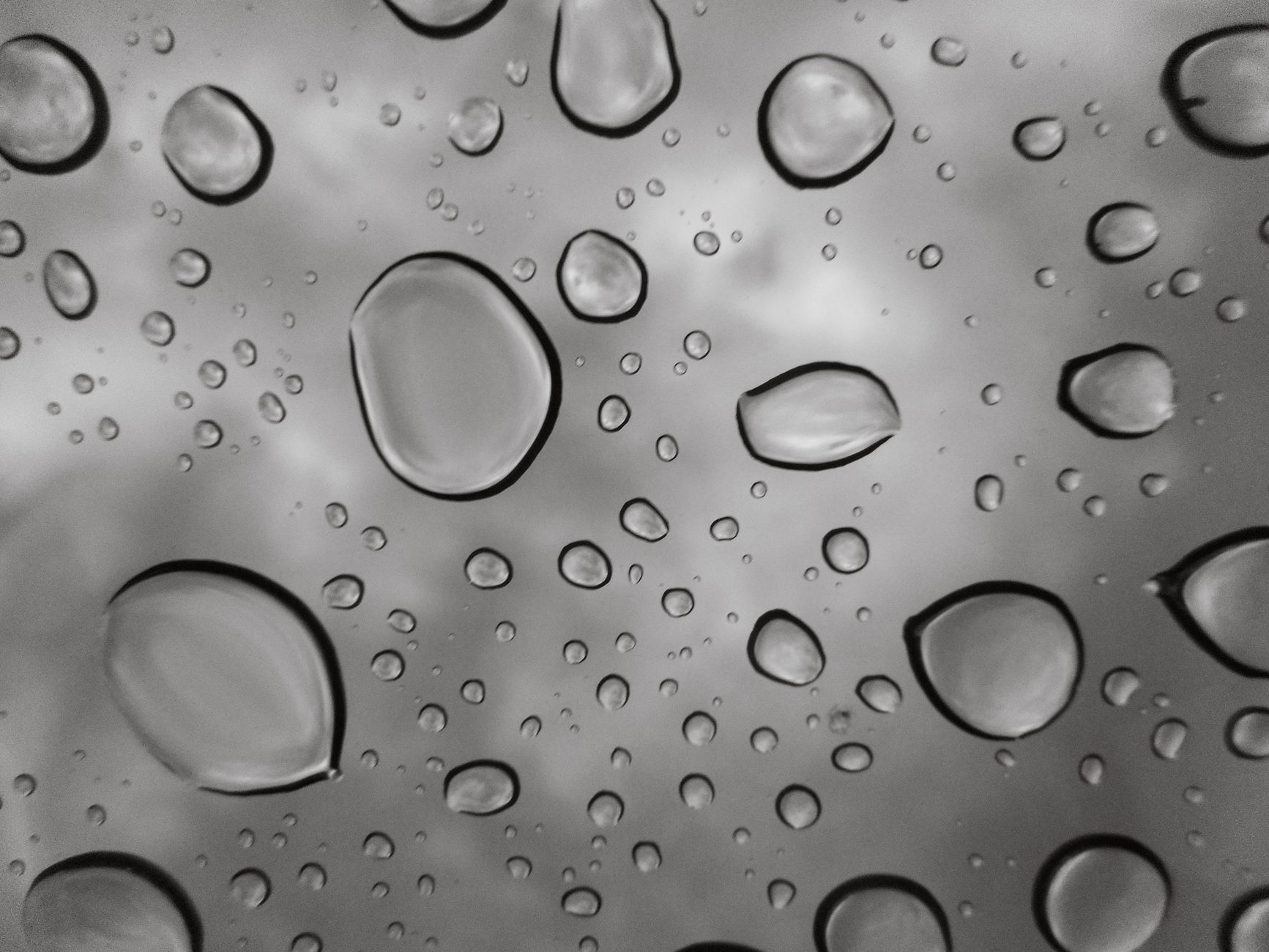
Watch a raindrop make its way down a window and you will notice how bad it is at moving smoothly.
It pauses. Its upper edge stretches thin while the lower edge refuses to budge. The drop swells, wobbles, then suddenly jumps a few millimeters and settles into another pause. To the eye, this looks like the ordinary messiness of rain. At the scale of the drop’s edge, it is a sequence of small mechanical failures. The water keeps pulling until its contact with a microscopic rough spot gives way.
A March 2025 paper in Physical Review Letters reports that each of those releases can also be an electrical event. Shuaijia Chen and colleagues at the University of Melbourne and RMIT University watched charge rise in sharp steps as the edge of a water drop stuck to and then slipped past tiny irregularities on Teflon.
This is one study, not settled consensus. It did not measure natural raindrops running down glass. The researchers used deionized water, a flat sheet of polytetrafluoroethylene, or PTFE, and a syringe pump that made one drop repeatedly expand and contract. That controlled arrangement is exactly what allowed them to see a charging process that ordinary sliding-drop experiments had blended into the background.
The familiar story starts when a wet surface becomes dry
Water does not have to rub against wool like a balloon to exchange charge with a surface. At a liquid-solid boundary, ions and charges arrange themselves into what physicists call an electric double layer. One set of charges sits near the solid; countercharges in the water balance it.
When the rear edge of a drop retreats, that paired arrangement can split. Charge remains on the newly exposed dry surface while charge of the opposite sign travels with the water. This wet-to-dry separation has been the standard way to explain much of slide electrification. A 2024 experiment on receding water-air contact lines examined that separation in detail.
It is a neat picture, but moving droplets contain two edges doing different jobs. The rear edge is receding and uncovering dry solid. The front edge is advancing and turning dry solid wet. Most experiments let both happen at once, which makes it hard to know which edge produced which part of the electrical signal.
Chen’s team slowed the problem down and separated wetting from dewetting. That revealed an extra charge appearing at the advancing edge, precisely when its motion became jerky.
The important part of a drop is a line with no thickness
The contact line is the boundary where three things meet: air, water and solid. It is called a line, but around a drop it forms a closed ring. That ring decides whether the water spreads, beads up, slides or hangs in place.
No real surface is perfectly uniform. A scratch, speck of dust, patch of residue or microscopic bump can hold one section of the contact line in place. The rest of the drop can keep changing. As more water arrives, the pinned edge stretches and the contact angle grows. Interfacial energy builds until the line breaks free and races forward.
That sequence is stick-slip motion. It also appears when tires grip and release on a road, when a violin bow catches and slides across a string, and when tectonic faults remain locked before moving. The scales and physics differ, but the rhythm is recognizable: resistance stores energy; release dissipates it.
In the authors’ openly available manuscript, contact-line jumps show up as sudden changes in diameter and drops of more than 20 degrees in contact angle. At the same instants, the electrical measurement jumps. The timing is the heart of the result. The charge was not merely present while the drop happened to move. Its sharp increases tracked individual depinning events.
The laboratory drop expanded and contracted ten times
The setup was small enough to fit on a microscope stage and careful enough to separate signals measured in billionths of a coulomb. The researchers placed an initial 20-microliter drop of ultra-pure water on a 500-micrometer-thick PTFE sheet. A chromium-and-gold electrode sat beneath the polymer, insulated from the water.
A syringe pump added 150 microliters and then withdrew it, repeating that wetting-dewetting cycle ten times at several flow rates. Cameras recorded the contact line at 25 or 100 frames per second. An electrometer measured charge with a nominal resolution of 10 femtocoulombs, far below the roughly 0.1-to-1-nanocoulomb changes common in the trials.
In one representative run, the first wetting stage took the measured charge from zero to 4.1 nanocoulombs. The first dewetting stage and later cycles moved it reversibly between about 3.2 and 4.1 nanocoulombs, a swing of roughly 0.9 nanocoulombs. Across all samples, ordinary reversible wetting and dewetting averaged 0.69 plus or minus 0.13 nanocoulombs.
The first dry-to-wet contact was different. When the advancing edge repeatedly pinned and released, charge accumulated rather than simply oscillating back and forth. The paper calls that increase irreversible because reversing the drop’s motion did not cancel it. It does not mean the charge remains forever. Leakage, humidity, conductivity and later contact can still dissipate it.
The “ten times” result belongs to the high end, not every drop
The University of Melbourne summary described the newly observed charging as about ten times stronger than familiar wet-to-dry charging. The paper supplies a more textured set of numbers.
The team ran 380 first-wetting trials and identified more than 670 individual pinning-depinning events. Stick-slip appeared in about 55 percent of the cycles on PTFE that had been wiped with cleaning tissue, often more than once in a cycle. The median charge added by one jump was 0.31 nanocoulombs. The largest individual jump reached 2.3 nanocoulombs, about three times the average reversible charge. When several jumps occurred during one run, the highest total approached 6 nanocoulombs, or about nine times that average.
That is close enough to explain the “about ten times” line, but it is a high-end comparison. It does not mean any random raindrop reliably makes ten times more charge. In the representative 4.1-nanocoulomb first cycle, the increase was closer to four or five times the later swing.
The variability is not a flaw hidden in the margins. It is part of the finding. Depinning depends on the particular obstacles the contact line encounters. When the team cleaned PTFE with nitrogen gas rather than wiping it, the probability of observed pinning fell from roughly 55 percent to about 16 percent. A cleaner surface changed the electrical behavior because it changed the drop’s route.
Some of the energy lost in the jump appears as charge
When a pinned edge releases, its stored interfacial energy does not vanish. It becomes capillary waves, motion inside the liquid, a little heat and, according to this experiment, electrical potential energy.
For one 1.86-millimeter contact-line jump, the researchers estimated that depinning dissipated about 2.5 × 10⁻⁷ joules. The associated electrical potential energy was about 4.4 × 10⁻⁸ joules. Across the observed events, their calculation suggested that up to about 18 percent of the dissipated energy could appear as irreversible charge, with the rest going into heat, viscous motion and tiny surface waves.
The next step becomes less certain. The authors propose that concentrated energy and local heating near the releasing contact line may create ions or reactive molecular fragments, somewhat like the chemistry associated with friction between solids. The paper discusses possible radicals and charged polymer species, but it did not directly identify every species or establish exactly where the lasting charge resides.
That distinction matters. The experiment directly connects depinning with a persistent increase in charge. Its explanation of the molecular route from mechanical release to charge remains a hypothesis for further testing.
A rough spot has become part of the electrical design
This is the most useful insight in the paper. Engineers usually think of scratches, residue and roughness as imperfections to control because they alter friction and wetting. The new work suggests those same features can also decide when a liquid-solid interface becomes charged.
For a fuel pipe or storage vessel, that may be a safety problem. Flowing liquids can accumulate static charge, and a spark near a flammable vapor is unwelcome. The authors point to future work on ammonia, hydrogen-handling systems and other new fuels, where the additives and flow rules developed for petroleum may not transfer neatly. A coating that lets contact lines move smoothly could, in principle, suppress one source of buildup.
In an energy harvester, the aim would be reversed. A deliberately patterned surface might create repeatable stick-slip events and collect more of the mechanical energy already carried by drops. ScienceBlog has previously covered devices that arrange droplet generators like solar-panel arrays. The new mechanism offers another surface variable to engineer, not a complete generator by itself.
There is no free electricity here. The syringe pump did work on the laboratory drop; natural rain brings gravitational and kinetic energy. The surface merely determines how some of that input is divided among motion, heat and charge.
A wet window is a good picture, but not yet the experiment
The study used one liquid and one polymer: deionized water on PTFE. Rainwater contains salts, dust and dissolved gases. A windshield is glass with coatings, grime and previous droplets. Fuel systems involve different liquids, flow speeds, temperatures and surface chemistries. Each factor can change the sign, magnitude and lifetime of charge. Earlier work has already shown that the charge left by sliding drops can alter how later drops move, so the surface also remembers its recent wetting history.
The March 2025 result therefore does not turn windows into practical power plants or settle the old debate over how water and solids exchange charge. It isolates a missing event: the instant an advancing water edge tears itself free from a microscopic obstacle.
That instant lasts almost no time and produces almost no electricity by household standards. Yet it changes the way an ordinary drop should be pictured. The pause is not empty. While the water seems to be doing nothing, the interface is storing energy. When it finally slips, the surface keeps a tiny electrical record of the struggle.