

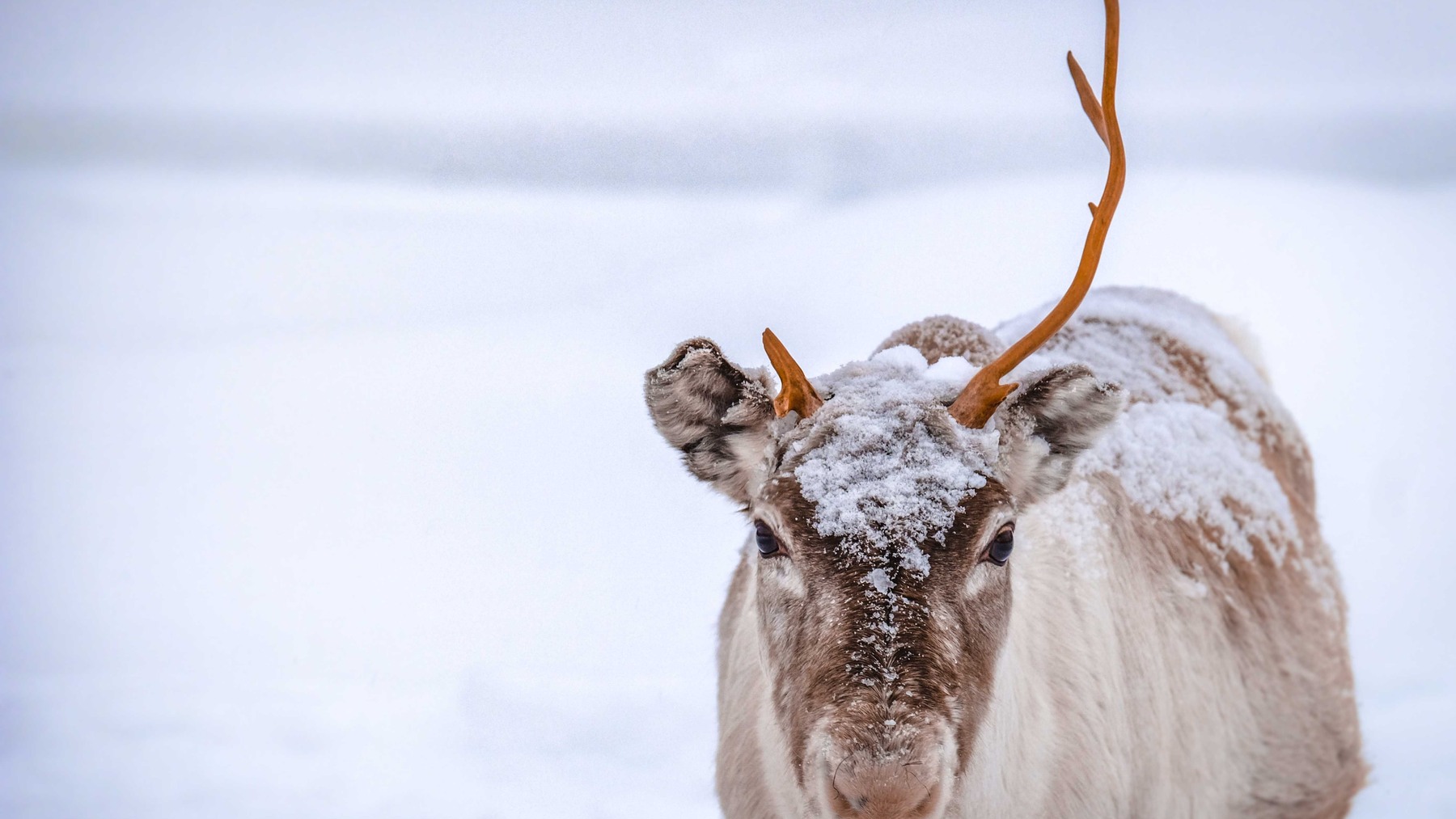
When Arctic winter arrives, a reindeer does more than open its pupils wider. A reflective layer behind each retina changes from the gold-turquoise mirror typical of many hoofed mammals to a deep blue surface tuned to the dim, blue-weighted light of polar twilight.
The structure is the tapetum lucidum, the source of the eyeshine seen when headlights catch a deer at night. It gives incoming light another pass through the retina. In reindeer, this mirror changes color and optical behavior with the season as its microscopic collagen framework is physically reformatted.
That winter setting catches more scarce light, but it gives up some sharpness to do so.
A second chance for every photon
The retina does not absorb every photon that enters an eye. Behind it, a tapetum lucidum reflects unabsorbed light back through the photoreceptors, providing a second opportunity for detection. The arrangement improves sensitivity in dim conditions, which is why reflective tapeta occur in many nocturnal and crepuscular mammals.
Reindeer have a tapetum fibrosum, a reflector built from layers of collagen fibrils. Its color is structural rather than pigmentary. When light waves bounce from a regular array of fibers, some wavelengths reinforce one another. Change the separation and order of the fibers, and the color of the returning light changes too.
During summer, the reindeer reflector is predominantly golden, sometimes with turquoise around its edges. During winter, it becomes a more consistent deep blue. “Rebuild” in this context does not mean that the animal discards the tissue and grows a replacement eyeball. The existing collagen-and-fluid structure appears to be reversibly reformatted into a different photonic arrangement.
The eye changes its mirror without changing its basic materials.
The evidence spans anatomy and function
The foundational 2013 study in Proceedings of the Royal Society B examined Eurasian mountain reindeer near Tromsø, Norway, within two weeks of the summer and winter solstices. At that latitude, the sun remains continuously above the horizon for part of summer and below it for part of winter.
The team did not infer the change from eye color alone. It photographed dissected tapeta, measured reflectance spectra, used electron microscopy to measure collagen spacing, recorded retinal electrical responses, and measured pupils and pressure inside living anesthetized eyes.
Six summer eyes and 14 winter eyes contributed to the color analysis. Spectral measurements of five eyes in each season put the principal reflection near 541 nanometers in summer and 444 nanometers in winter. Four animals per season supplied tissue for electron microscopy, which showed reduced spacing between collagen fibers in winter.
The functional difference was substantial. Under dim-light testing, winter retinal responses appeared at intensities three log units below the summer threshold. At the same stimulus levels, winter responses were generally larger. Five animals tested over two consecutive winters with an intervening summer showed the seasonal rise and fall within the same individuals, evidence that this is a reversible state rather than a permanent difference between unrelated groups.
Pressure is the leading trigger, not the last word
In prolonged darkness, a reindeer’s pupil stays widely dilated. The 2013 researchers proposed that this position partially obstructs drainage of aqueous fluid from the eye, increasing intraocular pressure. They measured significantly higher pressure in winter animals and suggested that the change compresses the tapetum’s collagen array.
A 2022 study treated the tapetum as a tunable photonic crystal. Its model focused on fluid between parallel collagen fibrils. With more inter-fibril fluid, the rods sit farther apart and with more disorder, producing the broad gold-to-turquoise summer reflection. With less fluid, the fibrils approach a tighter, more regular packing that moves the reflectance peak toward blue.
The researchers tested part of that model by allowing isolated summer and winter tapeta to lose fluid slowly while monitoring their spectra. The shifting peaks were consistent with fluid volume and fiber spacing controlling the reflector. The tissue is therefore not simply squeezed like a sponge by pressure; pressure may change fluid balance, which then changes spacing and order.
One important uncertainty remains. No experiment has kept a living summer reindeer’s pupil dilated for months, manipulated its eye pressure, and reproduced the complete winter transformation. The original team called that a key test. The 2022 study likewise described seasonal pressure as a possible trigger, not a causal chain proved at every link.
Sensitivity rises as precision falls
A golden summer tapetum behaves more like an orderly mirror. Much of the light returns directly through the retina and out of the eye. The winter tapetum reflects about 50 percent less light straight back, but scatters more of it among the outer segments of the photoreceptors. A wandering photon has more chances to be captured before it escapes.
That gain has a cost. Scattered light is less faithful to the location from which it arrived. The winter eye becomes better at detecting faint contrast or motion, but its image should be less spatially precise. For an animal scanning darkness for a wolf, the presence of movement can matter more than the fine outline of fur.
The three-log-unit extension of winter retinal responses is often translated as roughly a thousandfold change in threshold. It would be wrong to credit that entire shift to the blue mirror. Pupil dilation and other forms of dark adaptation contribute too. The tapetum is one physical component of a seasonal visual system.
Nature repeatedly exchanges detail for light. ScienceBlog previously described how a twilight-zone squid uses one large eye to scan faint light above and a smaller eye for flashes below. Reindeer make a temporal trade instead: the same two eyes occupy a different optical state in winter than in summer.
Blue twilight and ultraviolet contrast
Polar night is not uniformly black. When the sun lies below the horizon, atmospheric scattering leaves an extended twilight rich in short, blue wavelengths. The 2022 measurements found that the winter tapetum’s blue peak matched this spectral environment, with useful reflectance reaching toward the ultraviolet.
This complements another unusual feature of reindeer vision. As ScienceBlog reported in 2011, reindeer corneas and lenses transmit ultraviolet wavelengths that most mammalian eyes block, and their retinas respond down to roughly 350 to 320 nanometers. Snow reflects much of the available UV, while some biologically important materials absorb it and may appear dark by contrast.
Possible targets include lichen, predator fur and urine marks. These are plausible ecological advantages, not a direct recording of what a reindeer consciously sees. A later analysis of reindeer vision and lichen detection emphasized that lichen contrast is a hypothesis to test in realistic scenes. Demonstrating UV transmission and retinal response does not, by itself, prove how the animal uses every UV-dark object.
Even so, the pieces fit a coherent environment. The winter atmosphere supplies blue and ultraviolet-rich twilight. Snow preserves those short wavelengths. The front of the reindeer eye admits them, and the reflector behind the retina becomes better tuned to keep them in play.
A rare seasonal transformation
Reindeer remain the only mammals known to shift tapetal color seasonally in this way. That uniqueness should be read cautiously. It may mean the adaptation is genuinely rare, or that comparable changes in other animals have not yet been measured across a full annual light cycle.
The evidence also comes from Arctic reindeer exposed to extreme seasonal illumination. Animals kept near the distant glow of Tromsø developed an intermediate green winter tapetum rather than the deep blue found in animals from a darker island. Their retinal responses were intermediate too. The pattern is consistent with incomplete dark adaptation, but it was not a controlled light-pollution trial.
Nor does the winter state make sight superior in every respect. It retunes performance toward the task that matters: extracting signals from scarcity. Summer favors a cleaner, more direct reflection and finer localization. Winter favors photon capture, short wavelengths and movement detection.
Other Arctic animals carry different seasonal legacies. ScienceBlog has covered ancient near-primate relatives whose jaws and teeth changed under winter food pressure. Reindeer show that adaptation to the high Arctic can reach into a living sensory organ and rearrange its optics every year.
The Arctic winter does not merely demand that reindeer endure darkness. It changes the mirror through which they meet it.