

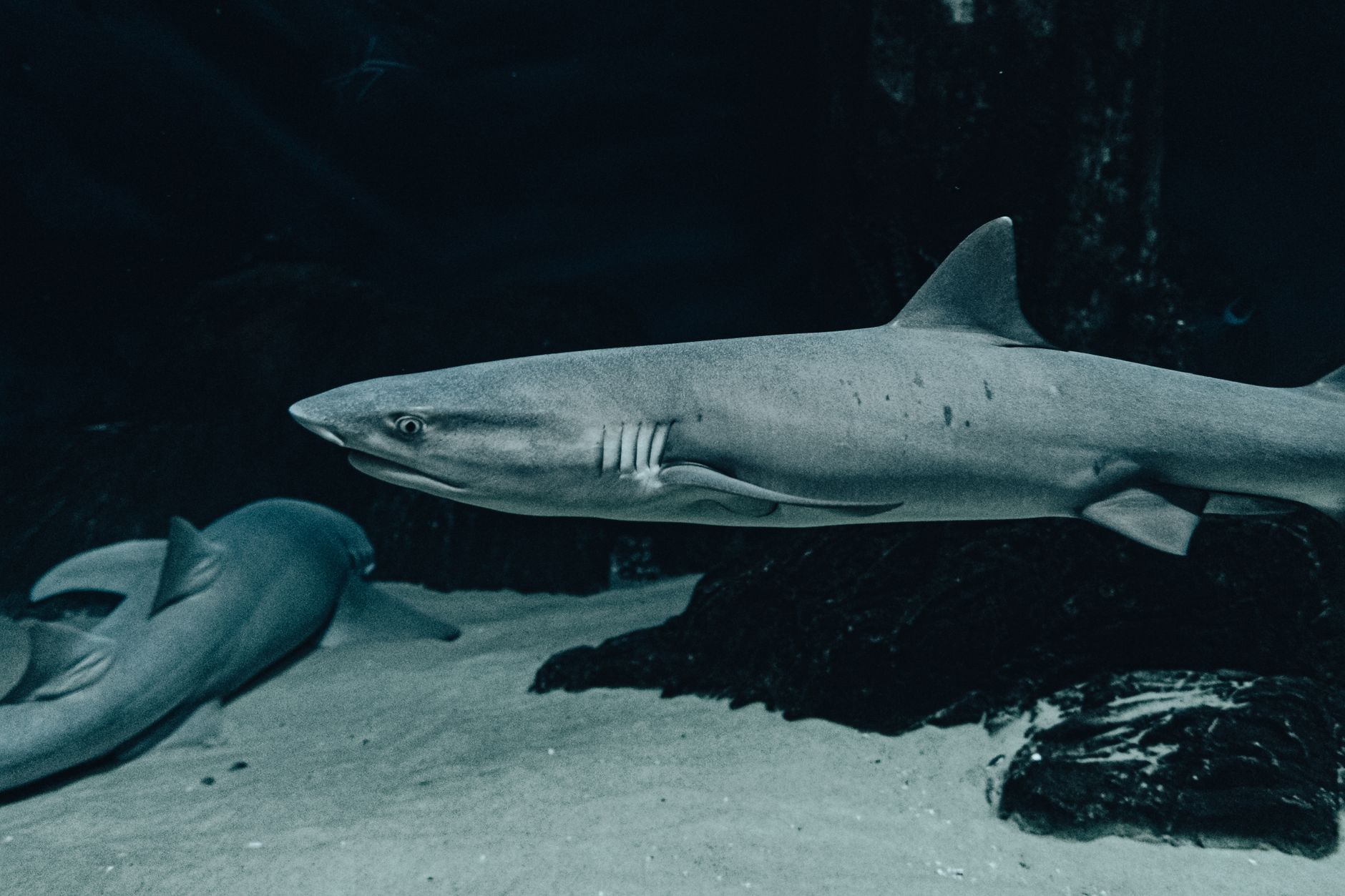
Sharks are often introduced as ancient animals, but the phrase can be misleading. A living tiger shark or great white is not a 400-million-year-old species that somehow avoided evolution. Sharks have changed, split, vanished, reappeared in new forms and been reshaped by the same evolutionary pressures as every other lineage.
The striking part is not that any modern shark has stayed frozen in time. It is that the deeper shark line goes back far enough to make most familiar measures of animal history feel recent. Fossil evidence places chondrichthyans, the cartilaginous-fish group that includes sharks, rays and chimaeras, in very ancient seas. A 2012 Palaeontology paper by Ivan J. Sansom and colleagues described chondrichthyan-like scales from Middle Ordovician rocks in Australia, pushing the roots of the group toward roughly 450 million years ago.
That is why the comparison works. Sharks are older than the dinosaurs by hundreds of millions of years. They are older than the first forests. And in the broad lineage sense, sharks and their cartilaginous relatives pass through the entire sequence of the so-called Big Five mass extinctions, the five intervals first framed in modern form by Jack Sepkoski and David Raup in their 1982 Science paper on mass extinctions in the marine fossil record.
Older than trees, but not unchanged
The “older than trees” line depends on what is being compared. The earliest known forests are Devonian. A 2024 Journal of the Geological Society paper by Neil Davies, William McMahon and Christopher Berry described fossilized trees and vegetation-shaped sedimentary structures from the Hangman Sandstone Formation in south-west England, dating to about 390 million years ago.
That forest was not a modern woodland. It was made of early tree-like plants such as Calamophyton, growing in a Devonian landscape where plant life was still learning how to build height, root systems and stable soils at scale. By then, shark relatives had already been part of marine ecosystems for tens of millions of years.
Dinosaurs came much later again. The oldest well-known dinosaurs are Triassic animals from roughly 230 million years ago, with possible earlier relatives debated in the fossil record. By the time dinosaurs appeared on land, shark-like fishes had already passed through long stretches of Paleozoic ocean history, including reef collapses, oxygen crises, sea-level shifts and global climate swings.
What survived the extinctions?
Saying sharks survived all five mass extinctions is true only if we keep the level of the claim clear. It does not mean the same shark species swam calmly through every catastrophe. Species, genera and whole families disappeared. Some shark groups were reduced, replaced or pushed into new ecological roles. Survival here belongs to the lineage, not to a fixed design.
The first of the Big Five, the Late Ordovician extinction, came around 445 million years ago, when complex animal life was still overwhelmingly marine. If the oldest chondrichthyan-like scales are correctly placed near the Middle Ordovician, the broader shark-and-cartilaginous-fish line had already begun before that crisis closed.
The Late Devonian extinction hit reef ecosystems and marine vertebrate communities hard. The end-Permian extinction, about 252 million years ago, was harsher still, eliminating an enormous share of marine species. The end-Triassic extinction helped open ecological room for dinosaurs on land. The end-Cretaceous extinction killed the non-avian dinosaurs and many marine reptiles. Across that entire sequence, cartilaginous fishes persisted, though not without losses.
Why sharks fossilize badly
Part of the reason shark history is hard to tell is built into their bodies. Sharks are cartilaginous fishes. Their skeletons are made mostly of cartilage, not dense bone, and cartilage usually does not fossilize as readily as bone. The fossil record of sharks is therefore heavily biased toward teeth, scales and occasional vertebrae.
That creates a strange archive. A single shark could shed thousands of teeth over its lifetime, so teeth can be abundant. But a complete ancient shark skeleton is far rarer than the skeleton of a bony fish, marine reptile or dinosaur. This is why small scraps can carry large importance. A scale, tooth or spine may be the only durable signal left by an animal whose softer support structure vanished.
It also explains why timelines shift as paleontologists reassess old material. A fossil may look “shark-like” without belonging cleanly to the modern shark crown group. Some fossils belong to stem relatives; some belong to broader cartilaginous-fish groups; some sit in disputed positions. The public shorthand collapses all of this into “sharks,” but the scientific version is more careful.
Ancient success is not modern safety
The survival story can also hide a modern problem. A lineage that endured ancient mass extinctions is not automatically safe from human pressure. In a 2014 eLife paper, Nicholas Dulvy and colleagues assessed extinction risk across 1,041 species of chondrichthyan fishes and estimated that about one quarter were threatened, largely because of overfishing, whether targeted or incidental.
That point changes the emotional shape of the fact. Sharks are not simply symbols of endurance. They are living animals whose deep history makes their current decline more uncomfortable, not less. Surviving the end-Permian ocean crisis did not prepare them for industrial fishing gear, shark fin markets, habitat loss and slow reproductive rates colliding at once.
Many sharks grow slowly, mature late and produce relatively few young compared with bony fishes. Those traits can work in stable ecosystems where adult survival is high. They are less forgiving when adult animals are removed faster than populations can replace them.
The long view
The most useful way to think about sharks is not as relics, but as a long-running evolutionary experiment. Their bodies have been rebuilt repeatedly around a successful basic arrangement: cartilage, replaceable teeth, sensory systems tuned to water, and predatory or scavenging lives in almost every kind of marine habitat.
That arrangement has carried the broader lineage through ice ages, warm oceans, changing continents and extinction pulses that erased many other marine animals. But endurance is not invulnerability. It is the record of repeated survival under past conditions.
So the headline fact is real, with one important correction built in. Sharks are older than trees, older than dinosaurs, and their lineage has crossed all five mass extinctions. But the living sharks in today’s oceans are not fossils that escaped time. They are the current, vulnerable edge of a history that began before forests existed.