

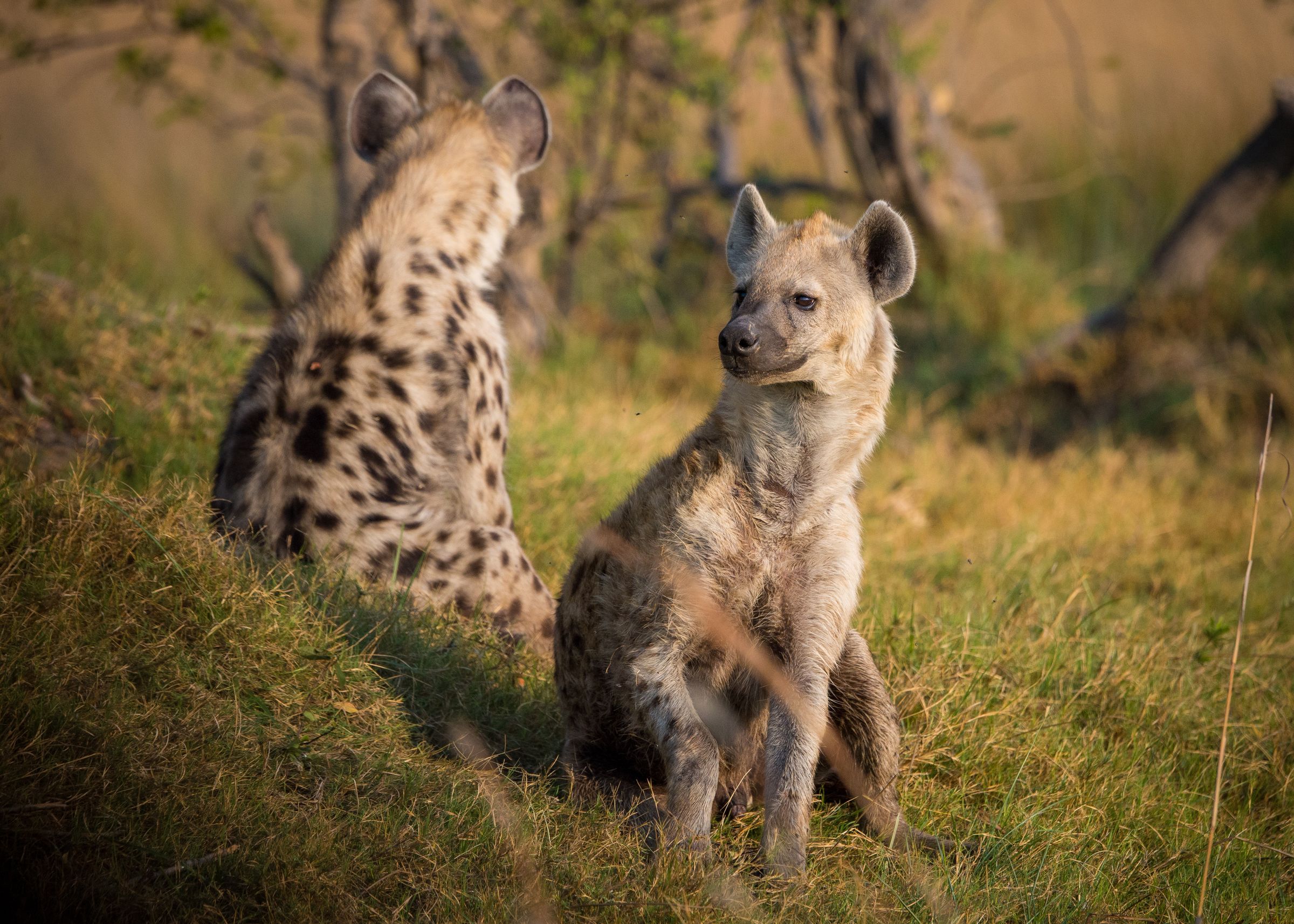
The food was ten feet above the hyenas, hidden behind a trap door. Two ropes hung from the platform. Pulling either rope alone achieved nothing. Two animals had to tug the matching ropes almost simultaneously, or lunch stayed where it was.
The first spotted-hyena pair solved the problem in less than two minutes. Across the first experiment, all three pairings succeeded on every coordination trial, including the harder version in which two platforms gave them four ropes to choose from. One pair released the first reward after just 16 seconds.
That ease looked remarkable beside classic primate studies in which chimpanzees often needed extensive shaping or highly compatible partners. Yet the result is more interesting than a simple hyenas-versus-chimps score. It shows how sharply an animal’s apparent intelligence can depend on whether a laboratory problem resembles something evolution has made worth solving.
The apparatus was designed to defeat coincidence
Christine Drea of Duke University and Allisa Carter tested eight captive spotted hyenas in 13 pairings. The study, published in Animal Behaviour in 2009, was the first experimental demonstration of cooperative problem-solving in a social carnivore.
Each metal platform stood 2.5 metres above the floor. Pulling a rope released one spring, but the trap door opened only when two springs were released together. A single hyena could not operate both ropes at once. The reward, bone chips and sticky meat, dropped to the ground when the pair succeeded.
With one platform, the problem required temporal synchrony: two pulls at the same time. With two platforms positioned apart, it also required spatial coordination. The animals had to choose both ropes belonging to the same platform. As the full experimental paper explains, doubling the apparatus made accidental success less likely and produced a challenge more complex than the single-device tasks then common in animal cooperation research.
The physical action was artificial but not arbitrary. Tugging downward with the jaws resembled movements hyenas use when several hunters seize and pull at large prey. The apparatus translated a familiar ecological demand into a controlled rule: another animal must apply force in the right place at the right moment.
The reward was hidden rather than displayed on the platform, and successful pulls scattered food on the floor so both animals could usually obtain something. That design reduced a familiar obstacle in cooperation tests: one dominant subject monopolising a single visible prize. It did not remove competition, but it made joint action worth attempting for both partners.
“Without training” does not mean without experience
The study’s “no training” result needs a precise reading. The hyenas received no specific coaching, shaping or human demonstration of the cooperative solution. Nobody taught one animal to wait for the other or rewarded closer and closer approximations to a coordinated pull.
They were not, however, dropped cold into a mysterious test. The platforms had been installed for a month so the naturally wary animals could become accustomed to them. Researchers trained the hyenas to move between holding pens, habituated them to different social pairings and first let them solve a solo version in which one rope opened the door.
In experiment one, the three adolescent males had extensive experience with that solo mechanism before pair testing. The authors themselves noted that those trials may have helped the cooperative response appear immediately. In a second experiment, four other hyenas received far fewer solo trials; their pair performance improved after exposure to the problem as a group.
The defensible claim is still impressive. Once the animals knew what pulling a rope did, they did not need to be taught the new social rule. All three first-experiment pairs solved the two-platform coordination problem on their initial trial, with first-success times of 1.52, 4.41 and 0.27 minutes.
The partner was part of the solution
Two hungry animals can perform the same action at the same time by accident. Drea and Carter therefore looked for evidence that the hyenas adjusted their behaviour to a partner rather than merely pulling whenever they saw a rope.
With experience, the animals were more likely to occupy the same platform zone and pull when their partner was close enough to help. Their rate of pointless pulling without an available partner fell sharply. They watched the apparatus, tracked one another and increasingly aligned their movements.
The clearest demonstration came when an experienced animal was paired with a cooperation-naive subordinate. Experienced hyenas followed the newcomer between platforms and joined whichever apparatus the newcomer approached. A high-ranking female temporarily took the unusual role of following the lowest-ranking male. After the newcomer acquired experience, the normal social pattern returned.
That does not prove the animals represented a partner’s intentions in the human sense. The paper explicitly leaves that mental-state question unresolved. It does show flexible, partner-dependent behaviour rather than a rigid two-rope reflex.
Social rank could make a clever pair fail
Knowing the mechanism was not enough. Cooperation changed with group size, dominance and aggression. Experienced hyenas sometimes completed the task faster when additional clan members were present as an audience, a form of social facilitation that may echo the way hunting parties gather in the wild.
Dominant animals could instead disrupt performance. Pairings involving the alpha animal were less efficient when aggression caused one partner to withdraw from the platform. Prior experience predicted success less well than the immediate social relationship did.
That finding fits a broader lesson from hyena field research. Collective action depends on relationships, not merely on how many bodies arrive. ScienceBlog has previously covered evidence that socially connected hyenas are more likely to join mobbing groups. In both settings, the network linking individuals helps determine whether technically possible teamwork actually happens.
Did the hyenas really outperform chimpanzees?
The researchers concluded that the hyenas surpassed well-trained chimpanzees from earlier studies on simpler synchrony tasks. Duke’s contemporary account of the experiment similarly reported that chimpanzees and other primates often needed extensive training, whereas the hyenas acquired the cooperative rule rapidly.
That comparison is legitimate within its boundary, but it was not a head-to-head tournament. The species were studied by different researchers, often decades apart, using different apparatuses, rewards, group arrangements and amounts of familiarisation. The hyenas’ task also resembled coordinated food acquisition in their natural lives unusually well.
Chimpanzees are capable cooperators. In a 2006 loose-rope experiment, 11 of 16 chimpanzee pairs succeeded at least once, and success was strongly related to whether partners tolerated sharing food. Primates also solve collaborative problems involving partner choice, recruitment and strategies more elaborate than simultaneous pulling.
So “outperformed” means faster and more reliable success on this family of food-coordination tasks. It does not mean a spotted hyena has greater general intelligence than a chimpanzee. There is no species-neutral intelligence exam hiding inside two ropes.
Intelligence makes sense inside an animal’s life
Spotted hyenas are not merely scavengers that happen to live near one another. They hunt much of their own food, sometimes tackling prey too large and combative for one animal to subdue. They live in complex fission-fusion clans, recognise rank and third-party relationships, form coalitions, defend territory and adjust constantly to who is present.
A detailed review of spotted-hyena social intelligence notes striking parallels with the large, competitive societies of some primates. The animals face different physical problems, but many of the same social demands: remembering relationships, predicting responses and deciding when another individual is an ally, rival or necessary partner.
The rope task happened to meet that intelligence on familiar ground. This does not reduce the result to instinct. The animals learned, monitored partners, changed roles, responded to audiences and sometimes failed because politics overpowered mechanics.
The experiment did not crown hyenas as smarter than chimpanzees. It exposed something more useful: when researchers stop treating primate-style performance as the default measure of a mind, an animal long caricatured as a scavenger can look like what it has been all along, a flexible specialist in the difficult business of getting others to work with it.