

A fragment of a child’s little finger, small enough to offer almost no anatomical clues, revealed an entire extinct human lineage. DNA recovered from the bone showed that its owner belonged neither to our species nor to the Neanderthals. Researchers named the newly recognized population Denisovans after the Siberian cave where the fragment was found.
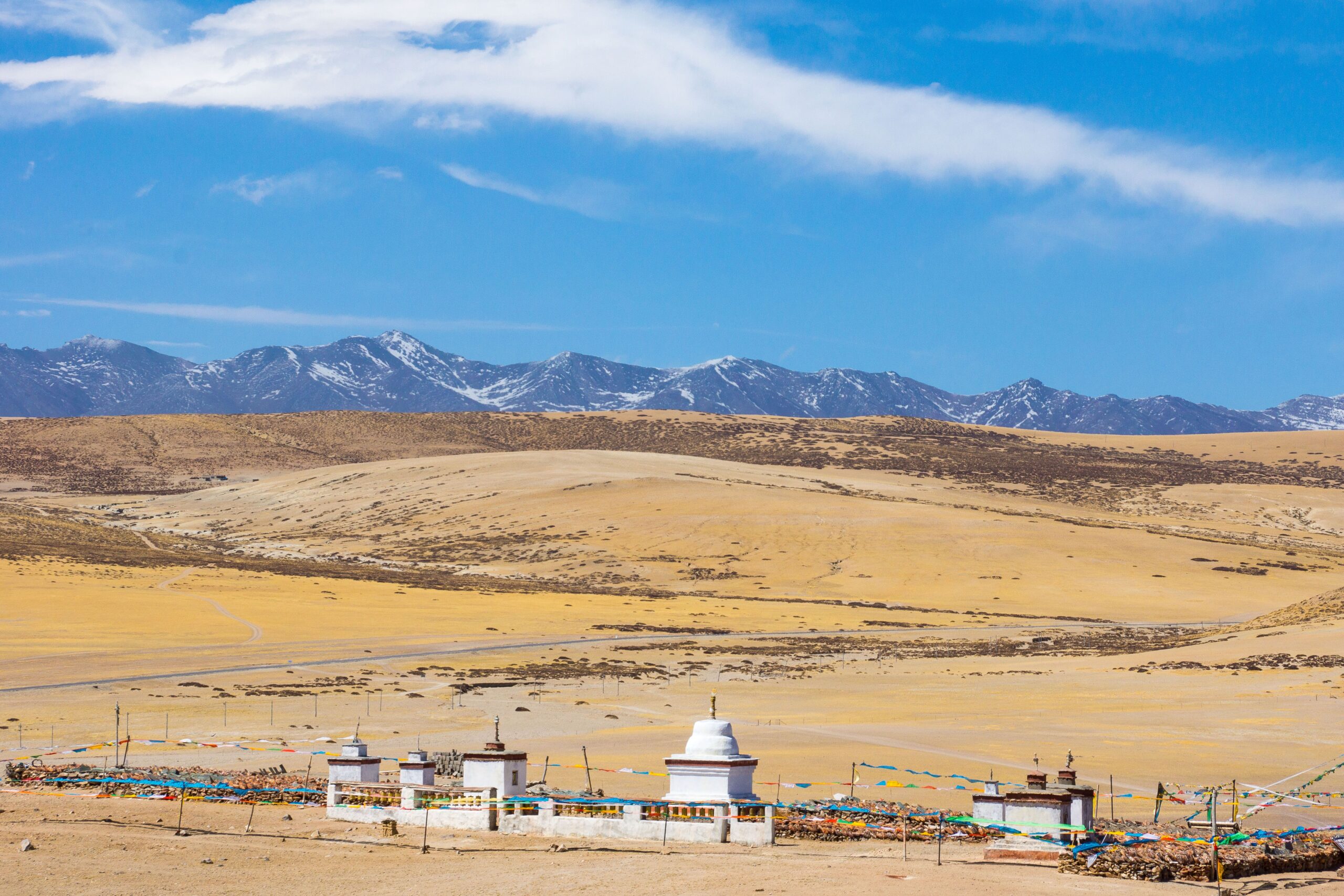
Their genetic afterlife reaches far beyond that cave. One Denisovan-derived stretch of DNA around EPAS1, a gene involved in the response to low oxygen, is now exceptionally common in Tibetan highlanders. Modern samples place the adaptive haplotype or closely linked marker alleles at roughly 80 to 86 percent frequency among Tibetan chromosomes. It is one of the clearest cases in which interbreeding with an extinct population supplied variation that natural selection later made valuable.
The percentage needs a boundary. It comes from population-genetic samples, not a census of every Tibetan person, and most studies report allele or haplotype frequency rather than simply counting carriers. Because each person has two copies of chromosome 2, those measures are not identical. The data nevertheless imply that a large majority of the sampled people carried at least one copy.
A human lineage identified from DNA before anatomy
Excavators found the distal phalanx, the end of a finger, at Denisova Cave in 2008. Its archaeological layer was dated broadly to tens of thousands of years ago. The bone looked unremarkable, but the cold cave had preserved enough genetic material to make it scientifically unusual.
An initial mitochondrial sequence reported in 2010 pointed to an unknown hominin. Later that year, David Reich and colleagues published a draft nuclear genome in Nature. It established Denisovans as a sister group to Neanderthals and found evidence that they had contributed DNA to the ancestors of some people alive today.
That order of discovery was remarkable. Neanderthals had been recognized from substantial bones more than a century earlier. Denisovans became a distinct branch of the human family largely through molecules extracted from a tiny fragment. The sequenced genome then became a reference against which researchers could test whether unusual DNA in living populations had an archaic origin.
EPAS1 had already drawn attention on the plateau
At 4,000 metres, oxygen still accounts for about 21 percent of the atmosphere, but lower air pressure means each breath contains fewer oxygen molecules. People arriving from low altitude commonly compensate by producing more red blood cells and more hemoglobin, the protein that carries oxygen. That response can help, but excessive hemoglobin thickens the blood and is a defining feature of chronic mountain sickness.
Tibetan highlanders tend to maintain lower hemoglobin concentrations than acclimatized lowlanders at similar elevations. In 2010, Cynthia Beall and colleagues identified a powerful signal of natural selection around EPAS1. In independent Tibetan samples, variants at the locus were associated with lower hemoglobin concentration. People with two copies of the common alleles averaged 0.8 grams per decilitre less hemoglobin than heterozygotes in one analysis.
EPAS1 encodes HIF-2 alpha, a transcription factor in the body’s oxygen-sensing system. It helps regulate downstream responses including red blood cell production. Yet it is not a self-contained “high-altitude gene.” All humans have EPAS1, and Tibetan adaptation reflects many genes, physiological traits, development, behavior, and culture. The genetic finding concerns a selected version of the surrounding region, not a trait that can be reduced to one switch.
The Tibetan haplotype pointed back to Denisovans
The origin became clearer in 2014. Emilia Huerta-Sánchez and colleagues resequenced the region around EPAS1 in 40 Tibetan and 40 Han Chinese individuals. Their Nature study identified a highly differentiated 32.7-kilobase haplotype that was common in the Tibetan sample, rare in Han Chinese, and closer to the Denisovan sequence than to the corresponding sequences in other modern populations examined.
A haplotype is a linked set of genetic variants inherited together on one chromosome. The researchers tested whether the shared sequence might be ancient variation retained independently from a common ancestor. Its length, distribution, and unusually close Denisovan affinity made that explanation much less convincing than introgression, the transfer of DNA through interbreeding.
“Denisovan-derived” remains a useful compression. The 2014 authors wrote Denisovan or Denisovan-related because one Siberian genome cannot represent every population belonging to that broad archaic branch. Denisovans appear to have lived across a large part of Asia and to have mixed with modern humans more than once. The genetic evidence identifies the contributing lineage more confidently than the precise population, place, or encounter.
What “more than 80 percent” measures
Frequency estimates depend on the sample and the exact markers used. Studies have reported the adaptive haplotype or representative alleles at about 80 to 86 percent among present-day Tibetan chromosome copies. By contrast, the haplotype is absent or very rare in many lowland populations, including neighboring Han Chinese samples.
An 85 percent allele frequency does not literally mean that exactly 85 percent of people carry it. A person can inherit zero, one, or two copies. Without individual genotypes and assumptions about how the copies are distributed, allele frequency cannot be converted into an exact carrier percentage. It does establish that the sequence is widespread, and the proportion of carriers would ordinarily be greater than the allele frequency because people with one copy count as carriers.
The estimate should not be projected without qualification onto every Tibetan community. Samples differ by geography, ancestry, size, and variant definition. The important evolutionary contrast remains large. Genome-wide Denisovan ancestry in Tibetans is only a small fraction of total DNA, yet this one region rose to an extraordinary frequency. Selection preserved and amplified a locally useful segment while most archaic DNA remained uncommon or disappeared.
The useful inheritance may have waited millennia
Interbreeding supplied the haplotype, but it did not necessarily become advantageous immediately. In 2021, Xinjun Zhang and colleagues analyzed EPAS1 sequences from 78 Tibetan individuals and used population-genetic simulations to separate the timing of introgression from the onset of selection.
Their Proceedings of the National Academy of Sciences paper estimated that an East Asian-specific Denisovan introgression event introduced the haplotype about 48,700 years ago, with a broad interval from 16,000 to 59,500 years. Selection was estimated to start around 9,000 years ago, with an even broader interval from 2,500 to 42,000 years. These are model-dependent estimates, not dates read directly from bones.
The gap supports a plausible two-stage history. A sequence entered modern humans and persisted at low frequency. Much later, as populations established lasting lives on the plateau, chronic low oxygen changed its reproductive value and pushed it upward.
Ancient human DNA adds direct snapshots. A 2023 Science Advances study analyzed genome-wide data from 89 ancient individuals spanning roughly 5,100 years across the plateau. The oldest sampled person carried two copies of the adaptive haplotype. Its estimated frequency varied in ancient groups but increased substantially over the past 3,000 years and sharply over the past 700. In a comparison sample of 33 present-day Tibetans, the estimate was 0.86.
Fossils place Denisovans in high country
The genetic story became geographically more tangible in 2019. Using ancient proteins preserved in a tooth, researchers identified a partial jaw from Baishiya Karst Cave on the northeastern Tibetan Plateau as Denisovan. The Xiahe mandible was at least 160,000 years old and came from a cave about 3,280 metres above sea level.
That finding shows Denisovans themselves occupied high altitude long before the formation of present-day Tibetan populations. It does not establish that the Xiahe individual carried this version of EPAS1, that the haplotype first evolved on the plateau, or that interbreeding occurred there. No usable Denisovan DNA has been recovered from the jaw, and the exact donor population remains unknown.
Our earlier report on EPAS1 and hemoglobin examines the physiological association in more detail. The longer evolutionary timeline adds a complementary point: adaptation can use genetic material borrowed from another human lineage rather than waiting for a helpful new mutation.
The finger bone did not itself contain a Tibetan adaptation, and one gene did not make the plateau habitable. The connection runs through population history. Interbreeding tens of thousands of years ago placed a Denisovan-related haplotype in the modern human gene pool. Selection later changed its fate in thin air, turning one archaic fragment into a common inheritance and preserving a trace of an extinct population in millions of living descendants.