

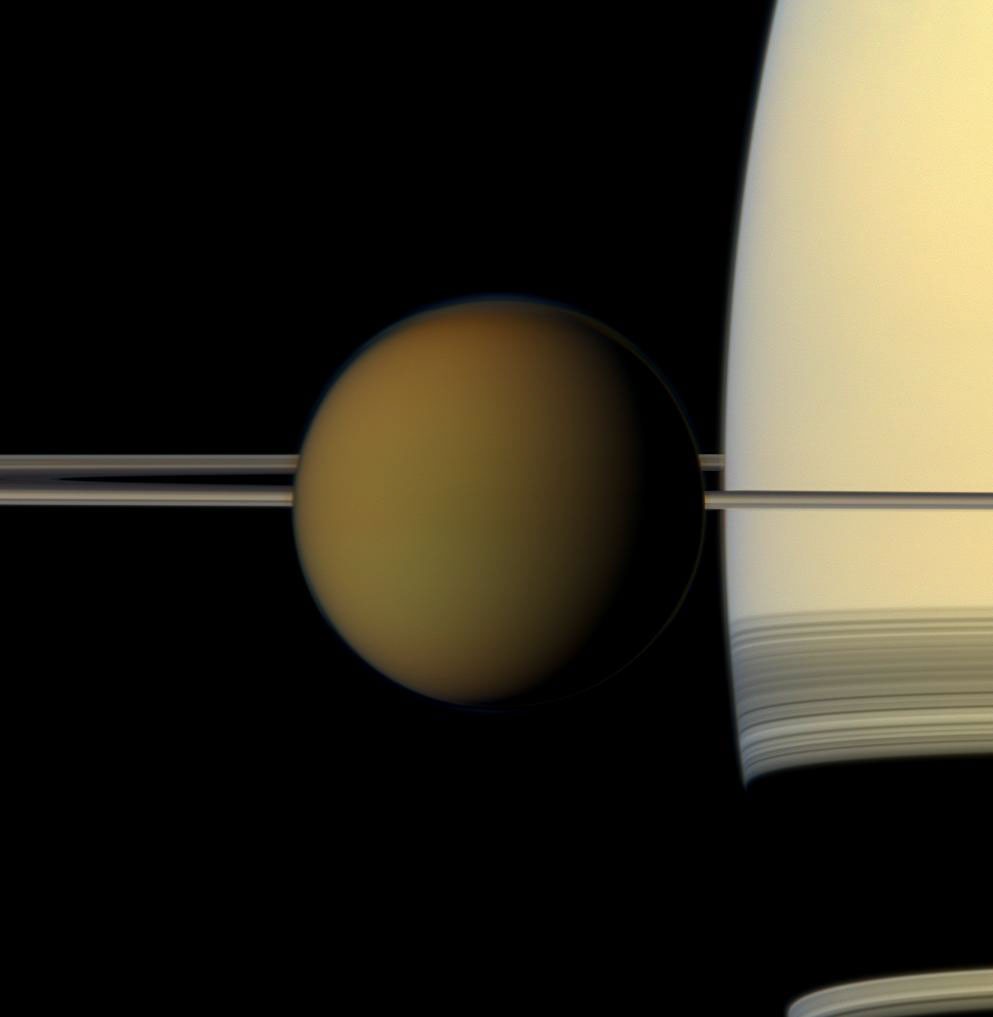
A human who stepped onto Titan without protective equipment would die quickly. The surprising part is what would not kill them.
They would not swell from exposure to a near-vacuum. Moisture on their eyes and tongue would not begin boiling because the surrounding pressure had collapsed. Unlike a person standing on the Moon or Mars, they would not need a garment inflated around the body simply to keep their tissues under pressure.
Saturn’s largest moon has a surface atmosphere about 60 percent more pressurised than Earth’s. That makes Titan the only known solid surface beyond our planet where the ambient pressure itself falls within a broadly tolerable range for an unpressurised human body.
But this is a statement about pressure, not survivability. Titan’s “air” contains almost no oxygen. The ground is about minus 179 degrees Celsius. Methane and ethane take the place that liquid water occupies in Earth’s weather. An explorer would still need breathing equipment, active heating and a sealed, heavily insulated suit.
The suit just would not need to be a pressure suit.
Titan’s pressure is closer to a dive than a spacewalk
According to NASA’s Titan facts, the atmospheric pressure at the surface is about 60 percent greater than at sea level on Earth. NASA compares it with the pressure a swimmer experiences about 15 metres below the ocean surface. The European Space Agency gives the standard figure as 1,500 millibars, or roughly 1.5 bar.
Human divers routinely experience greater total pressure than that, although safe breathing mixtures, ascent rates and exposure times matter underwater. The important point is simpler: 1.5 to 1.6 bar is not remotely like vacuum. It is a pressure the body can physically tolerate.
This is remarkable because Titan’s gravity is only about one-seventh of Earth’s. Surface pressure comes from the weight of the column of gas overhead, and weak gravity allows Titan’s atmosphere to stretch far into space. The moon has accumulated such a deep atmospheric envelope that there is still plenty of gas pressing down at ground level.
The gas is also extremely cold and therefore tightly packed. Near Titan’s surface, its atmospheric density is roughly four times that of air on Earth, even though the pressure is only about one and a half times greater. An explorer would experience the atmosphere as something physically substantial, not the faint wisp found on Mars.
What a pressure suit actually does
Popular descriptions of vacuum exposure often say the body would explode. The body would not explode. The real dangers are faster, subtler and no less lethal.
As external pressure falls, gases inside the lungs and digestive tract expand. Oxygen can no longer move into the blood. Below a sufficiently low pressure, exposed water at body temperature can change into vapour, a process called ebullism. NASA identifies the Armstrong line at about 63,000 feet as the altitude where the vapour pressure of water equals the surrounding atmospheric pressure.
A pressure suit creates a small artificial atmosphere around the astronaut. It does not need to reproduce Earth’s full sea-level pressure, but it must apply enough pressure to keep body fluids stable and allow a suitable breathing gas to deliver oxygen.
Titan does that first job naturally. Its atmosphere pushes on the skin from every direction, so clothing would not need to remain inflated or hold a large pressure difference against the environment. A tear in the outer insulation would still be a terrifying emergency, but it would not cause decompression in the way a torn spacesuit would on the Moon.
This is the narrow, useful meaning of “you could step outside without a pressure suit.” It does not mean shirt sleeves. A realistic Titan outfit would be a sealed environmental suit that happened to operate at ambient pressure.
The air would suffocate you
Titan’s atmosphere is about 95 percent nitrogen and about 5 percent methane. Oxygen is effectively absent. One breath would not provide the lungs with anything useful, and loss of consciousness from hypoxia would follow rapidly.
An explorer would therefore need a full-face mask or helmet with a supply of breathable gas and a way to remove exhaled carbon dioxide and moisture. Because the surrounding atmosphere already supplies pressure, the breathing system could deliver gas near ambient pressure. In that limited sense, its design problem resembles diving equipment more than an astronaut’s portable bubble of atmosphere.
The comparison has limits. A diver’s skin is protected by liquid water at a temperature that suitable insulation can manage. Titan’s atmosphere is a cryogenic nitrogen-methane mixture. The breathing apparatus would have to stop that external gas entering the lungs, prevent internal moisture from freezing and keep seals flexible at temperatures that destroy ordinary equipment.
Supplying pure oxygen at Titan’s full ambient pressure would also create its own physiological and fire-safety problems. An engineered system would use a controlled breathing mixture and pressure, not simply connect an oxygen bottle to a mask.
Minus 179 degrees changes the meaning of weather
Titan’s typical surface temperature is about 94 kelvin, or minus 179 degrees Celsius. At that temperature, water ice is not a slippery seasonal coating. It behaves as the moon’s hard mineral bedrock.
The dense atmosphere would carry heat away from exposed skin far more effectively than vacuum. Tissue would freeze, unprotected eyes would be injured and inhaling the ambient gas would cause catastrophic cold damage even before oxygen deprivation finished the job. Batteries lose performance, lubricants stop behaving normally, polymers become brittle and water produced by the life-support system becomes a persistent freezing hazard.
A viable suit would therefore need deep insulation, active heating and carefully protected joints, electronics and plumbing. It might not be pressurised, but it would still be an advanced spacecraft wrapped around a person.
Titan’s cold also creates its most Earthlike feature. Methane boils at temperatures far below the freezing point of water on Earth, but on Titan it can exist as a liquid. Ethane and dissolved nitrogen join it in the moon’s lakes and seas. The chemistry is alien, while the landscape it produces is strangely recognisable.
Rain really falls, but not like an endless drizzle
Titan has a working hydrocarbon weather cycle. Methane evaporates from surface reservoirs, enters the atmosphere, condenses into clouds and returns as rain. It flows downhill through channels and collects in lakes and polar seas before beginning the cycle again.
Ethane is created when sunlight and energetic particles break atmospheric methane apart and its fragments recombine. NASA notes that Titan’s rain contains liquid methane and ethane, both familiar as gases under ordinary conditions on Earth.
The title should not be read as a forecast of steady rain everywhere. Titan’s equatorial regions are generally dry, and precipitation appears to be seasonal and storm-driven. The Huygens probe landed on ground that showed no sign of very recent rain; later analysis found a surface with a crust-like top and softer material below, while organic dust lifted during the impact. Huygens bounced, slid and wobbled before coming to rest.
Cassini nevertheless caught weather changing the ground. A sequence of observations in 2010 showed large equatorial areas darkening soon after extensive cloud activity. Scientists interpreted those changes as methane rain wetting Titan’s surface.
The result is the only known landscape beyond Earth where liquid falls from clouds, runs through rivers, fills stable seas and evaporates back into the sky. The molecules differ, but the broad logic of the cycle is familiar.
The atmosphere that saves pressure suits also makes flight easy
Titan’s thick air and weak gravity produce a second unusual advantage: flying is comparatively easy. Rotor blades have a dense fluid to push against, while the vehicle they lift weighs only about one-seventh as much as it would on Earth.
NASA designed its Dragonfly rotorcraft around exactly that combination. The mission will travel between sites rather than creeping across the surface on wheels. NASA says Titan’s dense atmosphere, low gravity and frigid temperature will allow Dragonfly to remain aloft efficiently and cover far more ground than a traditional rover. The agency’s overview describes why those conditions suit a flying laboratory.
For a human visitor, low gravity would make movement easier and falls slower, but the heavy clothing and life-support package would still dominate the experience. The thick atmosphere would create noticeable aerodynamic drag. A person might weigh little, yet every warm breath and functioning joint would depend on equipment fighting the cold.
One friendly number does not make a friendly world
Titan is often called Earthlike, and with good reason. It has a nitrogen sky, clouds, rain, winds, dunes, rivers and seas. It may also conceal warm water within its interior, although recent Cassini reanalysis suggests slushy ice and melt pockets may replace the simple global-ocean picture.
Yet nearly every resemblance comes with a chemical reversal. The rocks are water ice. The rain and rivers are hydrocarbons. The sky is nitrogen without breathable oxygen. The comfortable pressure encloses a world colder than any natural environment on Earth.
That is why the pressure-suit fact is both true and easy to misunderstand. Titan uniquely provides the pressure that an unprotected body lacks almost everywhere else beyond Earth. It does not provide warmth, oxygen or safety.
A visitor could dispense with the inflated pressure garment. They would still need a heated, sealed personal habitat before taking the first step into methane rain.