
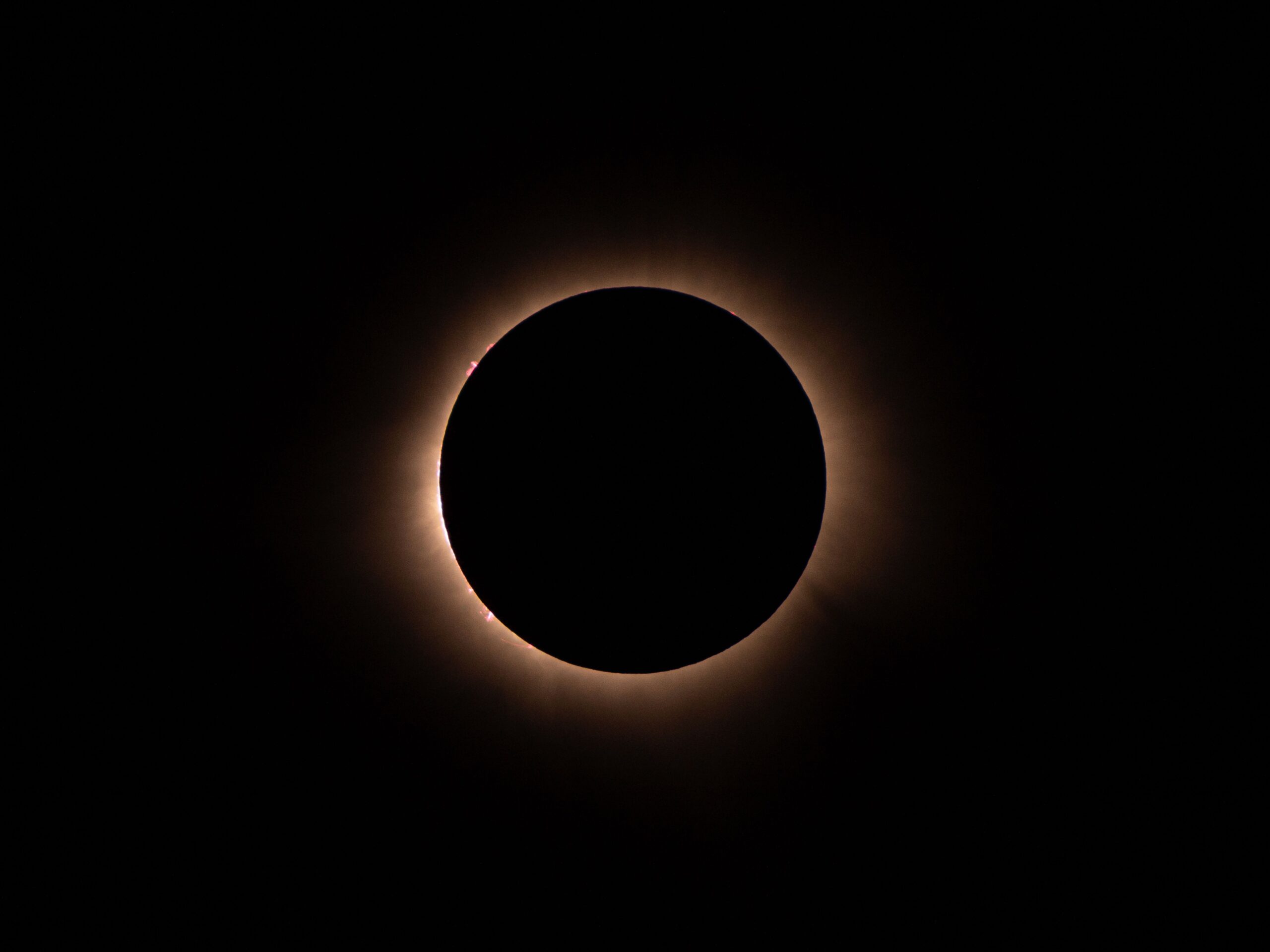
For a few minutes inside a narrow moving shadow, the brightest object in Earth’s sky becomes a black circle. Around it hangs a white, finely structured atmosphere that was present all along but drowned in glare.
The familiar explanation sounds almost designed. The Sun is roughly 400 times wider than the Moon, yet it also lies roughly 400 times farther away. The two enormous differences nearly cancel when projected onto the sky.
That is why a small rocky satellite can cover a star more than a million kilometres across. It is also why the coverage is close enough to reveal the corona rather than merely turning daytime dark.
The word “roughly” matters. The ratio is not exact, the apparent sizes change and the Moon does not produce totality every time it crosses the Sun. Earth’s eclipse is better understood as a shifting near-match than a permanent 400-to-one lock.
Apparent size is the ratio that matters
NASA’s guide to eclipse geometry uses the rounded comparison: the Sun is about 400 times larger than the Moon and about 400 times farther away. An object’s apparent angular diameter depends mainly on its physical diameter relative to its distance from the observer.
The Sun’s diameter is close to 1.39 million kilometres. The Moon’s is about 3,475 kilometres. Dividing one by the other gives a physical-size ratio a little above 400.
For distance, Earth lies about 149.6 million kilometres from the Sun on average, while the Moon’s average distance is about 384,400 kilometres. That ratio is closer to 389. Both distances vary, and an observer on Earth’s surface is not measuring from the centre of the planet.
So 400 and 400 should not be treated as matching laboratory measurements. They are a compact description of why two bodies of radically different size each span roughly half a degree in the sky.
A thumb held close to the eye can hide a building. The Moon performs the same piece of perspective on a celestial scale.
The fit changes from one eclipse to another
The Moon does not travel around Earth in a perfect circle. Its distance changes substantially between perigee, the closer part of its orbit, and apogee, the farther part. Earth’s orbit is also slightly elliptical, so the Sun’s apparent diameter changes more gently through the year.
When a well-aligned Moon appears a little larger than the Sun, its dark central shadow reaches Earth’s surface. An observer inside that umbra sees the photosphere completely covered and experiences totality.
When the Moon lies farther away and appears slightly smaller, the tip of the umbra falls short of Earth. Observers aligned beyond it see the bright outer edge of the Sun surrounding the Moon. That is an annular, or “ring of fire”, eclipse.
Rare hybrid eclipses change character along their path because Earth’s curved surface brings some locations close enough to the Moon’s shadow for totality while others remain in annularity.
This variation is evidence of the near-match. If the disks were permanently identical in apparent diameter, there would be no alternating family of total and annular eclipses.
A new Moon is necessary but not sufficient
The Moon passes between Earth and the Sun at every new Moon. A solar eclipse does not occur everywhere on Earth each month because the lunar orbit is tilted by about five degrees relative to the plane of Earth’s orbit around the Sun.
Most new Moons pass north or south of the required line. Eclipses become possible near the two points where the lunar path crosses that orbital plane. These points are called nodes.
Even then, the central shadow covers only a small part of Earth. The umbra sweeps out the path of totality, while a much wider region inside the penumbra sees a partial eclipse. A person can be close to the central path geographically and still miss the defining event.
The coincidence therefore has four moving parts: apparent size, lunar phase, alignment near a node and the observer’s position inside the shadow.
Totality removes the glare but leaves the atmosphere
The bright disk usually described as the Sun’s surface is the photosphere, the layer from which most visible sunlight escapes. The corona is the Sun’s tenuous outer atmosphere, extending millions of kilometres into space.
The corona never disappears between eclipses. It is simply far fainter than the photosphere. Scattered daylight in Earth’s atmosphere and the eye’s response to the bright solar disk normally overwhelm it.
During totality, the Moon covers the photosphere while the corona reaches far beyond the lunar edge. White streamers, loops and plumes emerge around the black disk. Pink prominences and a thin chromosphere may also become visible near the limb.
Artificial coronagraphs reproduce the basic trick with an occulting disk, allowing the corona to be studied routinely from the ground and space. But the hardware must block a little extra light and account for scattering. NASA notes that a natural total eclipse can expose parts of the inner corona that ordinary coronagraphs conceal.
That is the scientific advantage of the Moon’s close fit. An oversized moon could create a darker and longer eclipse while also hiding more of the region researchers want to see.
Other planets have eclipses, though the comparison is complicated
Earth is not the only world where one body passes in front of the Sun. The broad word “eclipse” covers partial coverage, complete coverage, annular events and the small silhouettes usually called transits.
Mercury and Venus have no moons, so an observer there has no natural satellite to create a solar eclipse. Mars has Phobos and Deimos, but both are small and irregular. Rovers have watched Phobos cross the Sun as a lumpy silhouette without covering it completely.
The giant planets possess more candidates. Their distant Sun looks smaller, but their moons occupy a wide range of sizes and orbital distances. Several can cast full shadows into the planets’ atmospheres.
A NASA survey published in 2026 identifies Callisto as the strongest Jupiter-system comparison. From an appropriate position near Jupiter, it can have the right apparent size to produce an Earth-like total solar eclipse. Io, Europa and Ganymede orbit closer and generally cover too much of the surrounding corona.
NASA also points to Saturn’s small moons Janus, Pandora, Prometheus and Epimetheus as bodies capable of total and annular eclipses. Their irregular shapes and rapid geometry would make the edge and timing unlike the smooth lunar disk seen from Earth.
The headline’s uniqueness claim therefore needs a precise reading. Totality itself is not unique to Earth, and Callisto may approach the size-distance match. What is not known elsewhere in our Solar System is the same complete observing arrangement: a large, round Moon closely matching the Sun, revealing the inner corona from a stable solid surface beneath a transparent atmosphere.
Jupiter and Saturn do not offer a solid surface on which to stand. Any account of their eclipses describes a hypothetical observer in an atmosphere, spacecraft or floating platform. The physics is real; the familiar viewing platform is not.
The Moon’s match is only passing through
The early Moon orbited much closer to Earth and would have appeared substantially larger. Ancient eclipses could still be total, but the oversized lunar disk would hide more of the corona around the Sun.
Tidal interactions gradually transfer angular momentum within the Earth-Moon system. Precise lunar laser ranging shows that the Moon’s average distance is increasing by about 3.8 centimetres each year.
That rate should not simply be projected unchanged across geological time, because tidal evolution depends on the changing Earth, oceans and orbital system. Even so, models agree on the direction. The Moon will eventually look too small to cover the photosphere from anywhere on Earth.
NASA estimates that the threshold lies more than 600 million years ahead; broader estimates often place the final total eclipse between roughly half a billion and a billion years from now. Annular and partial eclipses will continue after totality ends.
Humanity therefore lives inside a temporary interval. The Moon is neither so close that it always dwarfs the Sun nor so distant that it always leaves a ring.
The corona makes the coincidence scientifically useful
For centuries, eclipses supplied the only direct naked-eye view of the solar corona. They remain valuable even in an age of space telescopes because instruments can be positioned along the shadow path and tuned to structures close to the photosphere.
The corona also carries one of solar physics’ enduring puzzles. It reaches temperatures of a million degrees or more even though the visible layer below is far cooler. ScienceBlog’s earlier examination of the coronal-heating problem explains why magnetic waves and tiny bursts of reconnection remain central to the search for an answer.
Eclipse observations can trace fine structure, magnetic organisation and how material flows outward toward the solar wind. The Moon is not merely blocking a view. It is removing the overwhelming foreground so the physically interesting faint light can be measured.
The one safe unfiltered moment has exact boundaries
The same geometry that reveals the corona creates an important viewing distinction. According to NASA’s current eclipse-safety guidance, direct viewing without specialised eye protection is safe only during the brief total phase, when the Moon completely covers the Sun’s bright face, and only from inside the path of totality.
During every partial phase, safe eclipse glasses or a handheld solar viewer are required. Ordinary sunglasses are not sufficient. Annular and partial eclipses have no unfiltered viewing period at all.
Cameras, telescopes and binoculars need solar filters designed for the instrument and fitted over the front of the optics. Looking through them while merely wearing eclipse glasses can concentrate sunlight and cause severe injury.
As soon as any bright photosphere reappears after totality, eye protection must return. The corona is visible precisely because the dangerous glare has reached zero, not because it has merely become small.
A near-perfect eclipse is perfect because it is not exact
The 400-to-one coincidence is a clean entry point into the geometry, not its final measurement. Real eclipses depend on changing distances, an inclined orbit, a narrow shadow and a moving observer.
Other worlds can produce total eclipses, and a few moons may come surprisingly close to the required apparent size. Earth remains exceptional in the quality and accessibility of the match rather than in possessing the only shadow that can cover a star.
Most importantly, the Moon is only slightly larger than the Sun during totality. It hides the source of the glare while sparing the atmosphere around it.
A mathematically perfect overlap would be an abstraction. Earth’s changing, temporary and slightly uneven fit is what turns an alignment into a view of the corona.