

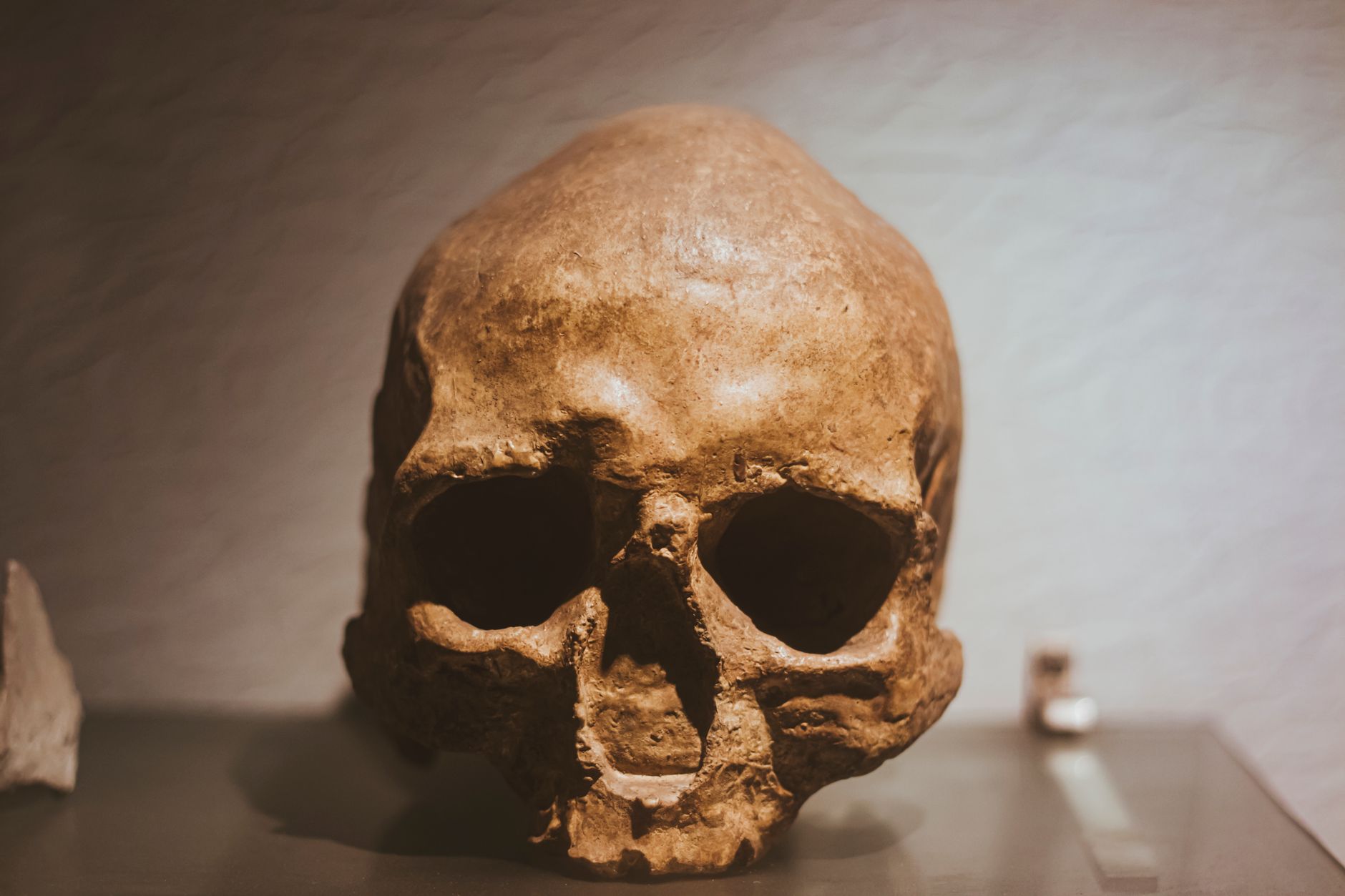
A genetic signal found in living people points to an encounter in Africa between the ancestors of modern humans and a deeply separated human lineage before the major migration out of the continent more than 50,000 years ago. The unknown group left no sequenced genome of its own, yet the new analysis estimates that roughly 0.49% to 1.1% of the genomes in each population studied came from this ancestry.
The finding comes from a 2026 Science paper led by Yulin Zhang and Arjun Biddanda. It is a computational inference from present-day genomes, not DNA recovered from an ancient African fossil. The researchers can map the genetic contribution and estimate how deeply its source diverged, but they cannot name the people who carried it.
This is one study, not settled consensus about the shape of early human populations in Africa.
A lineage inferred without its genome
Neanderthal and Denisovan ancestry can be recognized partly because scientists have sequenced DNA from fossils belonging to those groups. Researchers can compare stretches of a living person’s genome with those reference sequences and look for a close match.
No comparable reference genome exists for most ancient human groups that lived in Africa. Heat and moisture break DNA apart, making very old genetic material much harder to recover there than in cold caves at higher latitudes. That leaves a difficult question: how can an unknown ancestry source be detected when there is no ancient sequence to compare against?
Zhang and colleagues developed a method called TRACE, short for TRacking Archaic Contributions via ARG Estimation. It works with ancestral recombination graphs, statistical reconstructions of how different sections of present-day genomes relate to one another through time.
An introgressed segment carries an unusual combination of signals. Its ancestry may reach much farther back than neighboring DNA because it spent a long period evolving in a separated population. Yet the segment can show fewer signs of recombination than its age would ordinarily suggest because it re-entered the ancestors of the sampled population much later.
TRACE searches for that combination without requiring a genome from the archaic source or a supposedly unadmixed modern comparison population. In simulations, the method produced a low false-discovery rate. When applied to real genomes, it also recovered many regions already identified as Neanderthal or Denisovan ancestry, giving the team a test against known cases.
What “every population studied” covers
The central analysis used 503 phased whole-genome sequences from the 1000 Genomes Project. These represented five sampled populations: 91 British people, 103 Han Chinese people, 102 Indian Telugu people, 108 Yoruba people from West Africa and 99 Luhya people from East Africa.
TRACE detected the unknown ancestry in all five groups.
That is what “every modern population studied” means here. It does not mean the team tested every population on Earth, or that every living person has been individually shown to carry one of the detected segments. The result is a consistent population-level signal across the African and non-African groups included in this dataset.
The researchers separately analyzed 92 high-coverage genomes from people in Oceania while investigating a second, much older ancestry signal associated with Denisovans. Ghost segments in those genomes overlapped with segments found in the 1000 Genomes populations, adding support for the ancestry’s broad distribution.
A previous ScienceBlog report examined both unidentified lineages and the full set of 503 genomes. The African event is the one that directly contributed the 0.49% to 1.1% signal shared across the five main sampled groups. The other, “super-archaic” contribution reached some living people indirectly through Denisovan ancestry and is not the subject of the present headline.
Why the encounter is placed in Africa
The unknown segments appeared in both African and non-African populations. Most of the segments detected outside Africa were shared with people in sub-Saharan Africa, while the Yoruba and Luhya samples retained a greater diversity of distinct segments.
That pattern fits an admixture event before the main out-of-Africa expansion. A subset of the African population moved into Eurasia and carried some of the inherited segments with it. The population bottleneck associated with that dispersal reduced genetic diversity, leaving non-African descendants with a narrower sample of the older variation.
The UC Berkeley account of the study places the interbreeding before 50,000 years ago, prior to the most recent expansion of Homo sapiens from Africa into Eurasia. The genomic paper itself is more cautious about a precise date. Its central claim is that the event preceded that expansion; it says the number, timing and geographical locations of possible African admixture events remain uncertain.
The date of mixing should not be confused with the much older date at which the two lineages separated. TRACE estimated an average coalescence time, the point at which the inferred ghost and modern-human segments last shared an ancestor, of about 830,000 years. The 95% confidence interval ran from approximately 610,000 to 1.27 million years.
On that evidence, the authors conclude that the unknown population diverged more than 500,000 years ago, around the broad era in which the ancestors of Neanderthals and Denisovans were also separating from the lineage leading to modern humans.
“Ghost” does not identify a species
In population genetics, a ghost lineage is an ancestry source required or favored by a model even though no matching reference genome has been sequenced. The term does not establish that the source was a newly discovered species.
The authors note that Middle Pleistocene Homo groups in Africa, including populations sometimes assigned to Homo heidelbergensis, are possible candidates. That is a hypothesis based on overlapping time and place, not a genetic match. No skull, tooth or archaeological culture has been connected to these segments.
The deeper problem is that human evolution in Africa may not have followed a tidy sequence of long-isolated branches. Populations could divide, remain partly connected and later merge again. A genetic pattern described as introgression from an archaic lineage might therefore reflect a distinct ancient population within a structured African network rather than a species boundary that fossils would make obvious.
Earlier studies had already reported ghost ancestry, especially in West African genomes. A 2020 study of four West African populations inferred a substantially larger archaic contribution under a different demographic model. Those percentages are not directly interchangeable with the TRACE estimate. Each method defines, detects and models ancient ancestry differently, which is one reason the new result should be treated as a refinement in an active debate rather than the first hint of unknown African ancestry.
How much of the ghost genome remains
The 0.49% to 1.1% estimate applies to the average amount found in an individual genome from each sampled population. Across all people in the dataset, however, different individuals carried different pieces. When the researchers combined every ghost segment they identified, those pieces covered about 1.55 billion bases, or 71.5% of the accessible human genome.
That does not mean any person is 71.5% descended from the unknown lineage.
It means the lineage’s surviving fragments are scattered widely across humanity. Many sections occur in only some people or populations, so pooling the pieces reconstructs far more of the ancestral contribution than any single genome contains. The same principle is used to recover a larger collective portion of the Neanderthal genome from the different fragments carried by living people.
Ghost ancestry was less common near functional elements and in regions with low recombination, a pattern consistent with natural selection removing some inherited variants over time. The team also found regions where ghost segments were relatively frequent, including areas near genes involved in immune and metabolic processes. Those locations do not establish that the variants are beneficial or that they affect health today.
What would reveal who they were
TRACE provides a map of candidate archaic segments, but its conclusions depend on reconstructed genealogies, mutation rates, generation-time assumptions, length thresholds and demographic simulations. The method also recovered somewhat less known Neanderthal and Denisovan ancestry than some previous approaches, suggesting that it may miss genuine archaic segments even while keeping false positives low.
More genomes from underrepresented African and Asian populations could show whether the signal is equally widespread beyond the five main groups studied. Better ancient DNA recovery in Africa would provide a direct comparison, although preservation remains a formidable obstacle. Proteins recovered from fossils may eventually offer another route when DNA is gone.
For now, the study can say that a deeply separated population contributed DNA to the ancestors of the sampled modern groups before the out-of-Africa expansion. Matching that genetic population to a named group of ancient humans remains unresolved.