
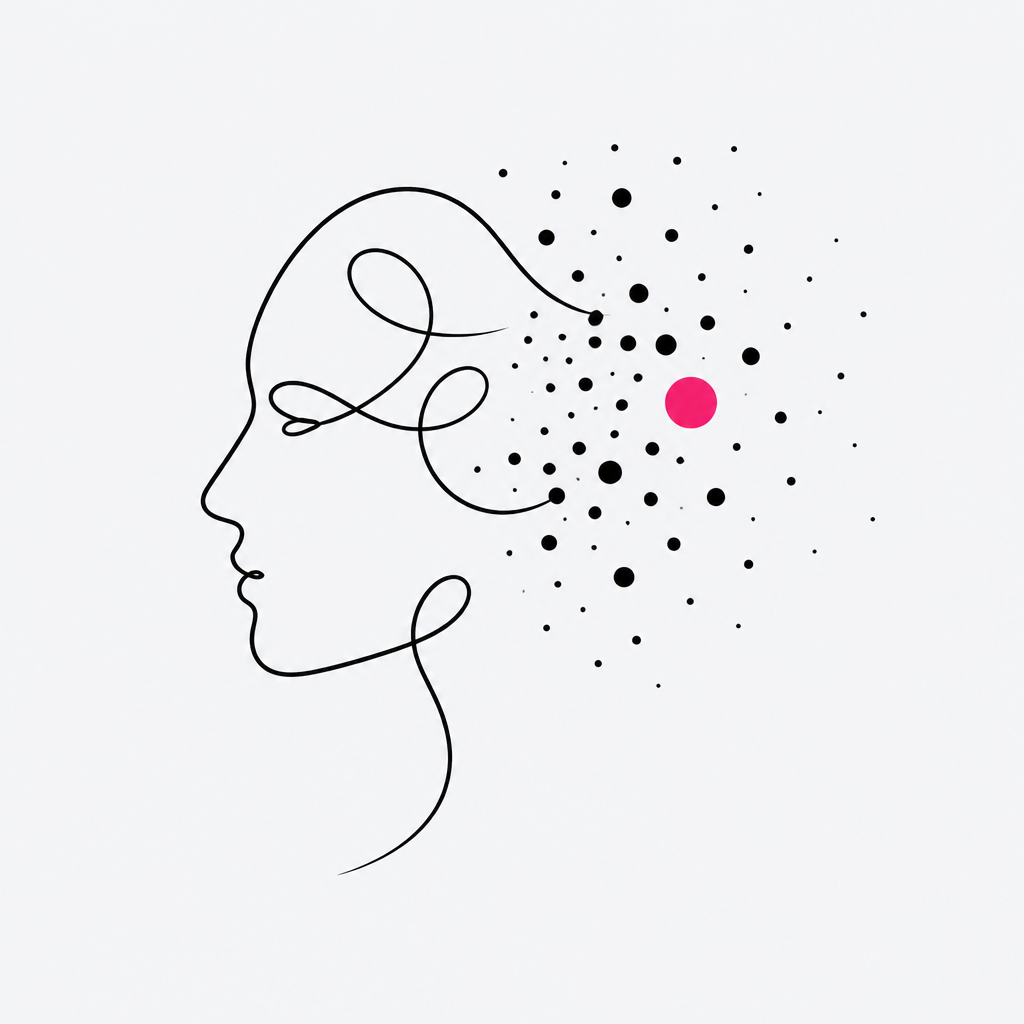

Some thoughts arrive carrying a useful question. What went wrong? What could happen next? What am I missing?
Then, somewhere along the way, the question stops opening the problem and starts circling it. You replay a conversation with improved dialogue. You prepare for an outcome, then prepare for the preparation to fail. You find a new angle, but it leads back to the same place. The thinking still feels active because the sentences keep coming.
A 2015 study in Personality and Individual Differences offers a tantalising clue about why some minds may be especially well equipped for this. In a sample of 126 university students, verbal intelligence uniquely predicted both worry and rumination. People who scored higher on verbal comprehension also tended to report more of both forms of repetitive thought.
It is an appealing result, particularly if you would like to recast overthinking as evidence of brilliance. But that is not what the study found. The effects were modest, the sample was narrow and the design could not establish cause. Its real interest is subtler: the same facility with language that helps us take a problem apart may also make it easier to keep taking the problem apart after the useful work is done.
What the researchers actually measured
The peer-reviewed study by Alexander Penney and colleagues involved 126 undergraduates. Their average age was 20.46, 77 per cent were women and 85.7 per cent were white. That last detail is not housekeeping. A small, mostly young and demographically similar group gives us a finding to investigate, not a rule about humanity.
Verbal intelligence was assessed with the Verbal Comprehension Index of the Wechsler Adult Intelligence Scale. Participants completed vocabulary, similarities and comprehension tasks. These tests ask people to define words, identify how concepts are alike and reason through situations using language. Scores in the sample ranged from 74 to 130.
The researchers measured non-verbal intelligence separately with Raven’s Standard Progressive Matrices, which involves selecting the piece that completes a visual pattern. Keeping the two kinds of ability apart was central to the question. Was repetitive thought linked to intelligence in general, or specifically to skill with words?
Participants also filled out questionnaires covering worry, rumination, depression symptoms, generalised anxiety symptoms, social anxiety, post-event processing, test anxiety and their negative mood during the session. These were self-report scales, not clinical interviews. The researchers therefore could not say how many participants met criteria for any disorder, and the paper should not be read as a study of diagnosed patients.
“Uniquely predicted” sounds stronger than it is
In everyday language, prediction means knowing what will happen next. In statistics, a “unique predictor” can simply be a variable that explains some differences in an outcome after other variables in the model have been considered. It need not forecast an individual person’s future, and it certainly does not establish cause.
After the researchers controlled for test anxiety and negative mood during the session, verbal comprehension had a partial correlation of .21 with worry and .24 with rumination. In the final regression models, verbal intelligence added about 2 per cent of explained variance in worry and 4 per cent in rumination.
Those are real but modest increments. They are not enough to turn a vocabulary score into a worry detector. Two people with similar verbal ability can have very different mental habits, while two habitual worriers can differ greatly in verbal skill. The result describes an average tendency within this sample.
There is another useful boundary. “Overthinking” was not a variable in the paper. It is an everyday umbrella term, not a clinical diagnosis or a precisely measured construct here. The researchers measured worry with the Penn State Worry Questionnaire and rumination with a scale focused on brooding and reflection. The headline translates those constructs into ordinary language, but it should not erase the distinction.
Worry looks ahead; rumination looks back
Worry and rumination often travel together, but they do not have identical directions. Worry is usually future-facing. Its favourite opening is “what if?” Rumination tends to look backward or inward: Why did this happen? What does it mean? Why am I like this?
Both can resemble problem-solving because both use some of the same equipment. Words let us name risks, divide a large problem into smaller ones, compare possible futures and rehearse a response before we need it. The ability to form precise verbal distinctions is plainly useful. It is how a vague sense that something is wrong can become a question we can actually answer.
But language also makes thought portable. A physical problem may no longer be in front of us, yet a sentence can bring it into the shower, the commute or the middle of the night. Experimental work describes worry as streams of negative verbal thought about possible outcomes. Once a threat has been converted into words, the mind can keep editing it without receiving any new information.
That suggests a useful, though untested, way to read the 2015 result. Verbal intelligence may increase the resolution of the mental workspace. More distinctions, counterarguments and hypothetical futures become available. That is a gift when the next sentence changes a decision. It becomes a loop when each sentence merely earns permission for another.
The anxiety finding that did not survive
The paper contains an especially important caution. Verbal intelligence initially showed positive relationships with symptoms of generalised anxiety and depression. But those relationships became non-significant when the analysis accounted for overlap among the different symptom measures.
In other words, the most defensible result was not “verbal intelligence predicts anxiety and depression.” It was the narrower link with worry and rumination. Verbal ability was not associated with social anxiety or with post-event processing, the habit of replaying social encounters afterwards.
Non-verbal intelligence produced a different pattern. Higher non-verbal scores were associated with less post-event processing. The authors speculated that people with stronger non-verbal ability might process non-verbal social information more efficiently, leaving less to revisit later. That is an interpretation, not something the experiment directly tested.
Direction remains unresolved too. Verbal skill could give repetitive thought more routes to follow. Repetitive thought could affect how someone performs during testing. Or another characteristic could influence both. The students were measured at one point in time, so the study cannot tell us whether one variable produced the other.
The hard part may be changing tracks
Thinking well is not only a matter of generating ideas. It also involves updating, discarding and shifting attention when a line of thought has stopped paying rent.
That distinction appears in other research. One study found that people high in worry and rumination had more difficulty switching the contents of working memory, particularly when the material was personally relevant and negative. The problem may not be an excess of raw thinking power. It may be that certain thoughts are unusually good at winning another turn.
Even then, the relationship is not a law. A later study involving 312 children and adolescents found that higher verbal intelligence was indirectly associated with less worry through lower intolerance of uncertainty. Better verbal reasoning might sometimes help a person make uncertainty more manageable rather than more elaborate. Age, context and the path connecting ability to worry all seem to matter.
Researchers also continue to debate how the shared process of repetitive negative thinking relates to the differences between worry and rumination. Experimental work finds that the two are strongly connected but may not have identical effects on attention and emotion. A neat story about “smart overthinkers” loses all of this texture.
A powerful tool can outlive its job
There is a human temptation to turn a statistical association into an identity: I overthink because I am intelligent, or I worry because my mind is unusually deep. That story can feel kinder than self-criticism, but it is still more certainty than this research offers.
A more grounded reading is that abilities and habits are different things. Verbal intelligence helps a person build explanations. It does not dictate which subjects receive that power, how long the analysis continues or whether new thoughts are adding information. For a related example of the difference between useful reflection and a self-renewing loop, ScienceBlog has examined research on moving from abstract “why” questions to more concrete thinking about what happened.
The 2015 paper was preliminary. It involved 126 students, relied on questionnaires and explained only a small portion of the variation in worry and rumination. Yet its central possibility is worth keeping. A strength does not become a weakness simply because it can be overused. The ability to analyse is still an ability. The mistake is assuming that because the mind can produce one more interpretation, one more rehearsal or one more exquisitely phrased concern, doing so must bring us closer to an answer.
Words can clarify a problem. They can also keep it alive. Intelligence supplies tools; it does not determine when to put them down.