

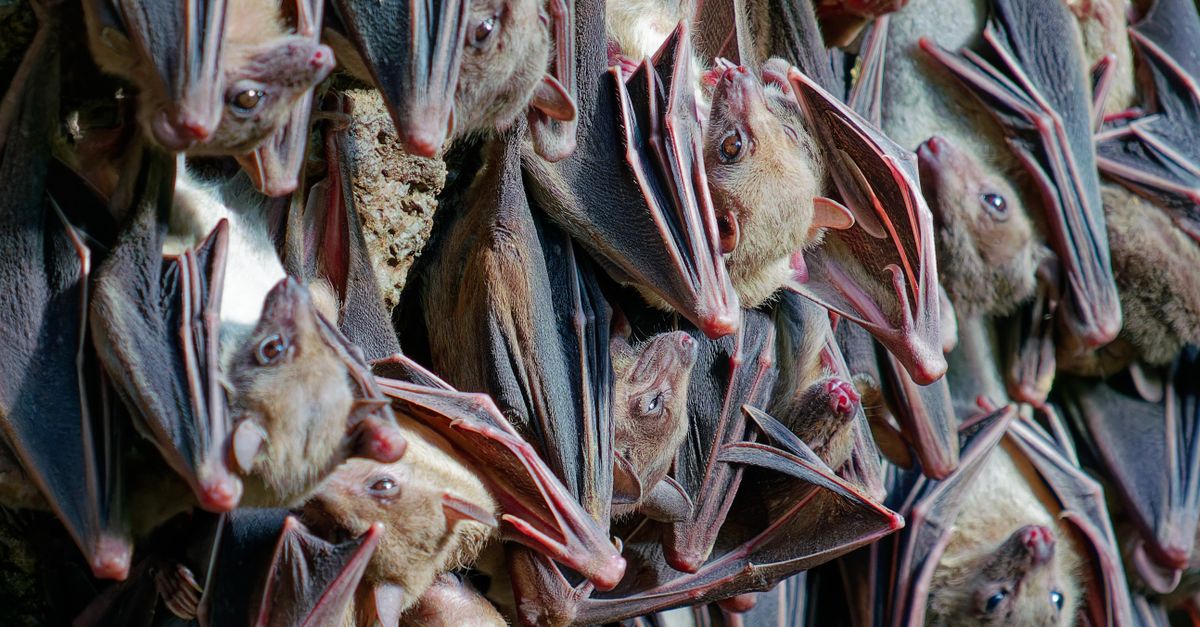
The surprise is not that bats make unusual antibodies. It is that some of them appear to begin with twice the usual genomic machinery for making an antibody’s heavy chain.
In a study published in Science Advances, researchers found two complete immunoglobulin heavy-chain loci on separate chromosomes in 26 species of vesper bats. Every other mammal examined closely enough has been understood to carry one such locus. Fish sometimes have duplicated arrangements, but nothing comparable had been established in a mammal.
That makes the discovery genuinely unusual. It also needs to be described carefully. The finding does not mean that every bat has this architecture, that one B cell normally makes two antibodies at once, or that the extra locus has been proved to protect bats from viruses. It reveals a previously hidden expansion of the adaptive immune system in one extraordinarily diverse bat family, and it offers a plausible new place to investigate viral tolerance.
A family hidden inside a familiar name
Vespertilionidae is the largest family of bats, with more than 500 recognised species as taxonomies are revised. Its members include pipistrelles, mouse-eared bats, long-eared bats, noctules and the big brown bat. They occupy almost every part of the world outside Antarctica and range from forests and deserts to city roofs.
The published study did not sequence all of those species. It identified the duplicated heavy-chain arrangement across 26 vesper species whose genomes could be examined. The detailed cellular work centred on the big brown bat, Eptesicus fuscus, a widespread North American insect-eater.
That distinction matters. The evidence supports an ancient feature of the vesper lineage, not a universal statement about every living vesper species. Nor did the researchers find the duplication outside Vespertilionidae in the bat genomes they examined. Bats are a vast order of more than 1,500 species, and their immune systems should not be treated as a single design.
Earlier ScienceBlog reporting on viral risk across the bat family tree reached much the same broader lesson from a different direction: associations with viruses of high epidemic potential cluster in particular lineages. “Bat immunity” is a useful shorthand, but it can conceal important differences between families and species.
What an antibody heavy-chain locus actually does
An antibody is often drawn as a Y. Its two long heavy chains form most of the structure, while two shorter light chains sit along the upper arms. The tips contain the variable regions that recognise a target. The lower part helps determine what the immune system does after that recognition.
The genome does not store one finished gene for every possible antibody. Instead, developing B cells assemble a variable region by choosing and joining gene segments known as V, D and J. Further variation appears at the joins. After a B cell encounters an antigen, mutation and selection can refine the fit still further.
The heavy-chain locus also contains constant-region genes. These allow a B cell to begin with IgM and later switch to antibody classes such as IgG or IgA without discarding the variable region that recognises the target. IgG is abundant in blood and tissues, while IgA is especially important at mucosal surfaces.
A locus, then, is not a single antibody gene. It is an organised genomic workshop containing many interchangeable segments and the instructions needed to rearrange them. Mammals were thought to have one heavy-chain workshop, accompanied by as many as two light-chain loci. The vesper bats examined here have two heavy-chain workshops on different chromosomes.
Two workshops with different inventories
In the big brown bat genome, the researchers called the smaller region A-IGH and the larger one B-IGH. A-IGH spans about 272,000 DNA letters on chromosome 5. B-IGH covers roughly 918,000 on chromosome 24.
Both loci contain the essential components required to build heavy chains, including V, D and J segments and constant-region genes. Yet they are not simple carbon copies.
A-IGH contains 33 annotated heavy-chain variable genes, about 15 per cent of which were classified as pseudogenes. B-IGH contains 99, but about 46.5 per cent were pseudogenes. A pseudogene resembles a working gene but has changes likely to prevent it from producing a normal functional product.
The larger B locus therefore offers a broader catalogue of germline variable sequences even after its many pseudogenes are considered. The smaller A locus is more compact and conserved. Those contrasting inventories are one reason the authors suspect the two regions may make different contributions rather than merely providing redundancy.
Long, repetitive immune loci are notoriously difficult to reconstruct from short fragments of DNA. The team relied on high-quality, chromosome-level, long-read assemblies and compared the surrounding genomic neighbourhoods, making it possible to place the two regions on separate chromosomes rather than mistaking an assembly error for a biological duplication.
An innovation tens of millions of years old
Comparing the heavy-chain regions across bat genomes allowed the researchers to ask when the extra locus appeared. Their evolutionary reconstruction points to one ancestral duplication in the vesper lineage.
The event appears to have occurred after vespertilionids separated from their closest sampled relatives around 37.5 million years ago, and before two major vesper subfamilies diverged around 26 million years ago. The confidence ranges around those dates are broad, as they usually are for deep evolutionary events, but the central point is firm: this is not a recent oddity in one population of big brown bats.
Once a gene region is duplicated, evolution can preserve both copies, degrade one, or push them towards different roles. Retaining two enormous, rearranging antibody loci for tens of millions of years suggests that both remained useful enough to escape deletion. That is an evolutionary clue, not proof of what the advantage was.
Vesper bats have shown other immune-gene duplications. Protein kinase R, or PKR, an antiviral sensor targeted by many viruses, has independently expanded and diversified in some bats. The new heavy-chain result adds the adaptive antibody response to a growing picture in which duplication creates extra raw material for immune evolution.
Both loci are active, but a B cell normally chooses one
Finding two well-preserved loci in a genome would mean less if one were silent. To test function, the team analysed 62,747 spleen cells from four big brown bats using single-cell RNA sequencing. They recovered full-length heavy-chain sequences from 5,010 B-lineage cells and found rearranged, expressed antibodies originating from both loci.
The two regions contributed to major B-cell states and to plasma cells, the antibody-secreting descendants of activated B cells. A separate bulk analysis of six animals produced 307,312 productive B-cell receptor sequences, giving the researchers a much deeper view of which gene segments appeared in the expressed repertoire.
Crucially, an individual B cell did not normally combine the systems indiscriminately. Mammalian B cells use a safeguard called allelic exclusion, which generally permits only one productive heavy-chain identity per cell. The big brown bats appeared to preserve that rule despite having two loci on different chromosomes.
Only about 2 per cent of the relevant cells showed two in-frame heavy-chain transcripts with different recognition regions. That small fraction was consistent with technical doublets, in which two cells are accidentally read together, or with the limited exceptions expected in this kind of dataset. The result argues against an immune system in which each B cell routinely produces two competing receptors.
The smaller locus appears to get the first attempt
The choice between the loci was not even. Among naive B cells, receptors derived from A-IGH outnumbered those from B-IGH by a ratio of 3.41 to one.
The authors propose an ordered process. A developing B cell may try to make a productive rearrangement from the smaller A locus first. If that attempt fails, the larger B locus offers additional chances. A simple model based on the number of available chromosome copies predicted an A-first ratio near 2.25, close enough to make ordered rearrangement plausible even though the observed bias was stronger.
This sequence would help reconcile two apparently opposing benefits. Trying the compact, conserved system first may impose order on development. Keeping the larger, more varied system in reserve may rescue cells whose initial rearrangement failed and broaden the range of receptors available to the population.
Direct developmental experiments are still needed. The single-cell data capture the results in spleen cells, not a frame-by-frame record of rearrangement inside the bone marrow. “A first, B second” is the study’s best-supported model, not a camera recording of the process.
Signs of different jobs after an antigen arrives
The clearest hints of specialisation appeared when the researchers compared antibody class switching, mutation and gene use. IgA-switched cells disproportionately used A-IGH, with a median of 38 A-derived cells against seven B-derived cells in the sampled animals. B-IGH appeared more often in cells that had not switched away from IgM.
Somatic hypermutation also showed different patterns between loci. Across the repertoires, mutation reached as high as 22.7 per cent in some sequences. Mean mutation was about 1.8 per cent in IgM, 4.8 per cent in IgA and 4.1 per cent in IgG, consistent with more extensive refinement in antigen-experienced, class-switched cells.
Together with the larger catalogue of variable genes in B-IGH, these patterns suggest a division of labour. B-IGH may contribute relatively broad early recognition through germline diversity, while A-IGH may be favoured when B cells mature, switch class and refine affinity. That interpretation is biologically coherent, but it remains a hypothesis.
The decisive tests would expose or vaccinate bats against known antigens, follow individual B-cell lineages over time, and measure what A-derived and B-derived antibodies actually bind. The current study mapped architecture and natural repertoires. It did not identify a virus neutralised only by one locus.
Why viral tolerance is a possibility, not a conclusion
Many bat species can sustain infections that cause little obvious illness in the bat yet are dangerous after crossing into another host. But tolerance is not the same as invulnerability. Outcomes depend on the bat species, virus, dose, age and physiological state, and bats can become ill or die from infections.
ScienceBlog’s earlier account of antiviral and cancer-related gene evolution in bats described genomic work on two species from other families. That study found rapid change in genes involved in immunity, cancer suppression and DNA repair, reinforcing the idea that bats have reached unusual disease outcomes through more than one evolutionary route.
A broader Bat1K comparison of 115 mammalian genomes found unusually strong selection across bat immune genes, including changes in viral entry, detection, interferon activity and inflammatory regulation. Those findings concern many moving parts of innate immunity. The new antibody duplication belongs to adaptive immunity, where B cells remember and refine responses to particular targets.
The duplicated loci could help by expanding recognition, providing alternative routes around viral immune evasion, or separating fast initial responses from more refined mucosal and systemic ones. They could also matter for pathogens other than viruses. None of those possibilities was directly tested in the new Science Advances study.
There was no infection challenge, no comparison showing that vesper bats with two loci fare better than bats with one, and no manipulation that removed either locus. The authors therefore use appropriately cautious language: the arrangement may contribute to resistance to viral disease. It cannot yet explain viral tolerance on its own.
The practical problem for bat antibody research
The discovery also exposes a measurement problem. Much of mammalian immunology rests on laboratory mice, humans and a small number of well-equipped model species. Reagents designed around one familiar heavy-chain locus may bind some bat antibodies better than others or miss an entire portion of the response.
Serological studies often concentrate on IgG because it is a convenient marker of past exposure. In vesper bats, that may underrepresent responses associated with B-IGH, especially if the larger locus contributes disproportionately to IgM and early recognition. Assays may need to measure IgM, IgG and IgA and confirm that their reagents recognise products from both loci.
This matters for interpreting wildlife surveillance. A weak signal can mean that an animal has not encountered a pathogen, that antibody levels have faded, or simply that the test was built for the wrong molecular architecture. The new map does not invalidate earlier bat serology, but it identifies a source of uncertainty that can now be tested.
A recent review of bat humoral immunity stressed how sparse the evidence remains across species. Better reference genomes, bat-specific reagents, controlled infection studies and repeated sampling are needed before researchers can compare antibody durability and function without forcing very different animals into a mouse-shaped framework.
A large answer that still leaves the main question open
The most secure result is anatomical at the level of the genome: vesper bats carry two complete heavy-chain loci, both can rearrange and both contribute to expressed antibodies, while individual B cells largely preserve the one-receptor rule familiar from other mammals.
The most interesting result is functional but provisional: the compact A locus and the diverse B locus show different patterns of use, class switching and mutation. That makes specialisation more likely than pointless duplication.
The most tempting result is also the least settled. An extra antibody system may be one ingredient in the ability of some bats to coexist with viruses, but the chain of evidence has not yet reached disease outcomes. Bat tolerance already appears to involve antiviral sensing, inflammation control, tissue repair, metabolism and long evolutionary relationships with particular pathogens.
What the study changes is the map. Researchers looking for the source of unusual bat immunity now know that, in the largest bat family on Earth, the adaptive immune system begins from an arrangement no other mammal was known to possess. The next task is to watch that arrangement respond to real infections and learn whether two genomic workshops produce a form of protection that one could not.