

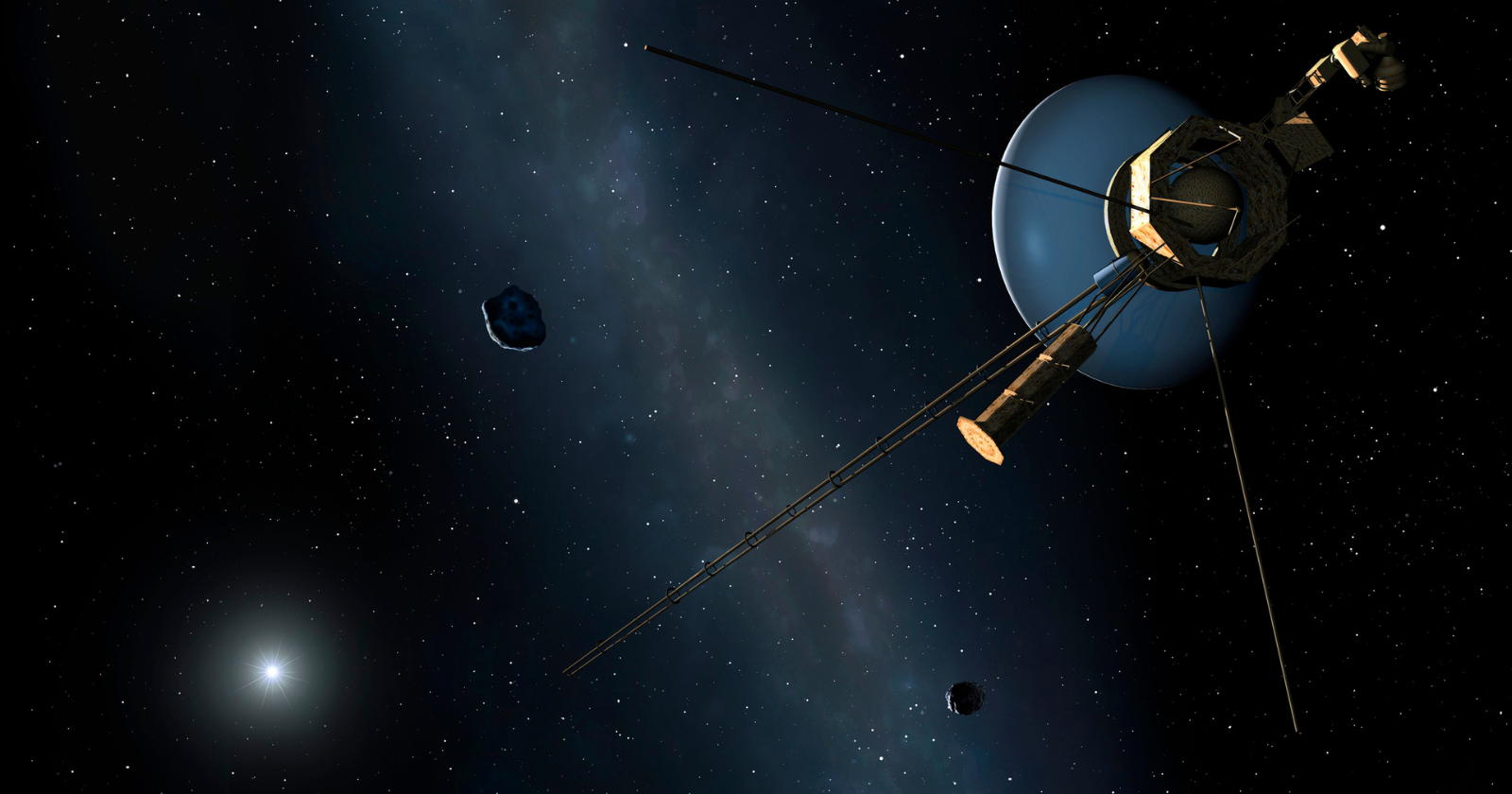
There is a version of the Voyager story that sounds almost too clean: engineers built a spacecraft they knew they would never see leave the solar system, and sent it outward anyway. The truth is more precise, and in some ways more moving. If leaving the solar system means crossing the heliopause, the outer edge of the Sun’s solar-wind bubble, then some of the people who led Voyager did live to see it happen. NASA says Voyager 1 entered interstellar space on Aug. 25, 2012, and Voyager 2 crossed the same boundary on Nov. 5, 2018. But if leaving the solar system means passing beyond the distant Oort Cloud, then the statement becomes almost unimaginably true. NASA’s Voyager FAQ says Voyager 1 will take about 300 years to reach the inner edge of the Oort Cloud and possibly about 30,000 years to fly beyond it.
That distinction matters because Voyager was never just one machine with one finish line. It was a spacecraft built for planetary science, then kept alive long enough to become a probe of the boundary between the Sun and the rest of the galaxy, and finally destined to become an artifact drifting through a future no human project manager could personally inspect. In 1977, when Voyager 2 launched on Aug. 20 and Voyager 1 followed on Sept. 5, the basic mission was already ambitious: NASA describes the original design as closeup studies of Jupiter, Saturn, Saturn’s rings, and the larger moons of those planets. The later scale of the mission was not a simple prediction. It was the result of careful design, good fortune, patient operations, and an unusual willingness to build for time beyond recognition.
To build Voyager was to work inside a contradiction. The spacecraft had to survive launch, cross the inner solar system, thread a rare alignment of outer planets, make scientific measurements in environments no machine had yet visited, and continue communicating across distances that turned radio signals into a test of patience. Yet the engineers also had to accept that the mission’s deepest meanings would unfold after the original planning horizon. Between them, Voyager 1 and Voyager 2 eventually explored Jupiter, Saturn, Uranus, Neptune, 48 moons, and the rings and magnetic fields of the giant planets. Voyager 2 remains the only spacecraft ever to have visited Uranus and Neptune.
The first gift was scientific. Voyager changed the outer planets from remote points of light into worlds with weather, geology, rings, magnetic fields, volcanoes, ice, storms, and moons that looked less like footnotes than places. The spacecraft were not built by people who expected immortality. They were built by people who trusted that future scientists, engineers, students, and the public would make use of measurements gathered long after the first headlines faded. That is a particular form of public science: build something well enough that it can keep being useful after the people who assembled it have moved on.
The second gift was engineering culture. A spacecraft operating for decades cannot rely on glamour. It relies on documentation, redundancy, power management, fault protection, careful command sequences, and teams willing to understand hardware older than many of the people now operating it. Voyager’s long life has often made the original engineering look almost prophetic, but it was also practical. The spacecraft were designed to work in places where repair was impossible. Every instruction sent from Earth would have to cross billions of kilometers. Every watt would matter. Every old subsystem would eventually become a negotiation between scientific value and survival.
That is why Voyager feels different from many space missions. It is not only that the spacecraft went far. It is that they made duration visible. A career is long by human standards. A spacecraft lasting nearly half a century is long by modern technological standards. But interstellar time is something else. Voyager forces those scales into the same story. It asks what kind of work people do when the most distant consequence of that work belongs to people not yet born, and perhaps to no one at all.
The Golden Record made that question literal. NASA describes the record carried by each Voyager as a time capsule launched in 1977, containing images, sounds, music, greetings, and instructions meant to say something about Earth to any future finder. It was not a scientific instrument in the usual sense. It did not measure plasma waves or cosmic rays. It measured a human impulse: the desire to send evidence of ourselves into a vastness that might never answer.
John R. Casani, Voyager’s project manager in 1977, is one of the people who gives that impulse a human face. NASA’s Voyager overview notes that Casani led the mission from clean room to space and was the first to envision attaching a message representing humanity to another civilization, the idea that became the Golden Record. Casani died in 2025 at age 92. He lived long enough to see both Voyager spacecraft cross the heliopause, but not long enough, and not nearly long enough, to see them pass beyond the Oort Cloud. No one alive in 1977 could reasonably have expected that.
Ed Stone, Voyager’s longtime project scientist, also lived to see Voyager 1 enter interstellar space. That fact does not weaken the title’s emotional claim so much as clarify it. Voyager was never a story about all of its builders dying before a single milestone. It was a story about people building across a horizon so wide that even the people who saw more than they could have expected still could not see the end. The mission outgrew careers, administrations, computer generations, and the cultural moment that launched it.
There is an almost unsettling humility in that. The builders of Voyager did not know exactly what future teams would need. They could not know how later scientists would interpret interstellar measurements, or which instruments would still be healthy, or what cultural meaning the Golden Record would acquire once the spacecraft were no longer merely probes but emissaries. They built anyway. They made something robust enough to be inherited.
That may be the cleanest lesson from Voyager. Some work is not complete when its makers understand it. Some work is complete only when it becomes available to people who come after. The spacecraft are still moving outward, still carrying traces of decisions made in laboratories, meetings, clean rooms, and launch facilities almost five decades ago. They are machines, but also a kind of promise: that it is worth doing careful work for futures we cannot enter ourselves.
Seen that way, Voyager is not only a triumph of distance. It is a study in responsibility across time. The people who built it were not sending a monument to themselves. They were sending instruments, records, and a little durable evidence that humans once looked outward and decided the unknown was worth preparing for. Long after the heliopause, and long before the Oort Cloud is behind them, the Voyagers remain what they were at launch: gifts from people who accepted that the most profound destination of their work might be beyond their own lives.