

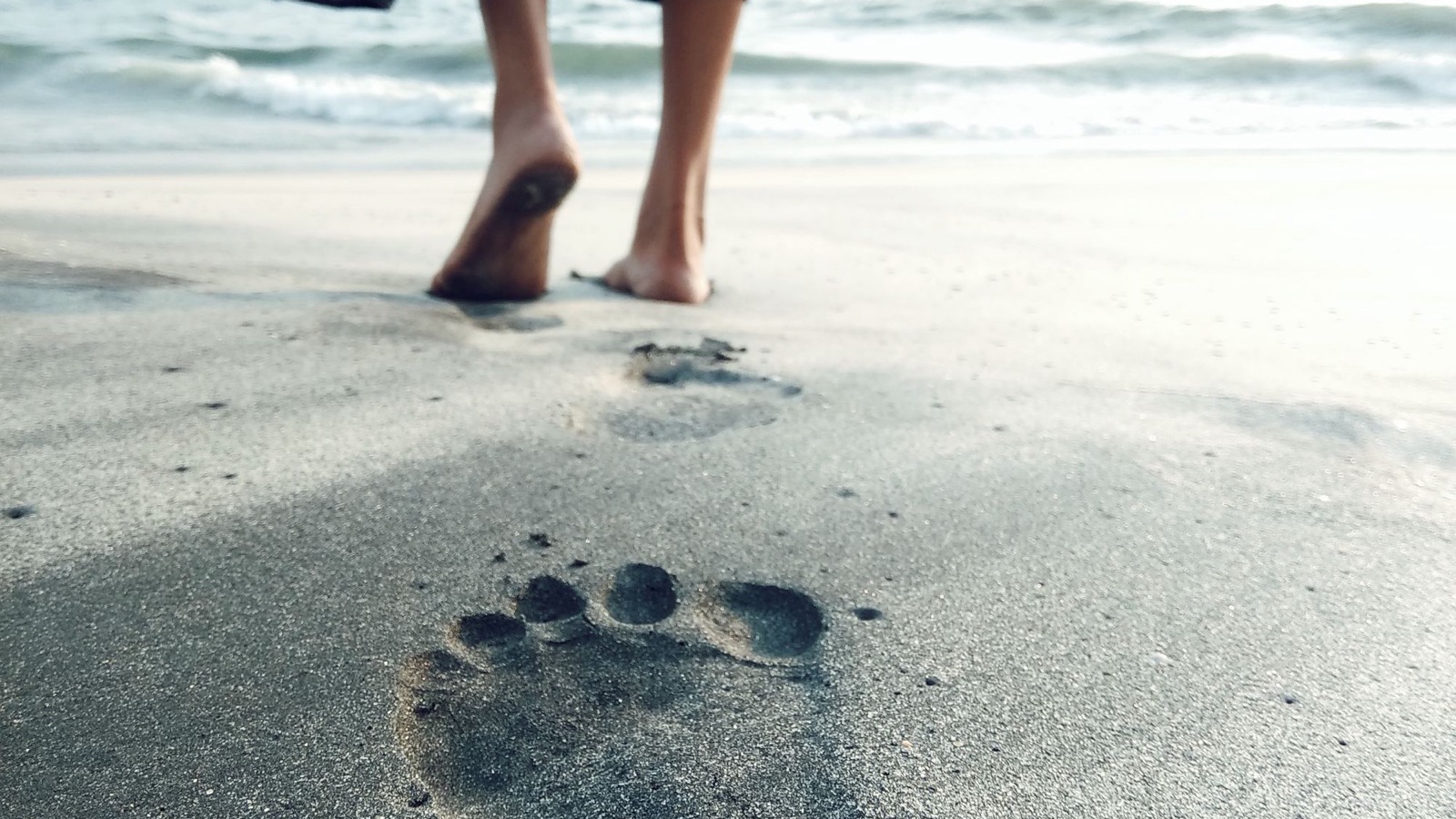
Walking on loose, dry sand can require roughly twice as much metabolic energy as walking on a hard surface at the same speed. In one small laboratory study, the measured range was 2.1 to 2.7 times higher.
That finding does not establish the rest of the headline. A gym is a place, not a single activity, and an hour there might involve anything from gentle mobility work to vigorous cycling or heavy resistance training. There is no sound basis for declaring a 30-minute beach walk more effective than what most people do in a gym.
This is a reporting-based reading of exercise research, not medical or training advice.
Where the 2.5-times figure comes from
The strongest version of the number comes from a 1998 paper by Thierry Lejeune, Patrick Willems and Norman Heglund in the Journal of Experimental Biology. The researchers compared walking and running on dry sand with movement on a hard surface, using oxygen consumption to estimate energy expenditure.
The study reported that walking on sand cost 2.1 to 2.7 times more metabolic energy at the same speed. It also found that running on sand cost about 1.6 times more than running on the hard surface.
The samples were small. Four participants provided the mechanical measurements, while a different group of ten provided the energy measurements. This is one study, not settled consensus, and it measured controlled movement on a particularly yielding surface rather than every kind of beach walking.
An earlier experiment by Pietro Zamparo and colleagues produced a smaller effect. In that 1992 study of nine adults, the average energy cost of walking faster than 3 kilometers per hour was about 1.8 times greater on sand than on compact terrain. Together, the studies support a substantial increase, but not one universal multiplier.
Why loose sand makes each step more expensive
Walking on firm ground is mechanically economical. The body repeatedly exchanges forward motion and height in a pattern often compared with an inverted pendulum. Muscles still do work, but some energy is recovered from one phase of the stride and carried into the next.
Loose sand gives way. The foot sinks and slips, grains are pushed aside, and some of the work that would propel the body forward instead deforms the ground. Lejeune’s team attributed the extra metabolic cost to work done on the sand and reduced efficiency in the muscles and tendons.
Modern field research confirms that terrain changes both gait and energy use. A real-world walking study published in PLOS ONE found that people alter speed and step patterns across pavement, grass, gravel and woodland trails. A controlled 2024 biomechanics study of 21 adults likewise showed that foot sinking depth changes how people walk on sand.
The phrase “at the same speed” matters. People commonly slow down when the ground becomes difficult. If a beach walker covers less distance per minute than on pavement, the per-minute energy difference may be smaller than the laboratory ratio. Wet, packed sand near the waterline is also very different from deep, dry sand above the tide line.
The hour-at-the-gym comparison does not hold
A 30-minute sand walk can be a demanding aerobic session. It still cannot be ranked against “an hour at the gym” without defining pace, intensity, rest periods, body size and the activity being performed.
Even the arithmetic is narrower than it first appears. At the upper laboratory estimate, half an hour on sand could use more locomotion energy than an hour of pavement walking at the same speed. That compares one form of walking with another. It says nothing about an hour of rowing, interval cycling, swimming, a fitness class or resistance exercise.
The 2024 Adult Compendium of Physical Activities lists energy costs for 1,114 activities. Gym-based activities span a wide intensity range, which is why calorie burn alone is a poor definition of an effective workout. Strength, cardiovascular fitness, balance, mobility and skill are different outcomes.
Current US physical activity guidelines reflect that distinction. They describe weekly targets for moderate or vigorous aerobic activity and separate muscle-strengthening work on at least two days. A beach walk can contribute to aerobic activity. It does not reproduce every adaptation provided by strength training or more intense exercise.
Barefoot walking is a separate question
The sand studies explain the effect of a yielding surface. They do not prove that removing shoes makes the walk a better workout or a safer one.
Bare feet change sensory feedback and foot motion, but footwear also protects against hot sand, sharp shells, glass and other debris. Soft, sloping ground places unfamiliar demands on the ankles, arches and lower legs. The American College of Foot and Ankle Surgeons notes that sand walking is associated with arch pain, heel pain and ankle sprains, particularly when someone is unaccustomed to the surface.
None of that makes a barefoot stroll inherently reckless for every healthy adult. It does mean that “barefoot” cannot simply be added to the energy-cost result as an extra benefit. A hard wet shoreline, a steep camber and deep powdery sand load the body differently.
The coastal setting may have effects beyond energy expenditure, but those should be kept separate too. Lachlan Brown previously examined the evidence behind claims that looking at water can alter heart rate and blood pressure. A calmer setting and a higher metabolic cost are different questions, even when they occur during the same walk.
What a fair test would have to compare
A useful head-to-head study would assign participants to a clearly described beach walk and a clearly described gym session, then measure oxygen use, heart rate, perceived effort and training changes over time. It would need to specify sand moisture and depth, speed, footwear, slope, participant fitness and whether energy was compared per minute or per kilometer.
It would also have to define “effective.” If the outcome were calories used during the session, sand walking might perform well. If the outcome were increased maximal strength, bone loading, sprint capacity or rowing performance, the answer could be different.
The research cited in the headline did not run that comparison. It measured the energetic and mechanical cost of locomotion across surfaces, mostly in small groups of healthy adults. Extending the result to the habits of most gym users goes beyond the data.
A harder walk, not a universal replacement
The supported claim is still useful: loose sand can turn an ordinary walk into substantially more demanding movement. The size of the increase depends on speed, sand and the person walking.
People with diabetes, reduced foot sensation, an existing foot or ankle problem, or uncertainty about returning to exercise have reasons to discuss barefoot or unstable-surface activity with an appropriate clinician or podiatrist.
For everyone else, the honest comparison is with the same walk on firmer ground. The beach changes that calculation. It does not tell us what happened during somebody else’s hour at the gym.
