

The lion owns the human imagination in a way few predators ever have. It is the animal on shields and flags, the roar behind the idea of wild Africa, the creature we instinctively cast as the continent’s final authority. But hunting success is not the same thing as reputation. Measured chase by chase, the story gets stranger.
A lion is a devastating predator when the circumstances suit it: close range, cover, darkness, surprise, or help from other lions. But in open daylight, a single lion is often asking its body to do something it was not really built to do for long. Classic field work on lions in East Africa, including George Schaller’s The Serengeti Lion, helped show that many hunts fail before they become the dramatic kill humans imagine.
Later field studies made the point more explicitly. In a 1984 African Journal of Ecology study of lions in Queen Elizabeth National Park, Karl van Orsdol found that hunting success depended strongly on cover, prey group size, hunting group size and, at night, moonlight. Lions were better when the landscape helped them close the distance before prey could react.
A sprinting ambusher, not a distance machine
That is why the “one chase in five” figure is best understood as a narrow comparison, not a universal law of lions. It refers to the poor odds facing a lone lion hunting by day, when surprise is harder and prey can see the stalk developing. Under other conditions, especially at night or with more cover, lions can do better.
The lion’s body explains much of this. Lions are explosive rather than tireless. They can accelerate brutally and overpower large prey at close range, but they are not built to run antelope down over long distances. If the first rush fails, the hunt is usually over. The prey lives because the lion’s window of advantage has closed.
Group hunting changes the calculation, but not in a simple “more lions means more success” way. In a 1992 Behavioral Ecology and Sociobiology study, P. E. Stander described role specialization among lionesses, with individuals tending to occupy different positions during cooperative hunts. Some act more like wings, others more like centers in an ambush. The system works because lions can turn cover, angle and timing into a trap.
Even then, lions are not guaranteed a meal. Their prey are also evolved for this contest. Zebras kick. Buffalo stand and turn. Wildebeest and antelope bolt early if they detect movement. A hunt is not a scene in which a predator simply decides to kill. It is a negotiation of physics, fear, terrain and timing, and the prey usually gets a vote.
The predator with the bigger ears
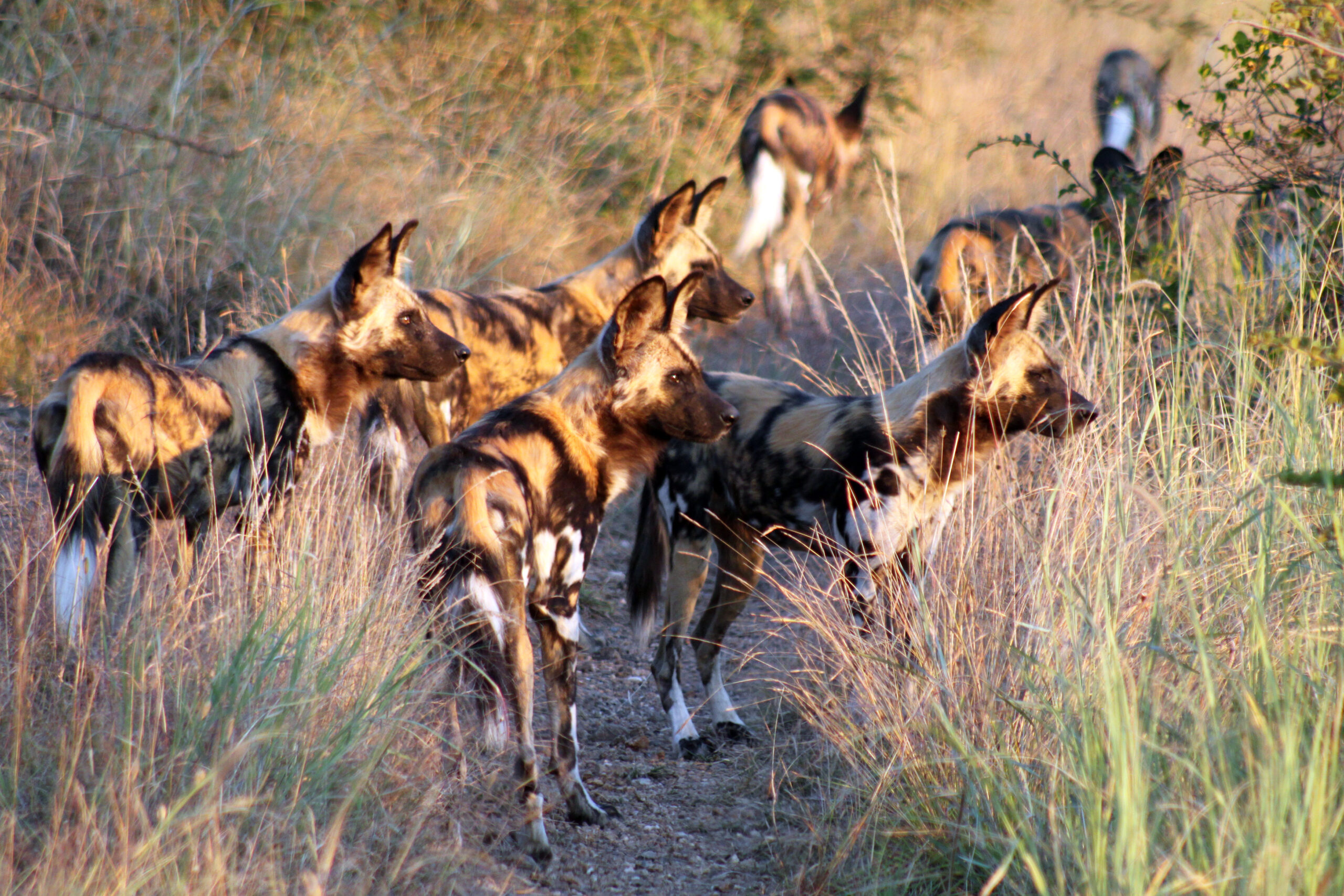
The African wild dog lives in the lion’s shadow, both literally and culturally. It is smaller, slighter, and rarely granted the same symbolic power. Its rounded ears make it look almost too expressive for the role of elite predator. Yet those large ears, spotted coat and social intensity belong to one of the most remarkable hunting systems among mammals.
The species, Lycaon pictus, is also in trouble. The IUCN Red List assesses the African wild dog as Endangered, with surviving populations fragmented by habitat loss, human persecution, disease and conflict with larger carnivores. The animal can be astonishingly efficient at hunting and still be vulnerable to a world that breaks up the space a pack needs.
Unlike the lion, the wild dog is a coursing pack hunter. A chase can unfold as a series of quick, opportunistic pursuits by several animals rather than one grand ambush. Older accounts often described wild dogs as endurance hunters that ran prey to exhaustion across long distances. More recent collar data have made that picture more complicated.
In a 2016 Nature Communications study, researchers fitted high-resolution GPS and inertial collars to African wild dogs in northern Botswana and recorded 1,119 high-speed chases by a pack of six adults. The dogs did not simply grind prey down in marathon pursuits. Many chases were short, fast and individually unsuccessful, but the pack’s shared feeding system made the overall economics work.
Why nine out of ten is not the whole story
The famous high success rates for African wild dogs come from particular field studies and particular definitions of success. In a 1993 Journal of Mammalogy paper, Todd Fuller and Pieter Kat studied wild dogs in southwestern Kenya, a line of research often cited in discussions of the species’ unusually high hunting success. Other work has reported that, in some habitats and prey contexts, packs may succeed in well over half their hunts and sometimes as many as nine in ten.
But the number should not be treated as a permanent scoreboard. The 2016 Botswana study found an individual kill rate of only 0.155 per chase under its definition, even though kills were shared among pack members. A different study site, prey community, pack size, vegetation structure or definition of “hunt” can produce a very different number.
That sounds like a caveat, but it is really the most interesting part. African wild dogs are not efficient because every individual charge is perfect. They are efficient because the pack turns many attempts into a group-level feeding strategy. The animal that misses may still eat if another pack member succeeds moments later.
This is also why comparisons with lions can mislead if they become a contest for “best predator.” Lions and wild dogs solve different problems. A lion tries to get close enough for one overpowering burst. A wild dog pack can make the hunt more distributed, with several bodies testing angles, selecting vulnerable prey and sharing the return.
Success does not mean safety
The irony is that the more efficient predator is the more endangered one. Lions can kill wild dogs, hyenas steal from them, and people remove habitat, set snares, transmit disease through domestic dogs and retaliate when livestock are threatened. Hunting ability is only one part of survival.
For wild dogs, social life is both strength and risk. Packs cooperate to hunt, feed pups, defend dens and move through large territories. But a pack also needs enough connected habitat to function, enough unrelated animals to form new groups and enough protection from disease outbreaks that can sweep through social carnivores.
The comparison therefore cuts against a simple hierarchy of killers. The lion remains a formidable apex predator, but its crown is not the same as a perfect success rate. The African wild dog, meanwhile, is not a lesser hunter because it lacks the lion’s myth. In the right circumstances, the pack can be one of the most effective hunting machines on the savanna.
Nature is full of these reversals. The animal that looks most powerful is not always the one with the highest odds. Sometimes the sharper strategy belongs to the leaner body, the larger ears, the social pack and the chase that looks chaotic until the meal is shared.