

When interstellar comet 3I/ATLAS rounded the Sun in 2025, the heating did more than brighten a visitor from another planetary system. It exposed layers of ice whose gases carried several different memories: methane released from beneath a depleted surface, water assembled in extreme cold and carbon shaped in a part of the Milky Way chemically unlike our own neighborhood.
Webb read those memories in separate observations and separate studies. A peer-reviewed methane paper used the telescope’s Mid-Infrared Instrument, or MIRI. A second peer-reviewed paper used its Near-Infrared Spectrograph, or NIRSpec, to measure isotopes in water, carbon monoxide and carbon dioxide. A newer methane-isotope result remains a preprint.
Keeping those results apart makes the story more interesting and more accurate. Webb did not directly measure the comet forming below 30 kelvin. The Nature isotope study inferred that most of its water ice formed at or below that temperature, about minus 243 degrees Celsius. Methane was detected by another team, with another instrument, after the comet’s passage around the Sun.
Nor is methane evidence of life in this setting. It is a simple carbon-bearing molecule that can be produced without biology in cold interstellar clouds and young planetary systems. On 3I/ATLAS, its value is as a tracer of chemistry and buried layers, not as a biosignature.
A first methane detection after perihelion
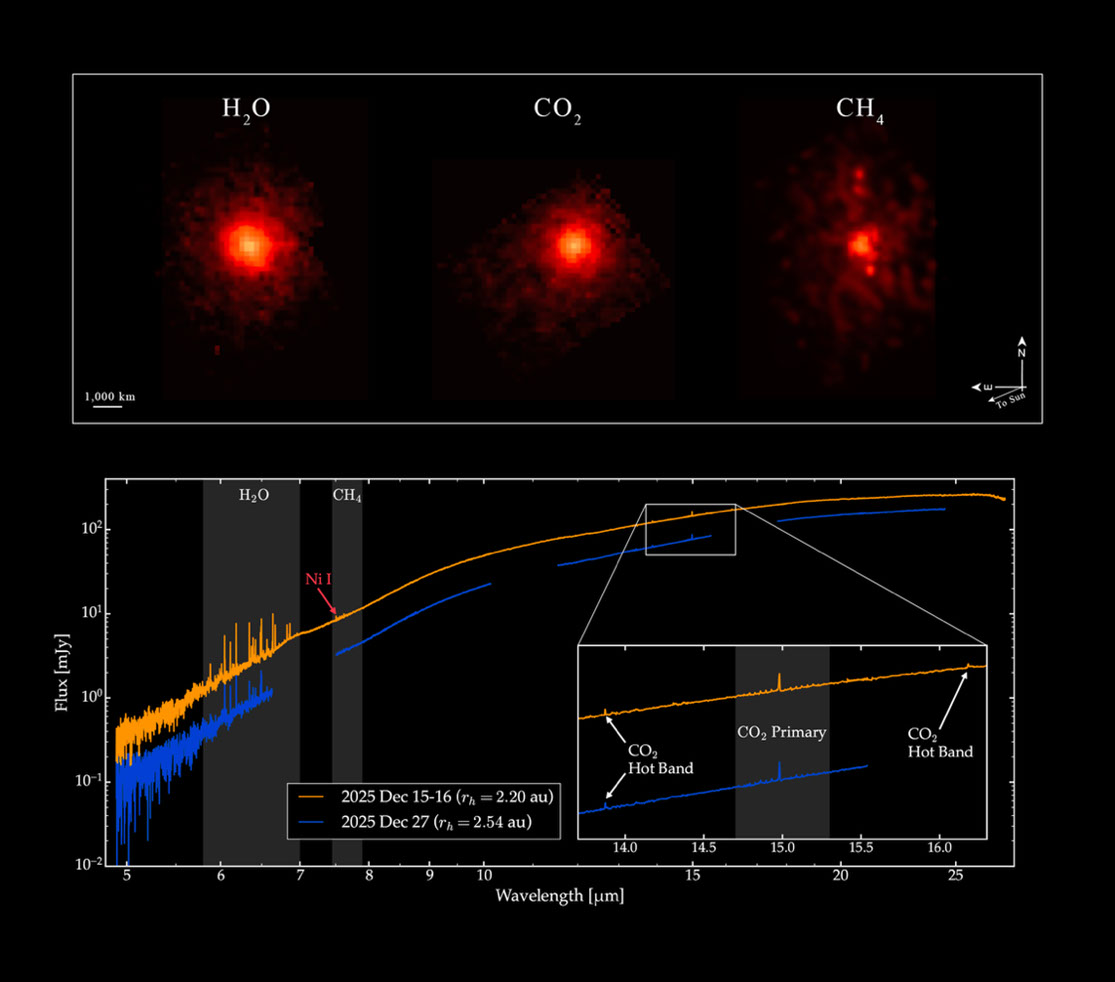
3I/ATLAS reached perihelion, its closest point to the Sun, in late October 2025. Matthew Belyakov of Caltech and six colleagues observed it with MIRI on December 15 and 16, when the comet was 2.20 astronomical units from the Sun. One astronomical unit is the average Earth-Sun distance. The team returned on December 27, after the object had moved outward to 2.54 astronomical units.
MIRI separated the comet’s mid-infrared light into a spectrum from 5 to 28 micrometers. Four fluorescence features between 7.50 and 7.65 micrometers matched methane. The detection was direct rather than an inference from a chemical byproduct, making it the first methane identified on any confirmed interstellar object.
The paper in The Astrophysical Journal Letters reported a methane production rate of about 4.2 x 1026 molecules per second during the first visit. Twelve days later, it was about 2.3 x 1026 molecules per second, a fall of roughly 45 percent. The rotational temperature fitted to the methane spectrum was 37 kelvin at both epochs, within the uncertainties.
That 37-kelvin value describes the distribution of methane molecules among rotational energy states in the coma during the observations. It is not the estimated temperature at which the comet’s ice formed. The ancient formation-temperature evidence comes from water isotopes and answers a different question.
The comet was more than a methane source
MIRI also found water, carbon dioxide and a forbidden emission line from atomic nickel. Its spatial maps showed different geometries. Water spread well beyond the nucleus because icy grains carried into the coma continued releasing vapor. Carbon dioxide and methane were concentrated more strongly toward the nucleus.
The pattern fits the broader chemical portrait Webb obtained while 3I/ATLAS was approaching the Sun. ScienceBlog’s earlier account of the comet’s carbon-dioxide-heavy inbound coma described a CO2-to-water ratio unlike the usual balance in solar system comets. The post-perihelion MIRI result confirmed that carbon dioxide remained strongly enhanced relative to water.
Methane was unusual too, but the degree matters. Belyakov’s team described its CH4-to-H2O ratio as “somewhat enriched” compared with typical solar system comets. Carbon dioxide was the more extreme relative abundance. Methane did not dominate the comet’s gas.
A ratio also depends on both substances being compared. From the first MIRI visit to the second, water production dropped more steeply than methane or carbon dioxide production as the comet moved away from the Sun. The relative methane abundance therefore reflects the changing water output as well as methane escaping from the nucleus.
Methane may have opened a view below the surface
The timing may preserve a record of earlier heating. Water activity was evident before the comet reached perihelion, but methane production turned on later. The researchers argue that methane had been depleted from the outermost layers, leaving Webb to see gas emerging from relatively unprocessed material below them once solar heat penetrated more deeply.
This does not mean MIRI photographed a clean geological layer or measured its depth. The telescope saw gas after it left the nucleus. Delayed outgassing, the evolution of production rates and the concentration of methane near the nucleus jointly support the subsurface interpretation.
The distinction also explains why “pristine” should be used carefully. Material below the surface may have experienced less recent solar heating than the exterior while still carrying radiation damage, chemical alteration and thermal history from its original system and its long passage through interstellar space. “Relatively unprocessed” is the narrower claim made in the methane study.
Heavy water became a thermometer for ancient ice
On December 22 and 23, between the two MIRI epochs, Martin Cordiner of NASA’s Goddard Space Flight Center and colleagues observed the comet with NIRSpec. They measured common molecules alongside rarer versions containing heavier isotopes.
In ordinary hydrogen, the nucleus contains one proton. Deuterium adds a neutron. The team’s water measurement gave a deuterium-to-hydrogen ratio of 0.98 percent, with an uncertainty of 0.06 percentage points. That was more than an order of magnitude above the values found in known solar system comets.
Very cold chemistry favors the transfer of deuterium into some molecules. By comparing the measurement with models of ice formation and later processing, Cordiner’s team concluded that the bulk of 3I/ATLAS’s water formed at no more than about 30 kelvin. It then avoided enough high-temperature reprocessing to erase that enrichment.
The result does not say that every molecule in the comet formed at exactly 30 kelvin, or that the nucleus remained at that temperature for its entire history. It constrains the environment in which most of the observed water ice assembled. Later mixing and heating could have affected portions of the object without destroying the overall isotope signature.
ScienceBlog previously examined the same result as a claim about water that may predate the Sun by billions of years. The cold-formation inference is more direct than the numerical age. Temperature follows from chemical fractionation; age requires an additional model of how isotope abundances changed as the Milky Way evolved.
Carbon supplied a possible Galactic clock
The Nature team also measured unusually high ratios of carbon-12 to carbon-13. Depending on the model used for overlapping spectral features, the ratio was 141 to 191 in carbon dioxide and 123 to 172 in carbon monoxide. Those ranges exceed typical solar system values and measurements in nearby interstellar clouds and young disks.
Generations of stars gradually alter the chemical inventory of the Galaxy. Massive stars manufacture elements and isotopes, then return material to space through winds and explosions. A high carbon-12-to-carbon-13 ratio can therefore be consistent with material formed before later stellar generations had contributed as much carbon-13.
Galactic chemical-evolution models led the researchers to a possible formation age of roughly 11 to 12 billion years. Their interpretation places 3I/ATLAS in an old, relatively metal-poor environment that had experienced intense early massive-star formation and a high rate of energetic irradiation.
That is not a chemical birth certificate. Carbon isotope ratios vary with distance from the Milky Way’s center, while models depend on uncertain histories of star formation, gas flow and stellar yields. The observations cannot identify a parent star, and they cannot tell how long the object remained in its original planetary system before being ejected. The isotope measurements are firm; the age is a model-based reconstruction.
Methane’s own isotope ratio adds a third clue
A later Webb analysis led by Nathan Roth reports deuterated methane, CH3D, in the coma. The latest version remains a preprint, so its publication status is different from the two peer-reviewed studies above.
The team measured a methane deuterium-to-hydrogen ratio of 3.33 percent, with an uncertainty of 0.31 percentage points. That is about 14 times the methane value measured by the Rosetta spacecraft at comet 67P/Churyumov-Gerasimenko, previously the only comet with detected CH3D.
The methane was also more deuterium-rich than the comet’s water, a pattern seen in some primitive solar system and interstellar material. The authors say the result is consistent with ice formed in a cold, low-metallicity environment exposed to a high cosmic-ray rate. Consistent is not identical to proven: models still have to explain how methane formed, moved through the ice and survived later processing.
What one interstellar comet can actually tell us
3I/ATLAS is only the third confirmed object on a path from beyond the solar system. ‘Oumuamua did not develop a conventional observable coma, and 2I/Borisov was active but faint. Webb’s sensitivity and the favorable activity of 3I/ATLAS made a much richer chemical comparison possible.
Even so, one comet cannot define what comets around other stars normally contain. It may represent a common product of old planetary systems, an unusual body from an extreme environment or a mixture of materials processed at different times. Discovering more interstellar visitors and measuring them with the same instruments will be necessary before astronomers can separate typical extrasolar chemistry from the peculiar biography of this object.
For now, the strength of the result lies in its layers rather than a single spectacular number. MIRI found methane emerging after perihelion and mapped it near the nucleus. NIRSpec found heavy water that points to formation at no more than 30 kelvin. Carbon isotopes suggest an ancient Galactic setting, while a methane-isotope preprint adds a compatible but still provisional clue.
The comet did not arrive with a label naming its star. It carried something more difficult to read: several chemical records, written at different stages of its history, that Webb is beginning to separate.