

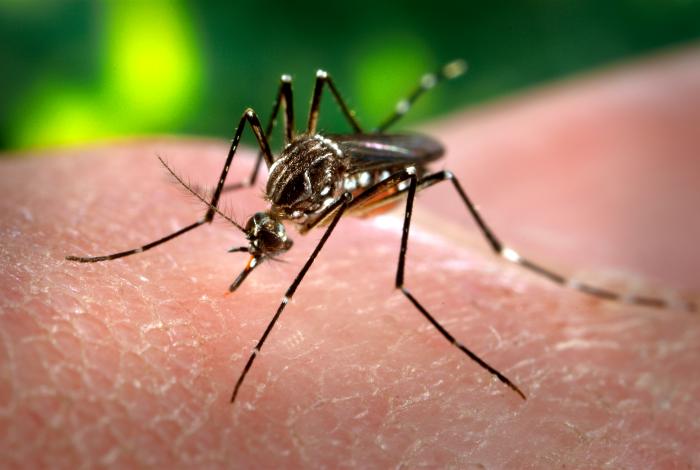
The mosquito does not arrive as a simple machine. A female Aedes mosquito is drawn by carbon dioxide, skin odours, warmth, moisture and visual cues, but the final choice of whom to bite can also be shaped by experience. In one laboratory experiment, a human smell paired with the mechanical shock of a swat became a smell to avoid.
The finding comes from a 2018 Current Biology paper by Clément Vinauger and colleagues on host learning in Aedes aegypti, the mosquito species known for transmitting dengue, yellow fever, chikungunya and Zika viruses. The researchers trained female mosquitoes by pairing host odours with a mechanical disturbance meant to mimic the kind of defensive movement a mosquito might experience when a host tries to slap it away.
We are writers, not clinicians. This is reporting on insect behaviour and mosquito biology, not medical advice about preventing bites or disease.
The important result was not that mosquitoes dislike being disturbed. That would be easy. The important result was that the association lasted. Twenty-four hours later, mosquitoes exposed to an odour that had previously been paired with mechanical shock were less likely to fly toward that odour. In the scale of a mosquito’s life, that is not a trivial memory.
This is one set of lab experiments, not a universal rule about every mosquito encounter outdoors. But it changes the way the bite is worth imagining. The insect hovering near an ankle is not only reading the present moment. It may also be carrying a record of how a similar scent worked out before.
The old picture was already complicated
Mosquito attraction was never just smell. A 2014 Cell study by Conor McMeniman and colleagues described how carbon dioxide and other sensory cues combine to drive attraction to humans. Exhaled carbon dioxide can wake up host-seeking behaviour. Skin odours help specify the target. Heat and visual cues help guide the last part of the approach.
That layered system makes sense for a small insect trying to find blood in a noisy world. A warm object is not always a host. A smell can drift away from its source. Carbon dioxide plumes break apart in air. A mosquito has to integrate partial signals while flying through moving, changing information.
Riffell’s group had already shown that sensory cues interact in more than one direction. In a 2015 Current Biology paper, Floris van Breugel and colleagues reported that mosquitoes use vision to associate odour plumes with thermal targets. Smell can prime a visual search; heat can help confirm that the search has found something alive.
The 2018 learning paper added another layer: memory. A host’s smell is not only an attractant in the abstract. It can become part of an individual mosquito’s history.
How to teach a mosquito an unpleasant smell
The experiment used aversive conditioning, a plain idea with a technical name. Present a cue, then pair it with something unpleasant. Later, test whether the animal treats that cue differently. In this case, the cue was odour, including human-derived odour. The unpleasant event was mechanical shock, standing in for the turbulence and impact of defensive host behaviour.
After training, the mosquitoes were tested in a flight arena. The question was whether they still flew toward the trained odour or avoided it. The paper reported that females could learn to avoid odours associated with the shock and that the learned avoidance could still be detected 24 hours later.
That is a modest-sounding result until the animal is considered. A female mosquito may live only weeks. She needs blood meals to produce eggs. Host choice affects whether she feeds, survives, reproduces and possibly transmits pathogens. A 24-hour memory can cover a meaningful part of her active life.
The study did not show that a mosquito recognises a person the way a person recognises a face. Odour is not identity in the human sense. Human scent is a chemical cloud shaped by skin secretions, microbes, diet, genetics, hygiene and environment. The point is narrower and stronger: under lab conditions, mosquitoes could associate a particular host-like odour with a bad outcome and change their next choice.
Dopamine was part of the story
The title of the Current Biology paper is deliberately about modulation, not just memory. Vinauger and colleagues examined the role of dopamine, a chemical messenger involved in learning across many animals. When dopamine signalling was disrupted, the mosquitoes’ ability to learn the odour-shock association was impaired.
That matters because it ties a behaviour people notice every summer to a nervous-system mechanism. The mosquito is not choosing with a human-like mind, but neither is it a passive needle with wings. Its brain can update the value of a smell after an encounter goes badly.
Earlier work had already made mosquito learning a serious subject. In a 2014 Journal of Experimental Biology study, Vinauger, Eleanor Lutz and Jeffrey Riffell showed that Aedes aegypti could form olfactory memories in response to learned associations, including memories retained for at least 24 hours. A 2016 Trends in Parasitology review placed this in a broader disease-vector context, arguing that learning and memory can shape how blood-feeding insects respond to hosts, odours and environments.
Why one person’s odour may stop working
One of the tempting interpretations is that mosquitoes “remember people.” That is close enough to be catchy and loose enough to mislead. The study does not show a tiny social memory of a named individual. It shows learned avoidance of an odour profile after that odour was paired with an aversive experience.
Still, that is enough to make host choice more personal than the usual explanation allows. People differ in skin odour. Some are more attractive to mosquitoes than others. If an odour profile has been followed by a failed or dangerous feeding attempt, avoiding it later could be useful. A host that keeps moving, swatting or interrupting feeding may not be worth the risk when another odour is available.
There is an evolutionary logic to that. Blood feeding is hazardous. A mosquito approaching a host can be crushed before feeding, during feeding or just after. The host is food, but also a threat. Memory lets the insect treat the world as uneven: not all attractive smells are equally safe.
That does not mean swatting is a reliable repellent strategy. The lab setup was controlled, the odour presentations were defined and the mosquitoes were tested under experimental conditions. Outdoors, wind, sweat, clothing, species differences, hunger state, local mosquito density and competing hosts all complicate the picture.
A bite is a decision, not just a reflex
The value of the study is that it makes the mosquito’s choice less automatic. The insect is guided by smell and heat, yes, but also by a nervous system able to revise what those signals mean. Attraction is not fixed at the moment a plume of human scent reaches the antennae.
This is one reason mosquito biology is difficult to reduce to a single explanation. Carbon dioxide matters. Skin odour matters. Heat matters. Visual contrast matters. Hunger and reproductive state matter. The Vinauger study adds that experience matters too.
There is something unsettling in that, but also clarifying. The mosquito at the edge of the room is not thinking about you. It is not holding a grudge. But if a smell has led to trouble before, its tiny brain may have marked that odour down.
The bite begins long before the landing. It begins in a stream of cues, corrected by memory, with the mosquito deciding whether this particular scent is still worth the risk.