

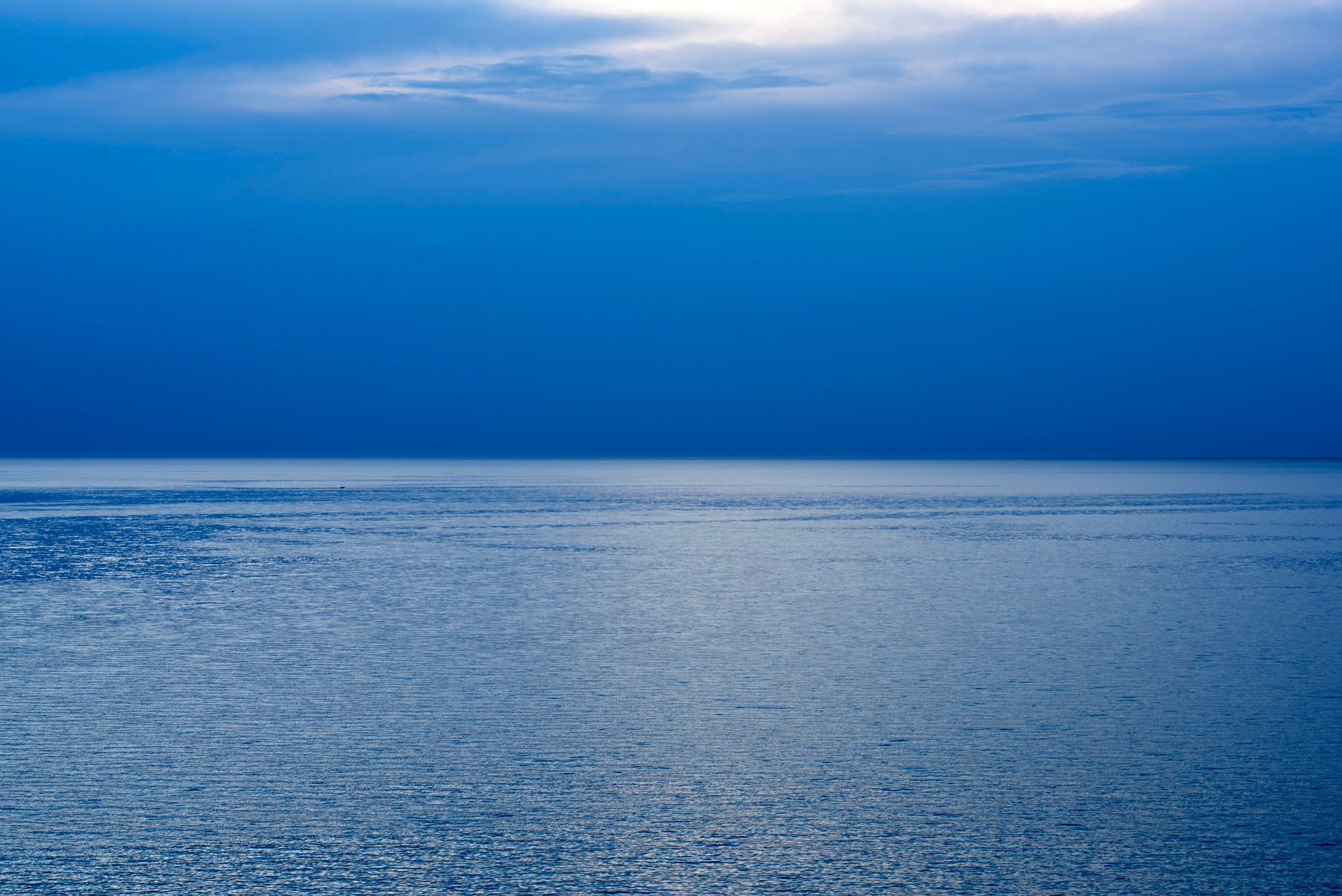
The sea can reflect a blue sky, a gray bank of clouds or the colors of a sunset. But that changing surface reflection does not explain the blue that remains when light travels through clear water. Water itself changes the balance of colors in sunlight.
NOAA describes the ocean as a sunlight filter: it absorbs the red part of the visible spectrum more strongly, leaving a greater proportion of blue. Some of the surviving light is redirected upward and reaches an observer. The color of deep, clear ocean water therefore depends on both what the water removes and what returns to our eyes.
Reflection from the sky is part of the view, but it is not the whole explanation.
Why a glass can look colorless
The US Geological Survey’s account of water color makes a useful distinction: pure water has a slight blue tint, even though a small glass of it usually looks colorless. The effect becomes easier to see along a longer column of water.
That difference is about the distance light travels through the material. A short path leaves relatively little opportunity for visible red light to be absorbed. Over a longer path, the difference between how strongly water absorbs different wavelengths becomes more apparent. Water does not need to contain a blue pigment to acquire a visible tint.
The molecular explanation also differs from the familiar story about the sky. USGS attributes water’s absorption to the vibrations of its atoms. Water preferentially removes part of the red end of the visible spectrum; the sky’s blue, by contrast, is primarily explained by scattering in the atmosphere.
Calling water transparent is therefore compatible with saying that it has an intrinsic color. Transparency does not require every visible wavelength to pass through equally well.
Absorption and scattering do different jobs
Absorption takes light out of the passing beam. Scattering changes its direction. Both processes matter when someone looks down at the ocean and receives light that has entered the water and then emerged again.
NASA’s PACE explanation of light in the ocean explicitly includes both absorption and scattering in clear water. Water molecules and materials suspended in the water interact with the incoming light. Some light continues downward, some is absorbed, and some is redirected toward the surface.
The returning light has already been filtered along its path. In sufficiently clear water, red wavelengths are more strongly depleted, so blue makes up a larger share of what remains. Scattering provides a route back to the observer; selective absorption helps determine the color of that returning light.
This is why “water absorbs red” and “blue light scatters back” belong in the same explanation. Neither means that water converts red light into blue light, or that every blue photon entering the ocean eventually comes back out.
The sky and the seabed still affect the view
Woods Hole Oceanographic Institution notes that the ocean surface really does reflect the sky. That helps explain why the same stretch of water can look different under sunshine, storm clouds or a colored evening sky. An observer sees a combination of reflected light and light emerging from below the surface.
Shallow water adds another contribution. Sunlight can reach a sandy bottom and return through the water, making a clear lagoon appear bright turquoise. The depth, bottom and remaining mix of wavelengths help produce those green-blue shades around islands and reefs.
That is a different situation from looking over deep ocean where the seabed contributes little or no light to the view. A photograph of a turquoise beach is not simply showing a more intense version of the same conditions that produce a dark offshore blue.
A turquoise shade by itself is not a depth measurement.
Why the ocean is not always blue
Real seawater contains much more than water molecules. Phytoplankton, mineral particles and dissolved organic material each interact with light differently. Their combined effects can change both the amount of light returning and its distribution across wavelengths.
Woods Hole describes how suspended sediment can turn water brown and how dense populations of phytoplankton can give it green or red hues. A river plume, an algal bloom and clear offshore water can therefore look different under the same sky.
NASA’s ocean-color overview for PACE places those differences in a broader measurement problem. The observed color depends on absorption and scattering by water and its contents, but also on atmospheric conditions and the positions of the Sun and observer.
Color can guide an investigation, but different contributions need to be separated. A green patch cannot be identified completely from its appearance in an ordinary photograph. Researchers need spectral measurements and suitable methods to separate contributions from different materials.
Blue light also runs out
“Penetrates farther” does not mean blue sunlight illuminates the entire ocean. NOAA’s guide to light penetration says there is rarely significant sunlight beyond about 200 meters, although faint sunlight can extend toward 1,000 meters under suitable conditions. These are broad ocean zones, not identical visibility limits in every location.
Below the sunlit layers, the ocean’s appearance is governed by darkness unless another light source is present. The blue seen from a ship is light returned from the upper water, not a view of blue illumination reaching the abyssal seafloor.
The same optical processes that produce that familiar surface view let scientists investigate water from above. Instruments compare wavelengths to extract information about its contents, accounting for the atmosphere and viewing conditions. What looks like a single field of blue to an observer can contain measurable differences across the spectrum.