

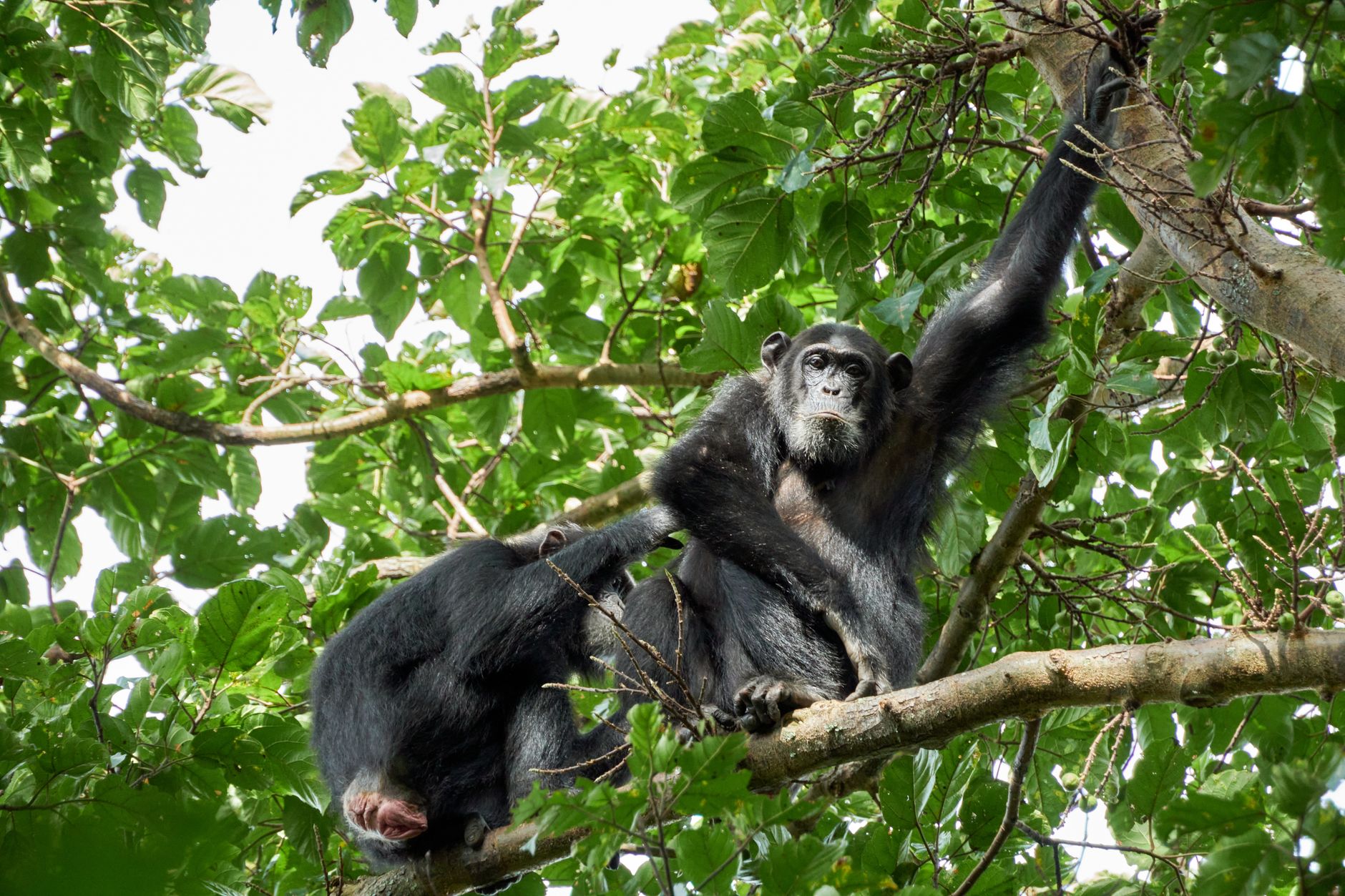
In the dense forest of Taï National Park, a chimpanzee can bark, grunt, pant, scream or send a soft “hoo” through the trees. The surprising part is not simply that the animals have different calls. It is that they can place familiar calls together, and the resulting sequence may be associated with a situation that neither component signals in the same way on its own.
A 2025 study in Science Advances found evidence for four ways that wild chimpanzees combine calls: creating a new association, narrowing an existing one, preserving information from both components, and using order to distinguish otherwise similar pairs. Across the system, that is the broadest range of combinatorial mechanisms yet documented in a nonhuman animal.
The claim is substantial, but it is also precise. The researchers inferred potential meanings from the events in which calls occurred. They did not show that a listening chimpanzee translated each sequence in a playback experiment, and they did not claim to have found words, grammar or human language in the forest.
First came a map of the sequences
The new analysis builds directly on work that ScienceBlog covered in 2022, when researchers reported that Taï chimpanzees combine calls into hundreds of ordered sequences. That earlier study established the architecture: 12 call types were not being strung together at random, and some sequences contained many different vocal units.
Its unresolved question was meaning. Knowing that one call tends to precede another does not reveal whether the pair carries more information than either call alone. A sound can follow another because of breathing, arousal or motor constraints, without functioning as a meaningful combination.
The 2022 structural study therefore supplied the map, while the 2025 paper asked how that map relates to what chimpanzees are doing. The distinction matters: sequence structure is a prerequisite for a combinatorial communication system, but structure by itself is not a message.
What 53 chimpanzees contributed
The team studied 53 chimpanzees older than 10 years across the East, North and South communities of the Taï Chimpanzee Project in Ivory Coast. Data were collected during two field periods in 2019 and 2020, with researchers following identified animals and recording both their calls and the surrounding events. The work was observational and noninvasive, drawing on long-term habituation rather than experimental disturbance in the forest.
The full recording set contained 5,399 vocal utterances. After applying the criteria needed for the event analysis, the researchers worked with 4,323: 3,589 single calls and 734 two-call sequences, or bigrams. The repertoire comprised 12 types, including barks, grunts, hoos, screams, whimpers and panted versions of several calls. One type, the panted roar, never occurred alone in the analysed data.
For the central comparison, the team selected 16 common bigrams. Every selected pair had been produced by at least 10 different chimpanzees, helping to prevent one unusually vocal individual from defining the result. The researchers then compared each pair with its component calls when those components occurred alone.
“Meaning” here is a probability, not a translation
Researchers coded 22 events that covered ordinary life: feeding, resting, travelling, grooming, playing, approaching another chimpanzee, aggression, copulation, nest building, hunting, intergroup encounters and more. For each call and bigram, they estimated the probability that it would occur in each event.
If a sequence appeared in a different distribution of events from its separate components, the team treated that as evidence that the combination likely encoded different information. This is a production-based definition of potential meaning. It is more rigorous than attaching an anecdotal English label to a sound, but it remains one step short of demonstrating what another chimpanzee perceives.
Even a single label can conceal variation. An earlier ScienceBlog article described how subtle versions of the chimpanzee “hoo” differed across alert, travel and rest contexts. In the current analysis, acoustic variants within a call type were combined for statistical power. That was necessary for testing many pairs, though it may also have blurred distinctions that future work can recover.
Four routes from two calls to richer information
The clearest candidate for a newly created association was a hoo followed by a pant. The bigram occurred overwhelmingly during nest-related events, while the two components used alone were not associated with nesting. In linguistic terms this resembles an idiom, whose combined use cannot be predicted simply by adding the broad associations of its parts. It is an analogy, not evidence that chimpanzees possess idioms in the human sense.
Other pairs behaved more compositionally. In one pattern, adding a second call narrowed the situations associated with the first, making the combination more specific. In another, a sequence retained event associations from both components, as if information carried by the two calls had been added together.
A hoo followed by a grunt illustrates why the results resist a one-line dictionary. The pair appeared mostly during feeding and, less often, resting. A hoo alone occurred across feeding, resting and travel, while a grunt alone appeared during approaches as well as feeding. The sequence did not merely copy one component; its distribution became more selective.
These mechanisms appeared across feeding, movement, nesting and social life, not only during a narrow emergency such as spotting a predator. That breadth is central to the researchers’ comparison with other animal systems, where a particular type of call combination has often been documented in a more restricted context.
When reversing a pair changed the pattern
The data included four combinations that chimpanzees produced in both orders. Two showed a clear order effect. A grunt followed by a hoo was more likely during travel and the fusion of separated parties, and less likely during rest, than a hoo followed by a grunt. Reversing those components therefore changed the pair’s event profile.
The same broad result appeared for a second reversible pair involving a hoo and a panted hoo. The other two reversals did not produce a comparably clear difference. The evidence is therefore not that order always changes a chimpanzee sequence, but that order can matter within this repertoire.
Word order is indispensable in human language, so the parallel is tempting. It should not be overstated. Four reversible pairs are a small window into the repertoire, and a statistical difference between contexts does not tell us whether a listener represents the sequence as an ordered structure. The title’s “apparent meaning” is the defensible formulation: the observable event associations changed.
The next decisive experiment belongs to the listener
Playback experiments could present chimpanzees with a combination and its isolated components, or reverse the same two calls, while researchers measure looking, movement or other responses. A 2023 playback study has already shown that wild chimpanzees can process the combination of an alarm hoo and a “waa” bark differently from its components. The 2025 catalogue now supplies many more precise candidates for such tests.
Longer sequences are another frontier. The present study deliberately analysed pairs, even though Taï chimpanzees can produce much longer strings. Researchers will need larger datasets to learn whether three or more calls add meaning in a predictable way, and whether the animals can extend those patterns freely rather than relying on a limited inventory of familiar sequences.
Sound is also only one channel. As ScienceBlog reported in 2023, young chimpanzees increasingly combine vocalisations, gestures and facial expressions as they develop. A complete account of chimpanzee communication will have to connect vocal order with those visible signals and with what receivers actually do.
For now, the finding closes one gap while leaving the largest one open. Taï chimpanzees do not merely possess a list of 12 calls; they repeatedly recombine those calls in ways associated with feeding, travel, rest, nesting and social events. The resulting system is more versatile than any other nonhuman vocal combination system yet described. Whether listening chimpanzees hear all the distinctions that the production data reveal is now the experiment waiting in the forest.