

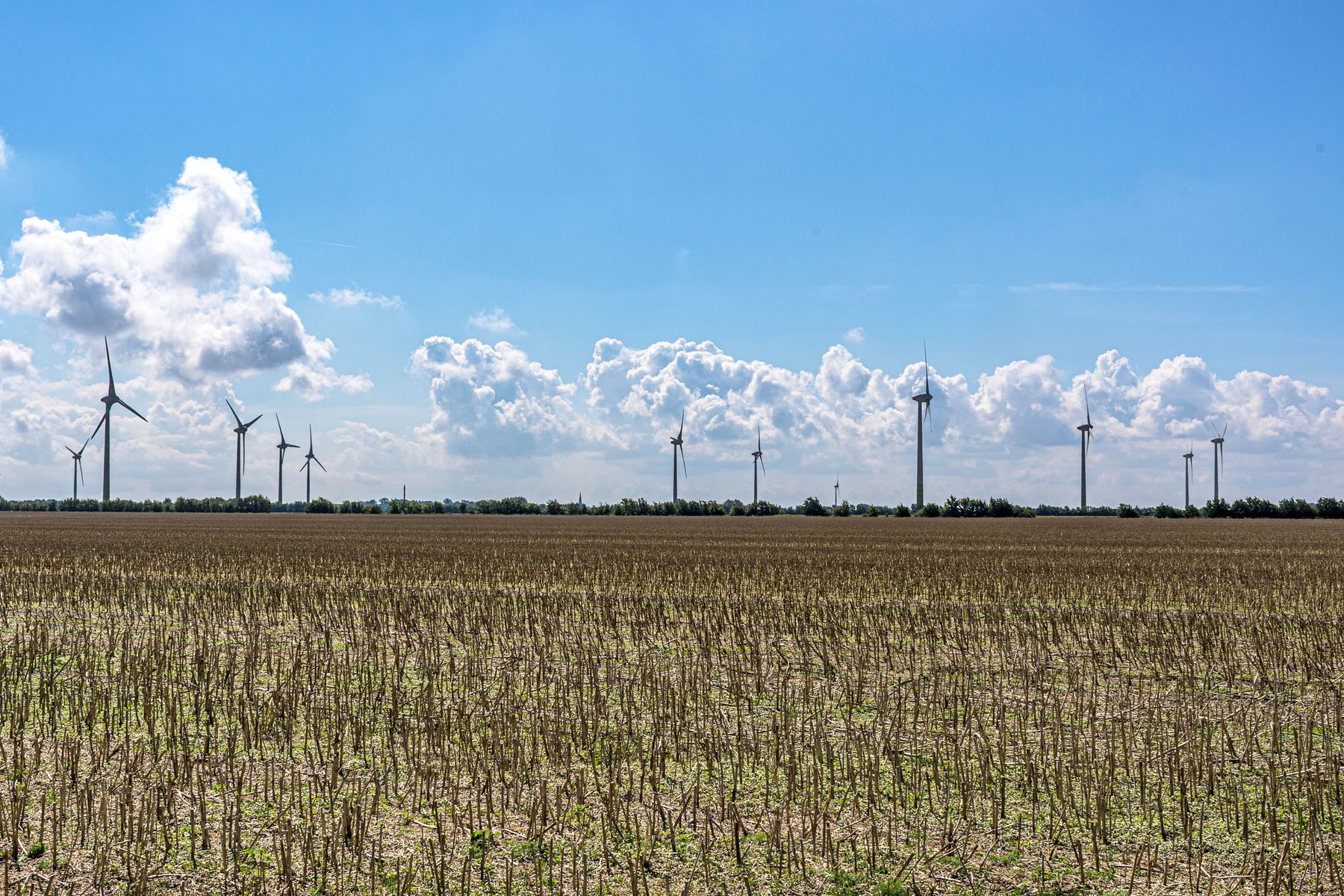
A wind turbine occupies a visible patch of farmland. Its construction can also disturb a less visible system: the buried pipes that let surrounding fields drain. A cut or crushed drainage line may not announce itself when equipment leaves. The first visible sign can arrive later, when rain exceeds the damaged system’s ability to carry water away.
This is a documented construction problem, although the available accounts do not establish how many Midwest farms currently have unresolved damage. A Center for Rural Affairs case study updated in July 2025 describes Iowa farmers who experienced tile damage and received compensation. Engineering accounts explain why other breaks can remain difficult to detect for years.
The field depends on connections below ground
Despite the name, modern drainage tile often consists of plastic pipe. Older systems may include clay sections. Water enters the buried network and moves toward an outlet, lowering a seasonally high water table in soils that otherwise drain slowly.
North Dakota State University Extension’s drainage guide, by agricultural engineer Tom Scherer and agronomist Hans Kandel, explains that the system removes excess gravitational water. It does not simply empty the soil of all moisture available to plants.
The agricultural consequences of inadequate drainage extend beyond a puddle. Wet ground can delay planting, restrict machinery movements and leave roots short of oxygen. Driving equipment over wet soil can add compaction, creating another obstacle to crop growth. The resulting yield effect depends on the soil, crop and rainfall pattern; there is no single loss percentage that can be applied to every damaged field.
Cables and construction routes cross existing drains
Wind development requires access for heavy equipment and electrical connections between turbines. Those routes can cross drainage installed long before a project was planned. A farm’s visible surface gives only partial information about what lies underneath it.
In a December 2011 construction column in Wind Systems, engineer Ron Krizan described drainage mapping as a recurring difficulty. Landowners and tenant farmers could often identify the general direction and number of lines even where accurate surveyed maps were unavailable.
Krizan distinguished the paths taken by underground collection cables from haul roads and crane routes. Excavation can cut a pipe; construction traffic can crush one. Routing a cable parallel to drainage laterals, where practical, can reduce the number of crossings compared with running across them.
He also noted that cable plowing could leave an operator unaware of a damaged drain until symptoms appeared at the surface. Repair then involved locating the break near installed electrical infrastructure, adding difficulty to work that would have been simpler before burial.
A dry season can hide a restricted pipe
Krizan’s January 2012 follow-up on identifying damaged tile described two different surface clues. Some breaks produce sinkholes as soil moves into the drainage line. Other damaged pipes cause water to back up, eventually appearing as standing water or crop stress.
A partially crushed pipe may continue carrying enough water to seem functional. Sediment can gradually narrow the remaining passage, and a dry year may never place enough demand on the line to expose the problem. Krizan described cases in which symptoms emerged three to five years after the initial damage.
The wettest spot is not necessarily directly above the break.
That makes a waterlogged strip a reason to investigate, rather than proof on its own that a particular construction operation caused it. A contractor needs to establish the pipe’s condition and the location of the obstruction. The physical connection between the drain and the construction route matters more than the appearance of one patch of ground.
Farmers have reported both damage and compensation
The Center for Rural Affairs’ Adair County case study draws on interviews with three farmers who host turbines. It reports that Ralph Lents and Sara Shepherd experienced damage to field tiling and crops during construction and were compensated afterward by the developer.
Lents also negotiated the placement of an access road to reduce interference with his farming operation. The interviews describe lease income as useful supplemental revenue, alongside practical concerns about how the project occupied the land.
These are individual accounts from a small case study, not a representative survey of wind leases across the Midwest. They show that drainage damage and a financial benefit from hosting turbines can coexist. They do not establish that compensation always restores a field’s drainage performance or that every construction project leaves unresolved problems.
Restoration requires records and follow-up
The Illinois Department of Agriculture’s agricultural impact mitigation program explicitly addresses restoration after wind, pipeline and transmission construction. Its public resources include both a wind-farm agreement and drain-tile repair diagrams. The stated goal is to restore affected farmland to its pre-construction capabilities.
University of Wisconsin Extension’s drainage guidance explains why follow-up depends on the season. It identifies snowmelt and periods after heavy rainfall as useful inspection windows. It also notes that older drainage records are often incomplete, making maps, visible outlets and field observations valuable pieces of evidence.
A restoration record can document a repair before the trench is closed.
Observations during later wet weather help establish whether the connected system is actually draining the field.