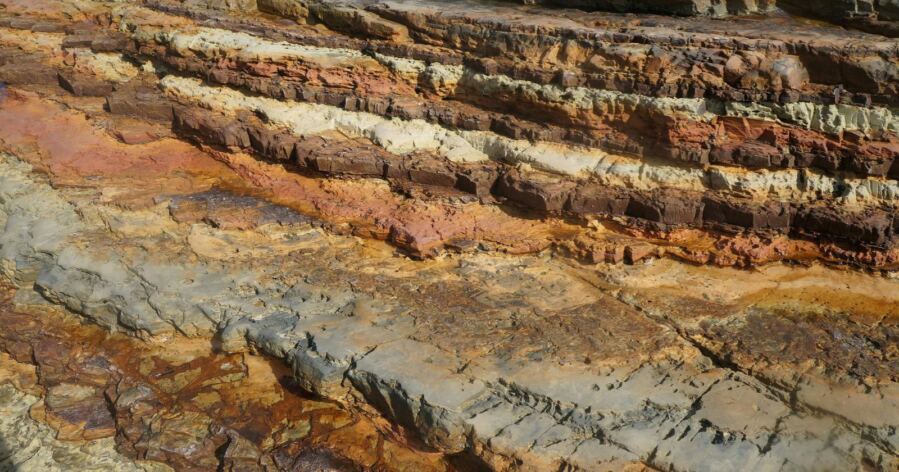
Somewhere in the low, rust-coloured hills north of Perth, in a remote scrap of Western Australia called Jack Hills, a geologist bent down in 2001 and picked up a piece of rock.
Inside it, embedded in the sediment, was a crystal. Barely visible to the naked eye — about 400 micrometres long, roughly the width of a few human hairs laid together. Translucent red under ordinary light. Blue when hit with a beam of electrons.
It has since been dated to 4.4 billion years old. It is the oldest confirmed physical fragment of the Earth ever found. And what it has quietly revealed, across two decades of increasingly sophisticated analysis, has forced scientists to substantially rewrite the story of what the very early Earth was like.
What we used to think happened
For most of the twentieth century, the story of Earth’s first few hundred million years was told with a specific texture. Molten. Violent. Hellish. This is the era geologists formally call the Hadean eon — named, quite deliberately, after Hades.
The picture was this. About 4.54 billion years ago, Earth formed from the collision of countless smaller bodies orbiting the young sun. Roughly 40 million years later, a Mars-sized object called Theia slammed into it, throwing enough debris into orbit to form the moon and melting Earth’s surface into a global magma ocean. For the next several hundred million years, the surface was assumed to have been a lifeless, seething, red-hot expanse of lava, continuously bombarded by asteroids, incapable of holding liquid water or supporting any kind of life.
Nothing was expected to have survived from this era. The rocks that would have recorded it had all been melted, recycled, or destroyed. The Hadean was, by definition, a period we could not directly observe.
Then the Jack Hills zircon showed up.
Why a crystal survived four and a half billion years
Zircon is one of the most durable minerals on Earth. It resists heat. It resists erosion. It resists chemical attack. When the rocks around it break down, are melted, or are pushed deep into the crust and re-formed, the zircon crystals inside them often survive unchanged. They get liberated from their parent rock, washed downstream, deposited in sediments, sometimes incorporated into new rocks entirely.
This is what makes zircons uniquely useful. A zircon crystal formed 4.4 billion years ago in some now-vanished continental rock could have been eroded, transported, deposited, re-eroded, and redeposited dozens of times across billions of years — and yet still preserve, unaltered, the chemistry of the moment it first formed.
The Jack Hills zircons are exactly that. They are detrital grains — fragments of much older rocks that have been recycled through generations of geological processes. The sedimentary layers they’re currently embedded in are “only” about 3 billion years old. The zircons themselves are far older, having outlived every rock they were ever part of.
The specific crystal that made the news was analysed by a team led by John Valley at the University of Wisconsin-Madison. Their 2014 study in Nature Geoscience used a technique called atom-probe tomography to essentially count individual atoms of lead within the crystal, allowing them to definitively confirm its age at 4.375 billion years, plus or minus about 6 million years.
What it revealed
The revolutionary finding wasn’t the age itself. It was what the crystal’s chemistry implied about the world it formed in.
Zircons carry a chemical signature of their formation conditions. Specifically, they preserve the ratio of oxygen isotopes present when they crystallised. That ratio depends on whether the parent rock had, at any point in its history, interacted with liquid water at the Earth’s surface.
The Jack Hills zircons show an unmistakable signature of interaction with liquid water. This means the rocks they came from — rocks that existed 4.4 billion years ago — had, at some point, been at the surface, in contact with cool water. Not steam. Not superheated vapour. Water.
The implication is genuinely staggering. Just 140 million years after the formation of Earth, only about 100 million years after the moon-forming impact, the planet had already cooled sufficiently to have solid continental crust and liquid water on its surface. The Hadean was not, it turns out, an eternal hellscape. It became something much more like modern Earth much faster than anyone expected.
Some researchers, including Valley himself, have gone further. If oceans existed by 4.4 billion years ago, they argue, then the conditions for life may have been present hundreds of millions of years earlier than the earliest fossil evidence suggests. Life may not have waited politely for the Hadean to end. It may have been trying to get started almost as soon as the planet gave it somewhere to live.
A crystal that changed a story
The Jack Hills discovery is one of the clearest examples in modern science of a single small artifact overturning decades of confident assumption.
The old picture of the Hadean — the seething magma world, the molten hellscape — was not idle speculation. It was the best interpretation of the available evidence at the time. But the evidence was incomplete, because the entire record of the earliest Earth had, or so it seemed, been destroyed.
The zircons had not been destroyed. They had survived, quietly, embedded in successive generations of rock, patiently carrying the chemistry of a world that no other physical thing on Earth still remembered. When the technology finally caught up — atom-by-atom mass spectrometry — the crystals gave up their story.
A world that had been imagined as uninhabitable was, four and a half billion years ago, already gentle enough to hold oceans.
The crystal that told us so is still there, on a slide in a laboratory at the University of Wisconsin. It’s smaller than a grain of sand. It has been dead longer than almost anything on Earth has been alive. And it is, in every way that matters, older than the ground you’re standing on.