

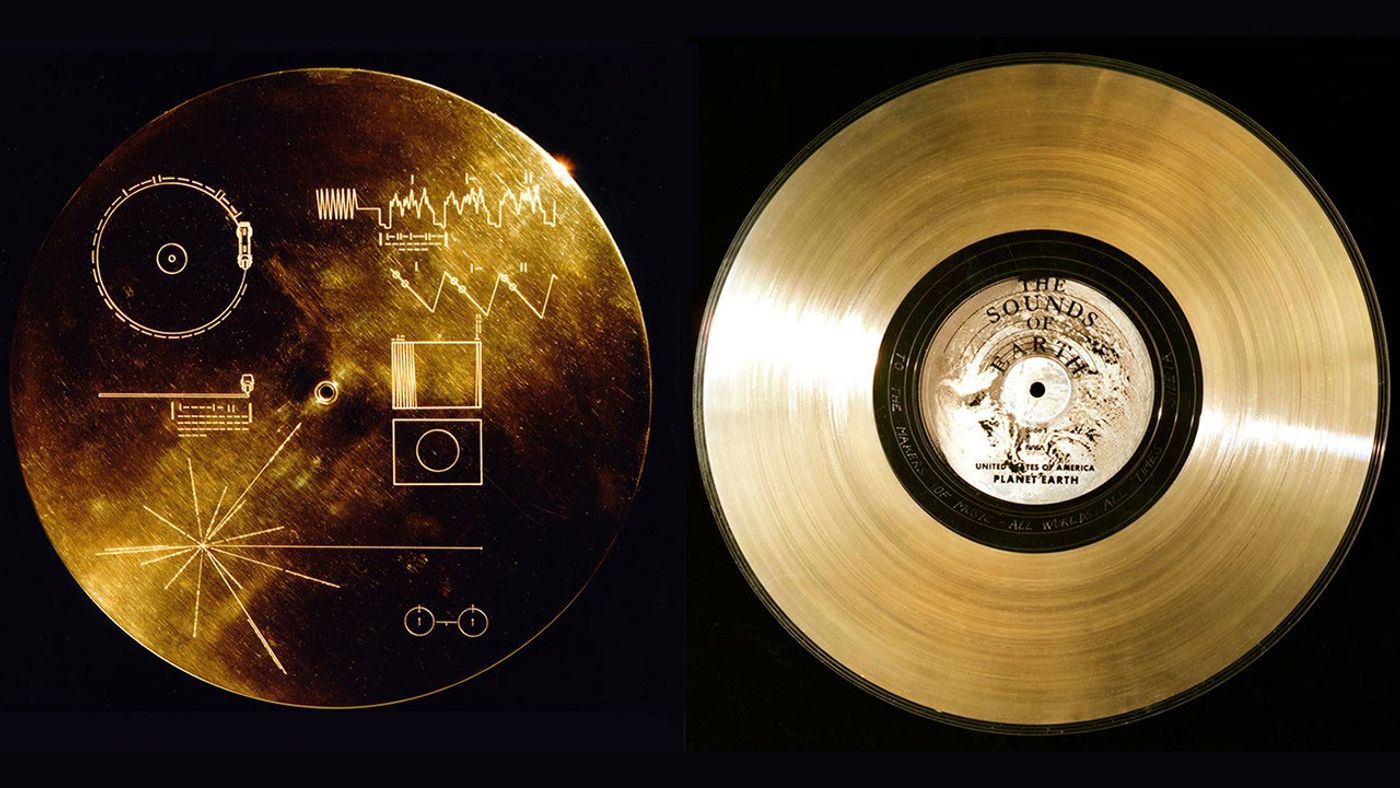
The Voyager Golden Record is usually described as a message: music, greetings, images, Earth sounds, and diagrams sent outward on two spacecraft launched in 1977.
But one of its most careful details is not on the record itself. It is on the cover.
According to NASA’s page on the Golden Record cover, an ultra-pure source of uranium-238 was electroplated onto the record’s protective cover. Its radioactivity was tiny, about 0.00026 microcuries, but its purpose was large. The uranium was a clock.
If some future finder could measure how much uranium-238 remained, and how much of its daughter material had appeared, they could estimate how long the record had been traveling since it left Earth.
A clock without gears
The clock works because uranium-238 decays at a known rate. NASA describes the cover’s uranium as decaying steadily into daughter isotopes, with half of the uranium-238 gone after about 4.51 billion years. Other references often give the modern value as roughly 4.47 billion years, but the point is the same: this is a very slow clock.
That slowness is exactly why it made sense for Voyager. A clock that runs out in decades would be useless on a spacecraft meant to drift between the stars. A clock with a half-life measured in billions of years can still carry a measurable signal long after human languages, cities, and storage formats have changed beyond recognition.
The idea is the same broad principle behind radiometric dating on Earth. A radioactive parent isotope decays into daughter products at a predictable statistical rate. If someone knows the starting condition and can measure the present ratio, the age can be estimated.
On the Golden Record, the starting condition was made deliberately simple: a small, ultra-pure sample of uranium-238 placed on the cover before launch.
The cover was a manual
The uranium was only one part of the cover’s job. NASA’s overview of the Golden Record describes the record as a 12-inch gold-plated copper disk containing sounds and images selected to portray life and culture on Earth. But the cover had to explain how to use it.
That meant several kinds of instructions had to be etched into a physical object, without assuming English, human symbols, or any shared culture.
In the upper left, the cover shows the record and stylus. Around the drawing is a binary number giving the time for one rotation, 3.6 seconds, expressed using the period associated with a fundamental transition of hydrogen. Another diagram explains that the record should be played from the outside in.
Other symbols explain how to reconstruct the images encoded on the record. A circular calibration image was included so that anyone decoding the picture signal could check that they had the proportions right.
The lower-left drawing is a pulsar map, inherited in concept from the Pioneer plaques. It uses 14 pulsars to indicate the location of the Sun and to give another way to estimate the era of launch, because pulsar periods change over time.
And then there is the uranium.
Why add a second date?
NASA says the uranium measurement would act as a check on the launch epoch described by the pulsar map. That redundancy matters. A future finder might misread the pulsar map, fail to identify one or more pulsars, or recover the cover after some damage. The uranium spot offers a different physical route to the same broad question: when was this made?
It is a simple thought with a demanding implementation. The record was meant for a recipient with no shared language, no shared calendar, and perhaps no knowledge of Earth at all. The designers therefore avoided dates such as 1977 or August 20. Those depend on a human calendar. Radioactive decay and hydrogen transitions do not.
This is why the Golden Record still feels unusual. It is not only a cultural artifact. It is a compact lesson in how to communicate across deep time using physics.
The billion-year ambition
The claim that the record was built for about a billion years should not be read as a guarantee that it will remain perfectly playable for that long. Space is not empty in a practical engineering sense. Dust, radiation, temperature changes, and chance impacts still matter.
But the far-future intention was real. A 2017 New Yorker account by Timothy Ferris, who produced the Golden Record, described the records as crafted to last over a billion years. NASA’s own contents page also preserves the larger logic of the project: Carl Sagan and his team selected the material, and the record was placed aboard Voyager as a message that could only be encountered if advanced spacefaring civilizations existed in interstellar space.
The number is almost difficult to hold in the mind. A billion years is about 200 times the age of the pyramids, far longer than the existence of Homo sapiens, and long enough for Earth’s surface and life to be deeply different.
That scale explains the choice of uranium-238. The Golden Record did not need a clock for the first few centuries. It needed one that would still be meaningful when ordinary human timescales had become irrelevant.
A message that dates itself
The record’s contents are often the part people remember: greetings in 55 languages, music from different cultures and eras, images, natural sounds, and printed messages. The cover is less emotional, but in some ways more revealing.
It shows what the designers thought a truly long-lived message would require. Not only beauty. Not only goodwill. Not only a story about Earth. It would need instructions, units, reference points, and a way to establish time.
The uranium spot is a small piece of that logic. It says, in effect: if you find this, do not trust only the map, and do not trust only the symbols. Measure the matter itself. The clock has been running since we sent it.
There is no reason to assume anyone will ever read it. The Voyagers are not aimed at nearby civilizations, and even a close stellar passage tens of thousands of years from now is still not a meeting. The Golden Record is more like a bottle placed in an ocean where shores may not exist.
Still, the uranium clock makes the gesture more precise. It turns the record from a message into a dated message, one that carries not just Earth’s sounds and images, but a built-in way to ask how long it has been alone.