

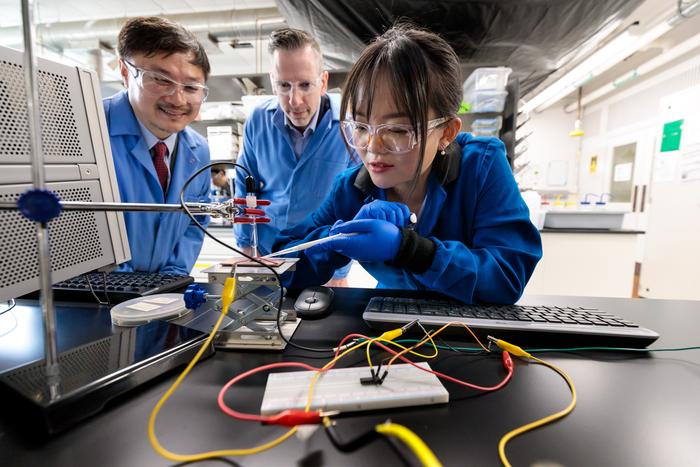
A grain of sand in an Olympic swimming pool. That’s the level of precision a new handheld sensor can achieve when hunting for some of the most elusive and dangerous contaminants in drinking water.
Researchers at the University of Chicago and Argonne National Laboratory have developed a portable device capable of detecting per- and polyfluoroalkyl substances (PFAS) at concentrations as low as 250 parts per quadrillion in tap water. The technology, described in the journal Nature Water, represents a significant advance in monitoring “forever chemicals” that have plagued water systems worldwide and been linked to cancer, thyroid problems, and compromised immune systems.
“Existing methods to measure levels of these contaminants can take weeks, and require state-of-the-art equipment and expertise. Our new sensor device can measure these contaminants in just minutes.”
The comment comes from Junhong Chen, Crown Family Professor at the UChicago Pritzker School of Molecular Engineering, whose team spent 15 years perfecting the underlying sensor technology. Their breakthrough addresses a pressing challenge: current laboratory methods for PFAS detection are expensive, time-consuming, and require specialized facilities that most communities cannot access.
AI-Designed Molecular Traps
The device works by using specially designed molecular probes that sit on a silicon chip surface. When PFAS molecules attach to these probes, they change the electrical conductivity flowing across the chip. The strength of this signal indicates the concentration of contaminants present.
What makes this approach particularly clever is how the research team designed the probes themselves. Rather than relying on trial and error, they turned to machine learning algorithms to predict which molecular structures would best capture specific PFAS chemicals while ignoring other substances commonly found in tap water.
“In this context, machine learning is a tool that can quickly sort through countless chemical probes and predict which ones are the top candidates for binding to each PFAS.”
The team’s computational predictions proved accurate when tested in laboratory conditions. Their sensors successfully detected perfluorooctanesulfonic acid (PFOS) even when other chemicals were present at much higher concentrations, a common challenge in real-world water testing.
Meeting New Federal Standards
The timing of this development coincides with increasingly strict federal regulations. In April 2024, the Environmental Protection Agency established maximum contaminant levels of 4 parts per trillion for both PFOS and perfluorooctanoic acid (PFOA) in drinking water. The new sensor’s detection threshold falls well below these regulatory limits.
PFAS chemicals have earned their “forever” nickname because they resist natural degradation, instead accumulating in the environment and human bodies over time. They’re found in everything from nonstick cookware to firefighting foam, and studies have detected them in drinking water supplies across the globe.
The current gold standard for PFAS testing involves liquid chromatography/tandem mass spectrometry, a laboratory technique that can separate and identify individual chemical compounds. While highly accurate, this method requires samples to be sent to specialized facilities and can take weeks to produce results.
The University of Chicago team envisions their technology eventually allowing consumers to test their own water and make informed decisions about their exposure. The sensors demonstrated the ability to maintain accuracy through multiple testing cycles, suggesting potential for continuous monitoring applications.
However, challenges remain. The sensors showed limited selectivity against certain structural analogs of PFOS, including sodium dodecyl sulfate, a common surfactant. The research team is exploring modifications to improve discrimination between different chemical compounds.
Chen’s group plans to expand their approach to detect other PFAS chemicals and explore applications beyond drinking water monitoring. The same sensing principles could potentially identify antibiotics and viruses in wastewater, opening new possibilities for environmental and public health surveillance.
The work represents part of the National Science Foundation Water Innovation Engine in the Great Lakes region, reflecting broader efforts to address water contamination challenges across multiple states. As PFAS regulations tighten and public awareness grows, accessible testing methods may prove crucial for protecting communities from these persistent environmental threats.