

You are part virus. Roughly 8 percent of your DNA comes from ancient viral hitchhikers, frozen into our genomes over millions of years. Now, scientists at the La Jolla Institute for Immunology (LJI) have cracked open one of those secrets. In Science Advances, they present the first three-dimensional structure of a protein from a human endogenous retrovirus, a breakthrough that could point toward new ways to detect and treat cancers, autoimmune diseases, and more.
Ancient passengers in our DNA
These viral remnants, called HERVs, are usually silent. Scientists often refer to them as genomic “dark matter.” But every so often, one wakes up. When that happens, the proteins they produce can show up on tumor cells or in autoimmune disease, where the body begins attacking itself.
“This is the first human HERV protein structure ever solved—and only the third retroviral envelope structure solved overall, after human immunodeficiency virus (HIV) and simian immunodeficiency virus (SIV),” said Erica Ollmann Saphire, LJI President and CEO.
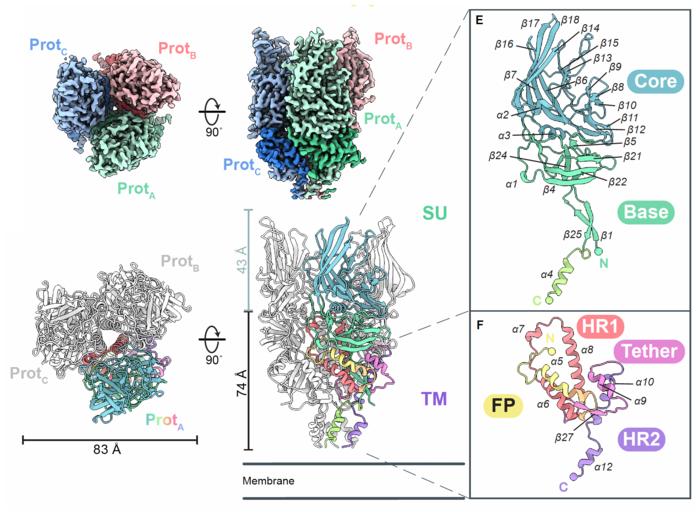
The LJI team zeroed in on HERV-K, the most active family of these viral fossils. They mapped its surface envelope glycoprotein, Env, the very protein that once coated virus particles and now reappears on sick human cells. Knowing its shape means scientists can begin to design antibodies and therapies that fit it like a key in a lock.
The structural challenge
Studying Env was not easy. Envelope proteins are primed like springs, ready to snap into action. “You can look at them funny, and they’ll unfold,” said Jeremy Shek, an LJI postdoctoral fellow and co-first author. To capture the fleeting “pre-fusion” state, the team engineered small stabilizing tweaks, then froze the proteins with cryo-electron microscopy.
What they saw was unexpected. Unlike the squat trimers of HIV or SIV, HERV-K Env stood tall and narrow. Its fold, the intricate weaving of protein strands, was unlike any retrovirus seen before. Distinct. Alien. Yet undeniably human at the same time, since the gene for this viral protein is part of us.
Opening the clinical door
The new structure could be more than a curiosity. It may help explain why Env crops up in cancers like breast and ovarian tumors, and in autoimmune diseases such as lupus and rheumatoid arthritis. In these conditions, cells display Env on their surfaces, where the immune system mistakes it for an invader and sparks chronic inflammation.
“These antibodies marked aberrant HERV display on neutrophils from rheumatoid arthritis and lupus patients, but not healthy controls,” Saphire said.
With the new protein maps, the LJI group built their own antibody panel, showing how different immune attacks can unfold. Some antibodies latched onto the protein’s surface like clamps, others tracked Env in patient cells. The results hint that these engineered antibodies could one day become diagnostic tools, flagging disease before symptoms worsen.
Viruses turned against disease
In cancers, the opportunity is different. Tumor cells often carry Env where healthy tissue does not. That means a targeted antibody—or even CAR-T cells tuned to recognize Env—could attack cancer without collateral damage. It is a bold prospect: using viral debris buried in our DNA as a red flag to identify rogue cells.
Truth be told, scientists are still piecing together what Env does in modern humans. Some suspect it meddles with cell growth or fusion. Others think it may play a role in neurodegeneration. What is certain now is that its structure is no longer hidden. With cryo-EM, the veil has lifted, and the outlines of a new field are visible.
Looking ahead
The work leaves more questions than answers. Which diseases are driven by Env, and which only reveal it as a byproduct? Can therapies target it safely without triggering harmful immune cascades? “We can really pick whatever disease we’re interested in and go down that route,” Shek said. That mix of opportunity and uncertainty is why the discovery matters. We are all part virus, after all. It is time to meet that side of ourselves, face to face.
Journal: Science Advances
DOI: 10.1126/sciadv.ady8168