

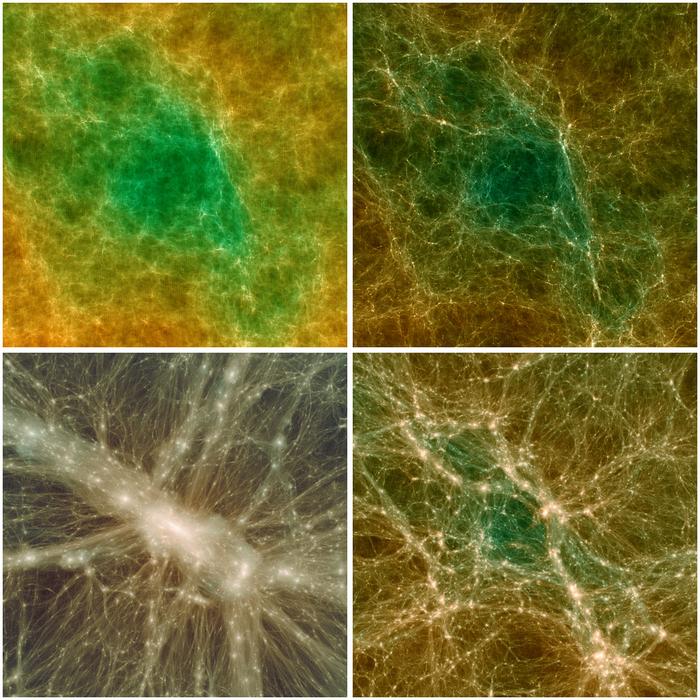
For nearly a century, physicists have worked with a comfortable assumption: dark energy, the mysterious force accelerating the Universe’s expansion, remains constant across cosmic time. It’s been the foundation of the Lambda Cold Dark Matter model, the scaffolding upon which modern cosmology is built. But what if that assumption is wrong?
New supercomputer simulations from Japan suggest the Universe might be far stranger than we thought. Using the Fugaku supercomputer, one of the world’s most powerful machines, researchers have modeled what would happen if dark energy changes over time. The results don’t just challenge textbook cosmology; they reveal a cosmos that forms massive galaxy clusters up to 70% more efficiently in its early epochs.
The catalyst for this work came from an unexpected source. The Dark Energy Spectroscopic Instrument (DESI), which surveys distant galaxies to map cosmic structure, recently released data hinting at something unusual: dark energy might not be the cosmic constant we’ve assumed. It’s a finding that sent cosmologists scrambling to understand the implications.
Running the Universe on a Supercomputer
Associate Professor Tomoaki Ishiyama from Chiba University led a team that ran three massive N-body simulations, each eight times larger than previous attempts. One simulation modeled the standard universe. The other two incorporated dynamic dark energy (DDE), a component that varies with time rather than remaining fixed.
The approach was methodical. First, they isolated the effect of time-varying dark energy alone by comparing it against the standard model while keeping other parameters constant. Then they ran a third simulation using the best-fit parameters from DESI’s first-year observations. This model included a 10% higher matter density than the standard cosmology predicts.
That 10% difference turned out to matter enormously. Higher matter density means stronger gravitational forces, which translates to earlier and more efficient formation of the massive galaxy clusters that serve as cosmic scaffolding. The team found their DESI-derived model predicted significantly more massive structures in the early Universe.
“Our large simulations demonstrate that variations in cosmological parameters, particularly the matter density in the Universe, have a greater influence on structure formation than the DDE component alone.”
The simulations also examined baryonic acoustic oscillations, cosmic footprints left by ancient sound waves that now serve as rulers for measuring distances across the Universe. In the DESI-derived model, the BAO peak shifted by 3.71% toward smaller scales. When the researchers checked this prediction against actual DESI observations, the match was remarkably close.
The Cosmic Scaffolding Paradox
Perhaps the most striking finding involves galaxy clustering patterns. The full DESI-derived model showed measurable differences in how galaxies group together compared to standard predictions. The higher matter density led to stronger clustering signals, especially at smaller scales where galaxies pack together in dense neighborhoods.
But here’s where things get interesting: the impact of dynamic dark energy itself turned out to be surprisingly modest. The real driver of structural differences wasn’t the time-varying nature of dark energy, but rather the adjusted matter density that comes with fitting models to DESI data.
This creates something of a paradox for cosmologists. While DESI observations suggest dark energy might vary with time, the simulations reveal that current observational constraints strongly favor models with a tightly controlled parameter (the matter density multiplied by the square of the Hubble constant) staying within 1% to 2% uncertainty. Whether you include dynamic dark energy or not, you end up in roughly the same parameter space.
The research, published in Physical Review D, arrives at a moment when multiple large-scale surveys are pushing the boundaries of cosmological measurement. The Subaru Prime Focus Spectrograph and continuing DESI observations are expected to dramatically improve the precision of cosmological parameters.
“This study provides a theoretical basis for interpreting such upcoming data.”
What the simulations really demonstrate is how sensitive cosmic structure formation is to seemingly small changes in fundamental parameters. A 10% shift in matter density cascades through billions of years of cosmic evolution, producing a Universe with dramatically different large-scale architecture.
The work also highlights how far computational cosmology has come. Running simulations at this scale requires not just raw computing power, but sophisticated algorithms that can track the gravitational dance of countless particles across cosmic time. The Fugaku supercomputer made it possible to explore volumes of space eight times larger than previous studies, providing the statistical power needed to detect subtle differences between models.
For Ishiyama and his colleagues, these simulations represent more than just testing one model against another. They’re building the theoretical framework needed to interpret the flood of data coming from next-generation surveys. As telescopes become more powerful and surveys more comprehensive, having detailed predictions for how different cosmological models should look becomes increasingly critical.
The question of whether dark energy truly varies with time remains open. What’s clear now is that answering it will require not just better observations, but more sophisticated simulations that can capture the complex interplay between dark energy, matter density, and the formation of cosmic structure. The Universe might be constant in some ways and dynamic in others, a possibility that makes cosmology both more complicated and more interesting than anyone expected.