It’s one of those stories that sounds almost too good to be true. Eight Burmese pythons, released into a fenced research area for a university tracking study in 1992. Then, just weeks later, Hurricane Andrew tears through South Florida, flattens the enclosure, and sets the snakes loose. Fast forward a few decades and their descendants have taken over the Everglades.
It’s got everything – science gone wrong, a natural disaster, and a monster ending.
The trouble is, when I went looking for that study, I couldn’t find it. There’s no record of a 1992 university project releasing eight pythons into a fenced enclosure. And the more I dug, the more I realised the real story is messier, slower, and a lot more human than the one that keeps getting passed around.
So I asked someone who spends his working life chasing these snakes. Ian Bartoszek, an environmental scientist at the Conservancy of Southwest Florida, told us at ScienceBlog exactly why he thinks the hurricane version has stuck around:
“I think the Hurricane Andrew story has persisted because it offers a simple explanation for something that was almost certainly more complicated.”
Where the hurricane story came from
There is a grain of truth in it – just not the grain in the headline.
When Hurricane Andrew hit as a Category 5 storm in August 1992, it destroyed a reptile warehouse in Homestead, just south of Miami. According to Live Science, one official later recalled seeing “hundreds of Burmese pythons in that warehouse”. So the popular version isn’t about a research study at all. It’s about a commercial reptile business.
And even that version has problems:
- The pythons were already there. Burmese pythons were spotted in the Everglades as early as 1979 – 13 years before Andrew – with unconfirmed reports throughout the 1980s.
- They were in the wrong place. As ecologist Dan Simberloff told Live Science, “When the population started to grow initially, in the 1990s, most of it was 20 miles [32 km] away from that facility.” Between 1995 and 2000, 11 pythons were found in the southwestern corner of Everglades National Park, miles from Homestead.
- The ‘tracking study’ is a mix-up. Researchers really do release tagged pythons in the Everglades – but as a modern tool for finding other snakes, not as the start of the invasion. More on that in a moment.
So where does that leave Andrew? Not off the hook entirely, as Bartoszek explained:
“Hurricane Andrew contributed additional animals to that landscape, but I don’t think the evidence supports pointing to the hurricane as the singular event that started the invasion.”
What actually happened
The real culprit is a lot less cinematic: the exotic pet trade.
Burmese pythons are small and manageable as hatchlings and enormous as adults, and for decades they were sold in huge numbers. Just how many depends on who’s counting, and over what period – which I found pretty telling in itself:
- Live Science puts it at about 17,000 imported into the US between 1970 and 1995.
- Bartoszek told us it’s around 100,000 since the 1970s, based on CITES import records.
- The US Fish and Wildlife Service says pet traders brought in “over 180,000” between 1975 and 2018.
Whichever number you go with, that’s a lot of giant snakes in a lot of homes – and some of them were always going to end up in the swamp, whether they escaped or were dumped by owners who couldn’t cope with a pet that kept on growing.
The Fish and Wildlife Service says the pythons were established “by the 1980s due to releases and escapes”. A 2011 study, cited by Live Science, concluded that “the simplest explanation” is that a few snakes were released into the southern Everglades sometime before 1985. The population then grew slowly until the 1990s – and then took off.
This is what Bartoszek meant when he told Live Science he’d “circle (D): ‘All of the Above'”. He told us he meant that literally:
“Burmese pythons were present in the pet trade in South Florida well before the Andrew event, and escapes and intentional releases almost certainly occurred over a period of years… It was a perfect storm of variables that led to the establishment of Burmese pythons in Florida.”
He also pointed out that while the first Burmese python was documented in Everglades National Park in 1979, confirmation that they were breeding came decades later. In his words, establishment “was more likely the result of multiple introductions over time, followed by successful reproduction and expansion in a landscape that proved especially suitable for this species.”
The Florida Fish and Wildlife Conservation Commission agrees: “Several introduction events likely occurred in south Florida.”
Where the ‘tracking study’ comes in
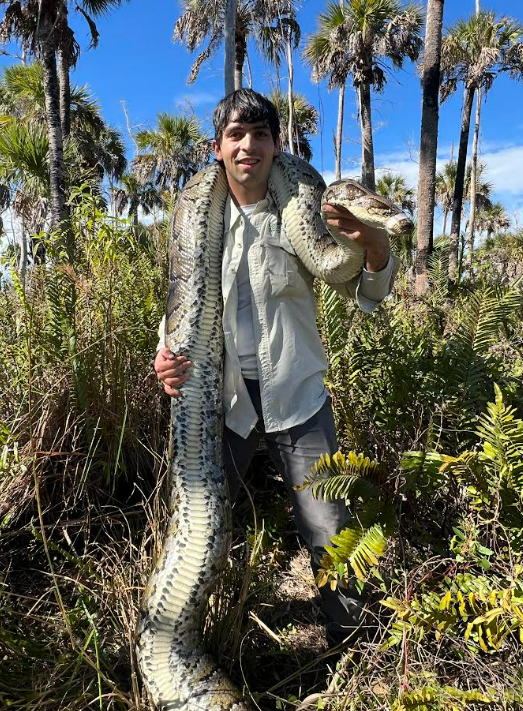
So where might the idea of researchers releasing pythons have come from? My guess is a mix-up with the work people like Bartoszek do today.
His team does release pythons into the wild – but for the opposite reason. As he explained to us:
“Our radio-tracking work involves intentionally fitting wild-caught male Burmese pythons with transmitters and releasing those tagged animals back into the established invasive population. These ‘scout snakes’ lead us to breeding aggregations and reproductive adults that can be culled from the population.”
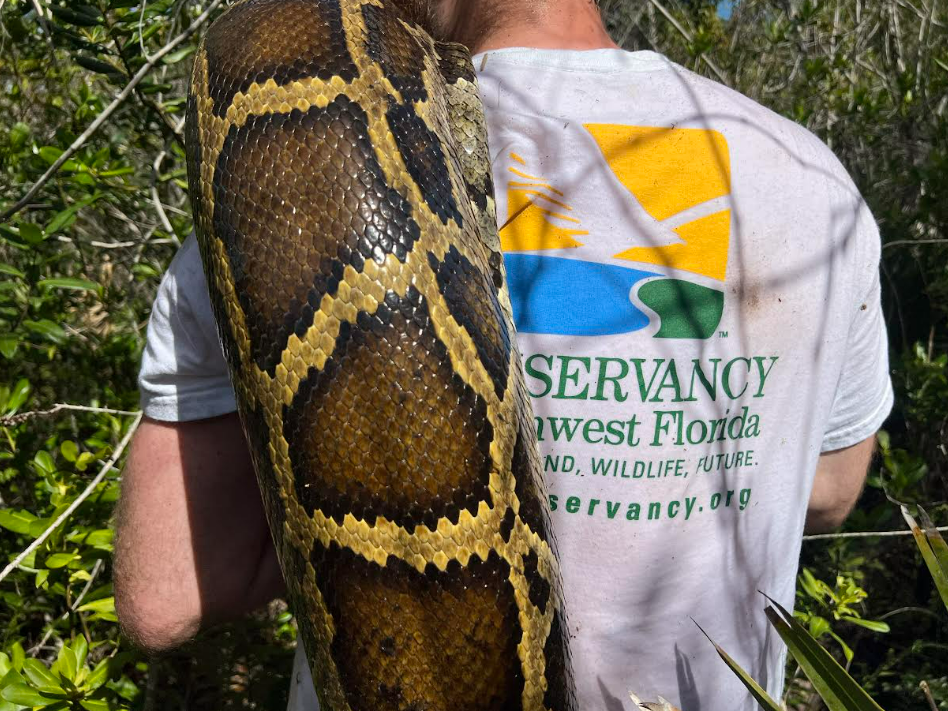
The real prize is the big females. Bartoszek told us the largest one his team has caught was carrying up to 122 developing eggs. “Not all pythons are created equal,” he said, “and these adult females are the high value targets for management efforts.”
And the scale of that work is staggering. To date, his team has removed more than 25,000 kilos of python from a management zone of just 500 square kilometres in southwestern Florida.
But he’s clear these are not how the invasion began: “The scout snakes are research and management tools operating within an invasion that was already well established, not an introduction pathway.”
I can see how the two stories got tangled. “Scientists released pythons with trackers” is true. It just happened decades after the snakes had already made themselves at home.
The part that is true
The one bit of the viral story that does hold up is the ending. There really are tens of thousands of Burmese pythons in the Everglades – and very possibly far more. Nobody knows the true number, but estimates suggest there could be hundreds of thousands, and a 2023 report concluded that wiping them out isn’t possible with the tools we have.
Around 15,000 have been reported and removed since 2000, according to the Fish and Wildlife Service. That sounds like a lot until you realise it barely dents the population.
And the damage is real. In Everglades National Park, observations of some mammal species dropped by 95% between 1996 and 2016 after the pythons moved in. Animals that used to be everywhere became a rare sight. The problem got serious enough that in 2012, the US banned importing Burmese pythons under the Lacey Act.
Which makes the origin story matter more than it might seem. If you think a hurricane did this, it’s a freak accident. If you know it was the pet trade, it’s a lesson.
Final thoughts
I get the appeal of the hurricane version. It’s neat. It has a beginning, a villain, and a twist. But as Bartoszek put it:
“The bigger lesson is that biological invasions rarely have the movie-ready origin story we would like them to have. With Burmese pythons, there were likely multiple opportunities for animals to enter the wild population.”
What you can fairly take from this: Burmese pythons now number at least in the tens of thousands across the Everglades, and they’ve devastated native mammals. The invasion came from the exotic pet trade, through escapes and releases, most likely starting with a small group of snakes before the mid-1980s. Hurricane Andrew probably added some more to the mix.
What it doesn’t show: that eight pythons were released for a 1992 university tracking study (there’s no record of one), that they escaped a fenced research enclosure (the story is really about a commercial warehouse), or that Andrew started the invasion (pythons were in the Everglades by 1979).
And that last point is the one that stuck with me most. Blaming a hurricane is comfortable – nobody’s responsible for the weather. Bartoszek didn’t mince his words on that:
“Hurricane Andrew is part of that history, but treating it as the beginning of the invasion gives the people responsible for their establishment an easier way out to blame a natural disaster.”
The Everglades python problem wasn’t an act of nature. It was decades of people buying, keeping, and letting go of animals they couldn’t handle. Which is a much less exciting story – but it’s the one we can actually learn from.