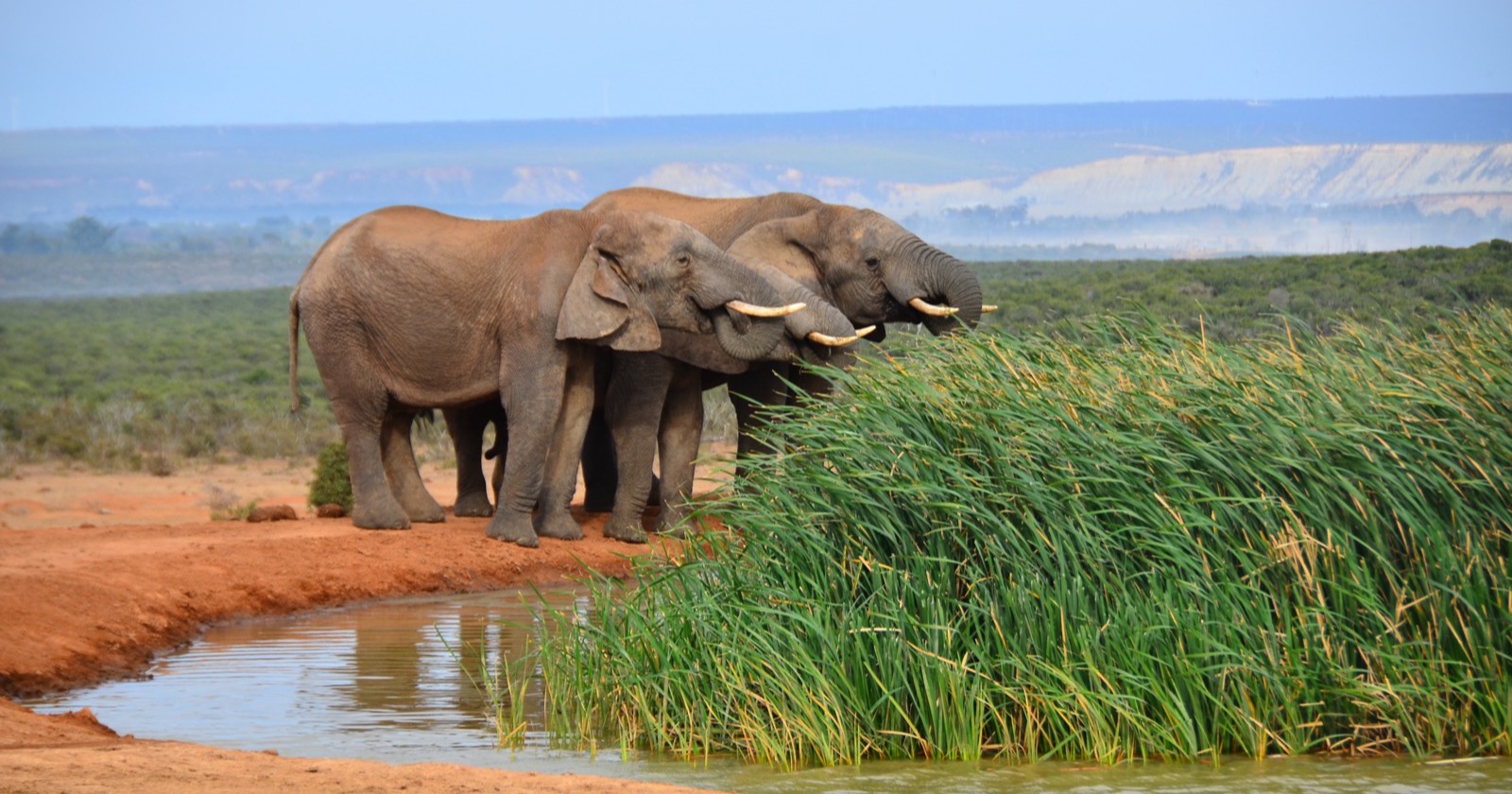
Watch a wild elephant fling its trunk or spread its ears at a rival and you know it means business. That is how Vesta Eleuteri of the University of Vienna puts it: “you intuitively understand that ‘they mean business’.” Intuition is not evidence, though, so she spent about 91 hours filming elephants in two South African parks to find out whether those gestures are deliberate messages or just dramatic habits.
The answer, published on 25 September in Animal Cognition, is that they appear to be. The elephants looked at their rival before gesturing. They waited to see what happened. And when nothing happened, they gestured again, or tried a different gesture.
Then came the twist. When the team worked out what the elephants wanted, it came down to two messages: “move away” and “stop what you are doing”. Those are the same two ways of saying no that wild chimpanzees use.
The team logged 844 gestures across 261 exchanges, all of them conflicts. Where the other elephant gave in, the signaller wanted it gone in 134 of 168 cases, and wanted a behaviour to stop in the other 34.
How do you prove an elephant means it?
Elephants cannot say what they mean, so the team borrowed a test from ape research. The logic is simple. A reflex, like a yelp, goes off whether or not anyone is listening. A deliberate message is aimed, the way you make sure someone is looking before you wave. So an animal gesturing on purpose should check that someone is looking, pick a gesture to suit what the audience can see, wait for a reaction, and try again if nothing happens.
The elephants aced it almost every time. Before gesturing, they were looking at the other elephant in 522 of 539 cases (97%). After gesturing, they paused for at least a second to watch for a response in 477 of 531 cases (90%). When nothing came of it, they carried on in 334 of 404 cases (83%), and that counts switching to a different gesture, not only repeating the first. It is the elephant version of saying something again, then rewording it when the other person still does not get the hint.
The audience test was the shakiest, and it is where the first chimpanzee echo appears. Catherine Hobaiter of the University of St Andrews, a co-author of the elephant paper, found in 2011 that wild chimpanzees use silent gestures for attentive targets and contact gestures for inattentive ones. Elephants did something similar. When the target was not looking, they leaned toward gestures that can be heard or felt, such as ear flaps and trunk pushes, over silent visual ones. That held across the full dataset, but not when the team looked only at elephants it could identify individually.
Forty-one gestures, two ways of saying no
Across the footage, the team saw 68 types of gesture. After dropping seven that never got a reaction and 20 seen fewer than three times, 41 were left, built from 32 basic movements. The trunk and ears did most of the work, accounting for 47% and 37% of gestures. Ear flaps, which make a sound, were logged 127 times, trunk flings 84 times and trunk pushes 56.
Forty-one gestures for two messages sounds like overkill. Of the 33 types seen often enough in successful exchanges, 21 were used for both. Hobaiter put it in human terms in an email to ScienceBlog. She wrote that “you need a lot of different ways to say something ‘negative’. Just as we might say ‘Stop that’ very differently to our boss or our little brother.”
She has seen this pattern before. In 2014, she and Richard Byrne reported in Current Biology that wild chimpanzees use 66 gestures for 19 meanings. Seventeen of those meanings invite contact, such as “groom me” or “move closer”. Only two push the other animal away, “stop that” and “move away”, and chimpanzees use those two broadly, across many contexts, to negate a wide range of behaviour.
The elephants’ two goals are the same pair. Animals separated by an enormous stretch of evolutionary time faced the same problem, how to tell someone no, and landed on the same two answers. “Finding the same in elephants is particularly exciting because elephants are so evolutionarily distant from primates,” Eleuteri said in the release. Hobaiter calls it “a strong case for convergent evolution: in essence, they are using the same tools because they’re solving similar communication problems.”
Because Hobaiter is part of the elephant team, her comments are the authors’ view, not an outside one.
Ninety-one hours, mostly empty footage
The work behind the numbers was slow and patient. Eleuteri did the filming herself, following elephants along a river in Marakele and at the main waterholes in Addo. The camera’s pre-record function caught the opening seconds of each encounter. Of the 2,469 clips she collected, only 127 (5.1%, our sum) held gestures clear enough to code, which is about nine coded gestures per hour of footage (our sum). That is a lot of waiting for a few seconds of drama.
The parks told different stories. Addo, a fenced park of about 700 elephants with no natural year-round water, saw competition over water. Marakele, with about 400 elephants and a river that runs all year, saw competition over reeds. Conflict showed up in 321 of 993 clips at Addo (32.3%) but only 101 of 1,476 at Marakele (6.8%). The filming spots differed, so the comparison is rough, and the authors cannot rule out that a few aggressive elephants inflated Addo’s share. Even so, the two populations shared 26 of their 41 gesture types.
What the study cannot say
The authors call it a first step. The team spent one month at Addo and three at Marakele, and it filmed only conflicts. That matters for the chimpanzee comparison, because the elephants could only show their “no” messages. Chimpanzees have 17 friendlier ones, and nobody yet knows what elephants gesture for when they greet or play. The 80% “move away” figure also covers only the 168 exchanges where the reaction let the researchers judge the goal, not all 261. In Marakele, males made 178 of the gestures and females 48.
The biggest limit is the phrase “on purpose”. Nobody can see inside an elephant’s head. The team judged each goal from what happened next: the other elephant left, and the signaller stopped. Hobaiter was careful about how far to go. The study, she wrote, “doesn’t (yet!) test the question of whether elephants have what we’d call a ‘Theory of mind’.” The paper draws the same line. These elephants appear to aim for a reaction, but there is still no conclusive evidence that any animal tries to change what another thinks.
Why it still matters
The finding is not only a curiosity, because people can use it. As humans and elephants meet more often, Lucy Bates of the University of Portsmouth, a co-author, said in the release that understanding how elephants communicate when they feel threatened “could help us better read their intentions or recognise when they don’t want us around, giving us the chance to move away before interactions become dangerous.”
Eleuteri’s hunch appears to hold up. When an elephant flings its trunk or spreads its ears, it is sending a message, and most of the time that message is “move away”.