

Reading in a quiet room feels effortless until a car alarm erupts outside. Suddenly your eyes aren’t processing text anymore, they’re scanning for threats. That shift isn’t automatic reflex. It’s your brain’s executive control center reaching backward through neural circuits to rewrite how your sensory systems interpret incoming information, tailoring the message to match your current state of alertness.
MIT neuroscientists have mapped this process in detail, revealing that the prefrontal cortex doesn’t broadcast generic “pay attention” commands. Instead, it sends precision-engineered signals to different brain regions, customizing feedback based on what you’re doing and how aroused you are. The findings, published November 25 in Neuron, show two prefrontal subregions, the anterior cingulate area (ACA) and orbitofrontal cortex (ORB), performing a delicate balancing act that determines what you see and how you move.
Working with mice running on wheels while viewing visual stimuli from simple patterns to naturalistic movies, the research team used advanced imaging to watch neural activity in real time. They occasionally delivered gentle air puffs to boost arousal, creating windows into how internal state alters information flow between brain regions.
Wired for Precision, Not Broadcast
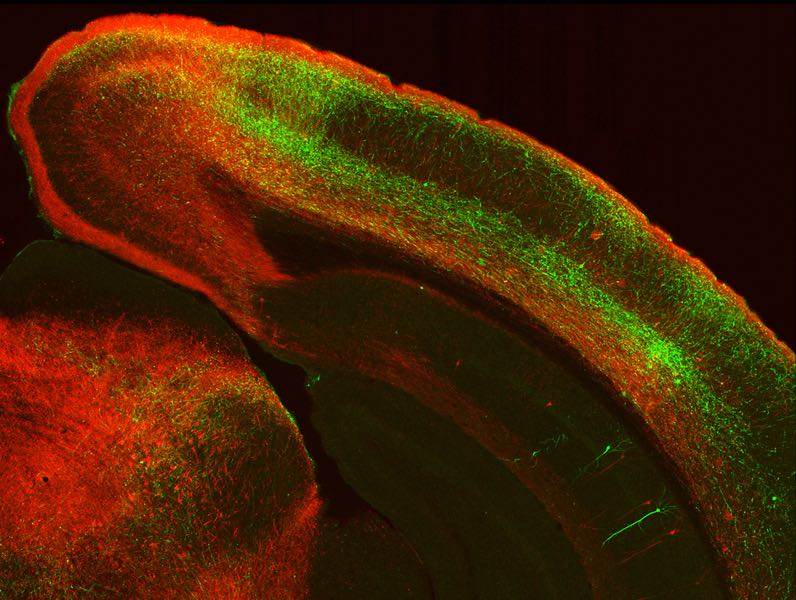
The anatomical architecture matters. ACA projections to the visual cortex primarily target layer 6, while ORB connections concentrate in layer 5. This physical separation allows each region to deliver distinct editorial notes without crosstalk. Lead author Sofie Ährlund-Richter traced these connections and found that ACA neurons carried strong visual information, tracking changes in contrast and scaling smoothly with arousal. Think of it as a gain control that sharpens vision as alertness rises.
ORB neurons behaved completely differently. They contributed minimal visual detail and only activated when arousal crossed a high threshold, functioning more like a brake that engages only when stimulation becomes overwhelming. In practice, while ACA enhances uncertain or difficult-to-detect stimuli, ORB dampens strong signals that might be irrelevant or distracting.
The team proved these weren’t passive reflections of behavior by temporarily blocking each circuit’s input to the visual cortex. Visual encoding shifted in opposite directions depending on arousal and movement. ACA feedback enhanced visual representations, especially under moderate arousal and lower contrast conditions. ORB feedback reduced high-contrast encoding, suppressing redundant information.
“Our data support a model of PFC feedback that is specialized at both the level of PFC subregions and their targets, enabling each region to selectively shape target-specific cortical activity rather than modulating it globally,” Mriganka Sur explains.
Context-Dependent Messaging
The same prefrontal regions communicated differently depending on their target. When projecting to the motor cortex, both ACA and ORB conveyed detailed information about running speed. When projecting to visual cortex, they only signaled whether the mouse was moving or stationary. Each downstream region received exactly the data points it needed, nothing more.
This reframes top-down control entirely. Rather than a simple volume knob, the prefrontal cortex operates like a mixing board in a recording studio, adjusting specific channels independently while keeping others untouched. The brain’s executive center doesn’t just decide what matters, it reaches into sensory systems to physically reshape how the world is represented based on how alert, active, or engaged you are.
That insight has implications beyond neuroscience. It suggests that our internal states, whether anxious, focused, or exhausted, are constantly rewriting the basic act of perception itself. The fire alarm doesn’t just grab your attention. Your prefrontal cortex actively reconfigures your visual system to process it differently than the book you were reading moments before.